Solution:
Concept: An echo is the sound heard after reflection from a distant obstacle, after the original sound has ceased. The sensation of a sound stays in our ear for about 0.1 s, so the echo is heard separately only if it arrives at least 0.1 s after the original sound. If the obstacle is at a distance d and the speed of sound is V, the sound goes to the obstacle and comes back, covering 2d in the echo time t, so 2d = Vt, that is d = Vt ÷ 2.
Given: V = 320 m s⁻¹; direct sound after t₁ = 2 s; echo after t₂ = 3 s.
Step 1 — Understand the two sounds.
The person on the shore hears the gun twice: first the direct sound from the ship, then the echo from the cliff. Light from the smoke arrives almost at once, so the times are the times taken by the sound.
Step 2 — Find the distance between the ship and the person (part i).
The direct sound travels straight from the ship to the person in 2 s, and distance = speed × time.
d1=Vt1=320×2=640 m
Step 3 — Write the path of the echo (part ii).
Let the cliff be x metres from the ship. The echo goes from the ship to the cliff (x), back to the ship (x) and then on to the person (640 m), and this takes 3 s.
x+x+640=Vt2=320×3=960
Step 4 — Solve for x.
We take 640 from both sides and halve the result.
2x=960−640=320
x=2320=160 m
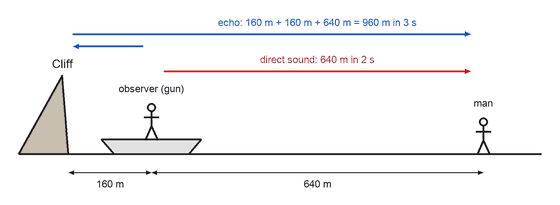
The echo arrives 1 s after the direct sound because it travels an extra 2 × 160 m = 320 m.
Watch out: The 3 s echo path is ship → cliff → ship → person; it is not just twice the cliff distance.
Therefore, (i) the ship is 640 m from the person, and (ii) the cliff is 160 m from the observer on the ship.

