Solution:
Concept: Forced vibrations are the vibrations of a body under an external periodic force: the body vibrates with the frequency of the applied force, not with its own natural frequency, and usually with a small amplitude. Resonance is a special case of forced vibrations: when the frequency of the applied periodic force is equal to the natural frequency of the body, the body readily takes energy from the force and vibrates with a very large amplitude.
Step 1 — Paper rider just vibrates (part i).
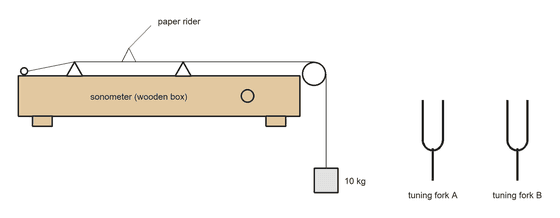
Fork A makes the wire vibrate with the frequency of A, which is different from the natural frequency of the wire. These are forced vibrations, of small amplitude, so the rider only flutters.
Step 2 — Paper rider flies off (part ii).
With fork B the wire vibrates with a very large amplitude: this is resonance (resonant vibrations).
Step 3 — Explain why the rider flies off with B (part iii).
The frequency of fork B is equal to the natural frequency of the stretched wire. The wire then takes energy from the fork readily and vibrates with a very large amplitude, and the strongly vibrating wire throws the paper rider off.

Watch out: Both forks force the wire to vibrate; only the fork whose frequency EQUALS the wire's natural frequency gives resonance.
Therefore, (i) forced vibrations; (ii) resonance; (iii) the frequency of fork B is equal to the natural frequency of the wire, so the wire resonates with a large amplitude and throws the rider off.