
Question 113 marksAsked 2017Easy
(i) What are damped vibrations?
(ii) Give one example of damped vibrations.
(iii) Name the phenomenon that causes a loud sound when the stem of a vibrating tuning fork is kept pressed on the surface of a table.
Confirming your payment
Sign up now and get 250 free tokens.
Previous Year Questions · Question 11 of 57
(i) What are damped vibrations?
(ii) Give one example of damped vibrations.
(iii) Name the phenomenon that causes a loud sound when the stem of a vibrating tuning fork is kept pressed on the surface of a table.
Solution:
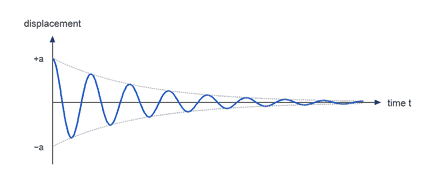
Concept: Damped vibrations are vibrations of decreasing amplitude: in a real medium a resistive (frictional) force opposes the motion, energy is lost as heat in every vibration, and the amplitude keeps falling, while the frequency stays the same. Forced vibrations are the vibrations of a body under an external periodic force: the body vibrates with the frequency of the applied force, not with its own natural frequency, and usually with a small amplitude.
Step 1 — Define damped vibrations (part i).
The periodic vibrations of a body of decreasing amplitude, in the presence of a resistive (frictional) force, are called damped vibrations. The energy lost in each vibration changes into heat.
Step 2 — Give an example (part ii).
A tuning fork struck on a rubber pad and left vibrating in air: its sound slowly dies away as its amplitude decreases. (A simple pendulum swinging in air is another example.)
Step 3 — Name the phenomenon (part iii).
When the stem of the vibrating fork is pressed on the table, the stem makes the table top vibrate with the frequency of the fork. These are forced vibrations. The table top has a much larger vibrating area, so it sets a much larger mass of air vibrating and a louder sound is heard.
Watch out: The table top is not in resonance: it is simply forced to vibrate at the fork's frequency, whatever its own natural frequency.
Therefore, (i) damped vibrations are vibrations of decreasing amplitude in the presence of a resistive force; (ii) example: a tuning fork vibrating in air; (iii) forced vibrations.