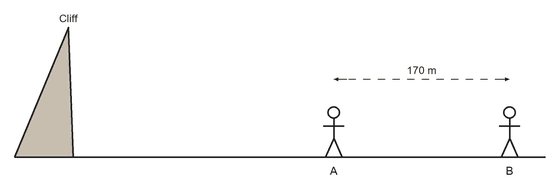
Solution:
Concept: An echo is the sound heard after reflection from a distant obstacle, after the original sound has ceased. The sensation of a sound stays in our ear for about 0.1 s, so the echo is heard separately only if it arrives at least 0.1 s after the original sound. If the obstacle is at a distance d and the speed of sound is V, the sound goes to the obstacle and comes back, covering 2d in the echo time t, so 2d = Vt, that is d = Vt ÷ 2.
Given: A and B 170 m apart in line with the cliff; B's echo after 3 s; V = 340 m s⁻¹.
(a)(1)
Step 1 — Find B's distance from the cliff.
B hears his own echo after 3 s, and the sound covers twice his distance from the cliff.
dB=2Vt=2340×3=510 m
A is 170 m nearer, so A is 510 − 170 = 340 m from the cliff.
(a)(2)
Step 2 — Find the least time for B to hear A's shot.
The shortest path for A's sound is straight from A to B, 170 m; any path by way of the cliff is longer.
t=340170=0.5 s
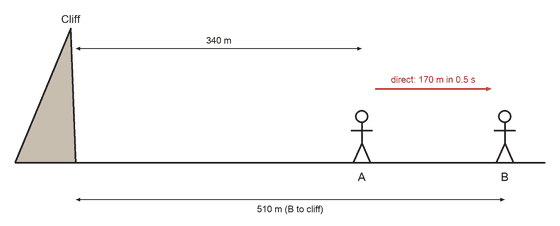
The echo of A's shot travels 340 m + 510 m = 850 m and reaches B later, after 2.5 s.
(b)
Step 3 — Fill in the blank.
Part of the sound energy is absorbed by the cliff and the air, so the reflected wave has a smaller amplitude and sounds softer. Its frequency does not change on reflection.
Watch out: The minimum time is for the DIRECT sound from A to B, not for the echo.
Therefore, (a)(1) B is 510 m from the cliff; (a)(2) B hears A's gunshot after a minimum of 0.5 s; (b) the echo is softer due to the decrease in amplitude of the wave.