Answer: (C) (A) is true but (R) is false.
Concept: In an assertion–reason item, judge A and R separately, then decide whether R explains A. The note of a wind instrument or a jar comes from its vibrating air column. The natural frequency of an air column is inversely proportional to its length (f ∝ 1/l): a shorter air column gives a higher frequency, that is, a higher pitch (a shriller note).
Step 1 — Judge the Assertion.
As the cylinder fills, the air column above the water gets shorter, so its frequency rises and the pitch gradually increases. The Assertion is true.
Step 2 — Judge the Reason.
The Reason says the frequency is inversely proportional to the length of the WATER column. It is the length of the AIR column that matters; as the water column gets longer, the frequency rises, which is not an inverse relation with the water column. The Reason is false.
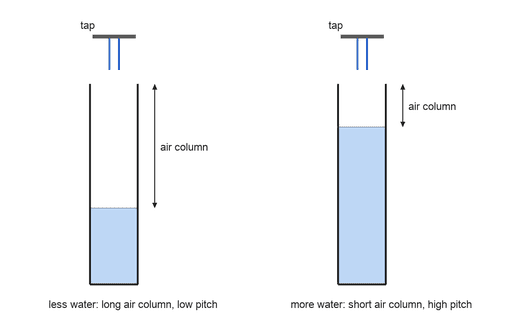
Watch out: The note comes from the air column above the water, not from the water.
Why the other options are wrong:
- (A) Both (A) and (R) are true and (R) is correct explanation of (A): it needs the Reason to be true, but the Reason is false.
- (B) Both (A) and (R) are true and (R) is not the correct explanation of (A): it also needs the Reason to be true.
- (D) (A) is false but (R) is true: it says the Assertion is false; in fact the pitch does rise as the cylinder fills.
Therefore, the Assertion is true but the Reason is false, option (C).
