Solution:
Concept: The note of a wind instrument or a jar comes from its vibrating air column. The natural frequency of an air column is inversely proportional to its length (f ∝ 1/l): a shorter air column gives a higher frequency, that is, a higher pitch (a shriller note). Resonance is a special case of forced vibrations: when the frequency of the applied periodic force is equal to the natural frequency of the body, the body readily takes energy from the force and vibrates with a very large amplitude.
Step 1 — Name the phenomenon (part a).
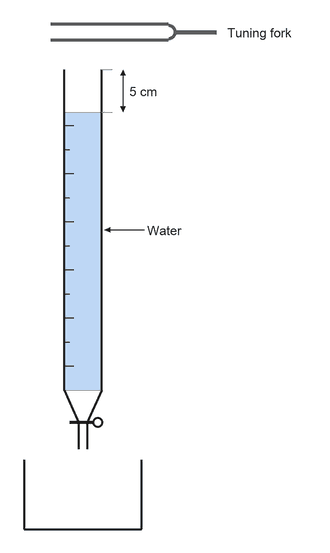
The loud sound at one particular length of the air column is resonance in an air column.
Step 2 — Explain the loud sound (part b).
At a length of 5 cm the natural frequency of the air column becomes equal to the frequency of the tuning fork. The fork then makes the air column vibrate with a large amplitude, so much more sound energy is sent out and a loud sound is heard. At other lengths the air column makes only small forced vibrations.
Step 3 — Decide the new length (part c).
To resonate with a fork of higher frequency, the air column must have a higher natural frequency. Since f ∝ 1/l, it must be shorter than 5 cm, so the length should decrease (the tap is opened less, keeping more water in the burette).
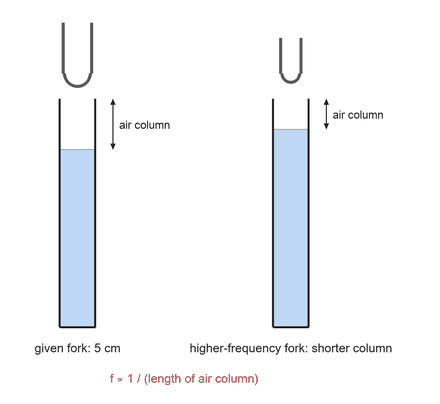
Watch out: A higher frequency needs a SHORTER air column, not a longer one.
Therefore, (a) resonance; (b) at 5 cm the natural frequency of the air column equals the frequency of the fork; (c) the length of the air column should decrease, because f ∝ 1/l.