Solution:
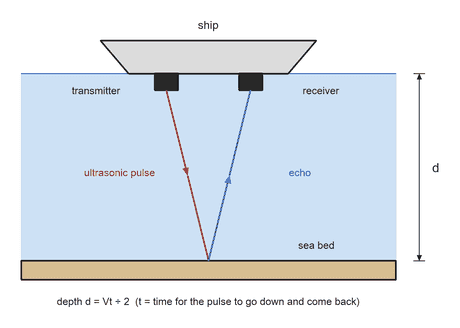
Concept: An echo is the sound heard after reflection from a distant obstacle, after the original sound has ceased. The sensation of a sound stays in our ear for about 0.1 s, so the echo is heard separately only if it arrives at least 0.1 s after the original sound. If the obstacle is at a distance d and the speed of sound is V, the sound goes to the obstacle and comes back, covering 2d in the echo time t, so 2d = Vt, that is d = Vt ÷ 2. A larger vibrating surface sends out more sound energy, so the sound is louder.
Given: V = 1.5 km s⁻¹; echo received after 14 s.
Step 1 — Name the characteristic (part a).
A bell with a larger surface sets a larger area of air vibrating and sends out more sound energy, so it is heard louder and farther. The characteristic affected is loudness.
Step 2 — Change the speed into m s⁻¹ (part b).
Since 1 km is 1000 m, we multiply the speed by 1000.
V=1.5×1000 m s−1=1500 m s−1
Step 3 — Find the distance covered (part b).
The wave travels to the obstacle and back in 14 s, and distance = speed × time.
distance covered=Vt=1500×14=21,000 m
That is 21 km, there and back.
Step 4 — Find the distance of the obstacle.
The obstacle is half of this distance away, since the wave covers the gap twice.
d=2Vt=221,000=10,500 m
Watch out: Read the question carefully: the distance COVERED by the wave is the whole round trip; the DISTANCE of the obstacle is half of it.
Note: the question asks for the distance covered by the wave, which is 21 km; if it is read as the distance of the obstacle, the answer is 10.5 km.
Therefore, (a) loudness; (b) the wave covers 21,000 m (21 km) in going to the obstacle and back, so the obstacle is 10,500 m (10.5 km) from the SONAR.
