
Question 342 marksAsked 2023Easy
A metal foot ruler is held at the edge of a table. It is pressed at its free end and then released. It vibrates.
(a) Name the vibrations produced.
(b) State one way to increase the frequency of these vibrations.
Confirming your payment
Sign up now and get 250 free tokens.
Previous Year Questions · Question 34 of 57
A metal foot ruler is held at the edge of a table. It is pressed at its free end and then released. It vibrates.
(a) Name the vibrations produced.
(b) State one way to increase the frequency of these vibrations.
Solution:
Concept: Free (natural) vibrations are the vibrations of a body under its own restoring force only, with no resistive or external force. The body vibrates with its own natural frequency, and its amplitude and frequency stay constant. They are possible only in vacuum. The natural frequency of a ruler clamped at one end is higher when its vibrating part is shorter.
Step 1 — Name the vibrations (part a).
Once released, the ruler vibrates on its own at its natural frequency, with no external periodic force: these are natural (free) vibrations. (In air their amplitude slowly falls, so in practice they are damped.)
Step 2 — Find a way to raise the frequency (part b).
The natural frequency of the ruler depends on the length of the part that sticks out beyond the table edge. Pushing more of the ruler onto the table shortens the vibrating part, which is stiffer and vibrates faster, so the frequency increases.
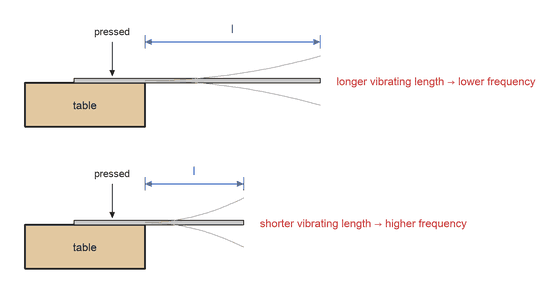
Watch out: Pressing the free end harder only gives a larger amplitude (louder sound), not a higher frequency.
Therefore, (a) natural (free) vibrations; (b) decrease the length of the ruler projecting beyond the table edge.