Solution:
Concept: Resonance is a special case of forced vibrations: when the frequency of the applied periodic force is equal to the natural frequency of the body, the body readily takes energy from the force and vibrates with a very large amplitude.
Step 1 — Find the frequency of E (part a).
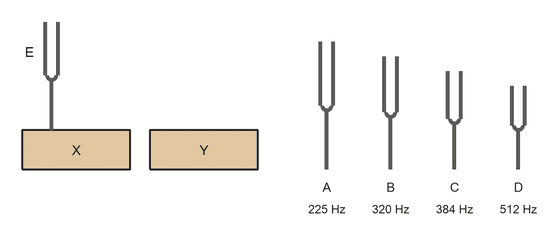
A loud sound is heard only when the fork on box Y is in resonance with fork E, that is, when the two forks have the same frequency. The loud sound comes with fork B, of frequency 320 Hz, so E also has a frequency of 320 Hz.
Step 2 — Explain the loud sound with B (part b).
The frequency of B (320 Hz) equals the natural frequency of fork E. The vibrations of B, carried through the air of the sound boxes, set E vibrating with a large amplitude (resonance), and both boxes, with their large mass of air, vibrate strongly, so a loud sound is heard.
Step 3 — Compare with the other forks.
Forks A, C and D (225 Hz, 384 Hz and 512 Hz) have frequencies different from E's, so they make E perform only weak forced vibrations, and the sound is not loud.
Watch out: E resonates only with a fork of EXACTLY its own frequency; a fork of double frequency (like 512 Hz against 256 Hz) is a different case and is not what the question shows.
Therefore, (a) the frequency of E is 320 Hz; (b) B has the same frequency as E, so E resonates with it and a loud sound is produced.