
Question 43 marksAsked 2016Easy
(i) Name the waves used for echo depth sounding.
(ii) Give one reason for their use for the above purpose.
(iii) Why are the waves mentioned by you not audible to us?
Confirming your payment
Sign up now and get 250 free tokens.
Previous Year Questions · Question 4 of 57
(i) Name the waves used for echo depth sounding.
(ii) Give one reason for their use for the above purpose.
(iii) Why are the waves mentioned by you not audible to us?
Solution:
Concept: Ultrasonic waves are sound waves of frequency above 20 kHz, beyond the upper limit of human hearing (the audible range is 20 Hz to 20 kHz). Their wavelength is very short, so they can be sent as a narrow beam in one direction, and they are not easily absorbed by water.
Step 1 — Name the waves (part i).
Echo depth sounding (SONAR) uses ultrasonic waves, that is, sound waves of frequency above 20 kHz.
Step 2 — Give a reason for their use (part ii).
Ultrasonic waves have a very short wavelength, so they can be sent as a narrow beam straight down to the sea bed, and the echo comes straight back. They are also not easily absorbed by water, so the echo is strong. Ordinary audible sound would spread out in all directions.
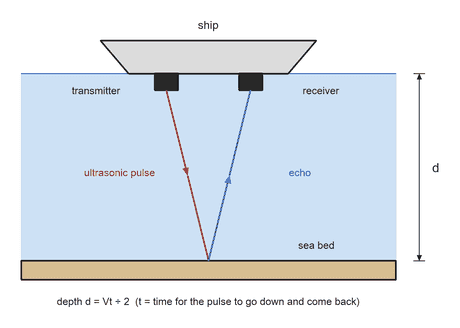
The depth is then found from the echo time t as d = Vt ÷ 2, where V is the speed of sound in water.
Step 3 — Explain why we cannot hear them (part iii).
The human ear hears only sounds of frequency 20 Hz to 20 kHz. Ultrasonic waves have a frequency above 20 kHz, beyond the upper limit of hearing, so they are not audible to us.
Watch out: Ultrasonic waves are not heard because their frequency is too HIGH, not because they are too faint.
Therefore, (i) ultrasonic waves are used; (ii) they can be sent as a narrow beam and are not easily absorbed by water; (iii) their frequency is above 20 kHz, beyond the audible range.