
Question 53 marksAsked 2016Easy
(i) What is an echo?
(ii) State two conditions for an echo to take place.
Confirming your payment
Sign up now and get 250 free tokens.
Previous Year Questions · Question 5 of 57
(i) What is an echo?
(ii) State two conditions for an echo to take place.
Solution:
Concept: An echo is the sound heard after reflection from a distant obstacle, after the original sound has ceased. The sensation of a sound stays in our ear for about 0.1 s, so the echo is heard separately only if it arrives at least 0.1 s after the original sound. If the obstacle is at a distance d and the speed of sound is V, the sound goes to the obstacle and comes back, covering 2d in the echo time t, so 2d = Vt, that is d = Vt ÷ 2.
Step 1 — Define an echo (part i).
An echo is the sound heard after reflection from a distant obstacle, such as a cliff, a hillside or the wall of a building, after the original sound has ceased.
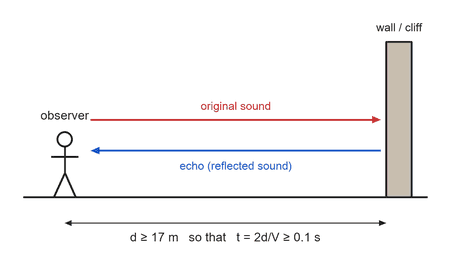
Step 2 — Condition 1: enough distance (part ii).
The reflected sound must reach the listener at least 0.1 s after the original sound. In air (speed 340 m s⁻¹) the sound covers 2d in 0.1 s, so the obstacle must be at least this far:
Step 3 — Condition 2: a large reflector (part ii).
The reflecting surface must be large compared with the wavelength of the sound, so that the sound is reflected back and not scattered round it. (The reflected sound must also be loud enough to be heard.)
Watch out: The 0.1 s is for the WHOLE trip, there and back; the obstacle itself is only half the distance covered, 17 m and not 34 m.
Therefore, (i) an echo is the reflected sound heard after the original sound has ceased; (ii) the reflector must be at least 17 m away in air (so that the echo arrives at least 0.1 s later), and it must be large compared with the wavelength.