Solution:
Concept: Forced vibrations are the vibrations of a body under an external periodic force: the body vibrates with the frequency of the applied force, not with its own natural frequency, and usually with a small amplitude. An echo is the sound heard after reflection from a distant obstacle, after the original sound has ceased. The sensation of a sound stays in our ear for about 0.1 s, so the echo is heard separately only if it arrives at least 0.1 s after the original sound. If the obstacle is at a distance d and the speed of sound is V, the sound goes to the obstacle and comes back, covering 2d in the echo time t, so 2d = Vt, that is d = Vt ÷ 2.
Given: Echo after t₁ = 3.5 s; after moving 84 m closer, echo after t₂ = 3 s.
(i)
Step 1 — Fork held in air.
The prongs of the fork have a small surface area, so they set only a little air vibrating, and only a faint hum is heard.
Step 2 — Fork pressed on the table.
The stem makes the table top vibrate with the frequency of the fork (forced vibrations). The table top has a large surface area, so it sets a much larger mass of air vibrating and sends out much more sound energy, and a loud sound is heard.
(ii)
Step 3 — Write the two echo times.
Let the cliff be d metres from the first position and V be the speed of sound. Each echo time is the round trip divided by the speed.
3.5=V2d
3=V2(d−84)
Step 4 — Subtract to find V.
Subtracting the second equation from the first removes d.
3.5−3=V2d−2(d−84)=V168
V=0.5168=336 m s−1
Step 5 — Find d.
We put V = 336 m s⁻¹ in the first echo.
d=2Vt1=2336×3.5=588 m
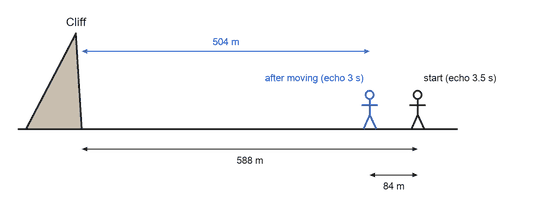
Step 6 — Check the answer.
From the new position the cliff is 84 m nearer, and the echo time comes out as given.
d−84=588−84=504 m
t2=3362×504=3 s
Watch out: Moving 84 m closer shortens the ROUND trip by 168 m, which is what saves the 0.5 s.
Therefore, (i) the table top is forced to vibrate and its large area sends out much more sound energy, so the sound is louder; (ii) the cliff was 588 m from the man's first position.
