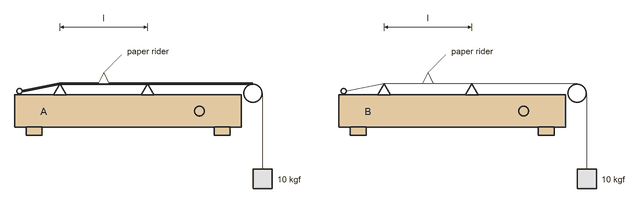
The diagrams given below show two sound boxes A and B with wires of same length (l) and tension (10 kgf) but different…
Question 444 marksAsked 2025Medium
The diagrams given below show two sound boxes A and B with wires of same length (l) and tension (10 kgf) but different cross-sectional areas. Simultaneously, vibrating tuning forks of frequency 300 Hz are placed on the boxes A and B. The paper rider falls off in case of B but not in case of A.
(a) Name and explain the phenomenon responsible for the falling off of the paper rider in B.
(b) The wire A resonates with a tuning fork of frequency ‘f’. Is ‘f’ greater than, less than or equal to 300 Hz? Justify your answer.
Solution:
Concept: The natural frequency of a stretched string is f=2l1mT, where l is the vibrating length, T the tension and m the mass per unit length. So f ∝ 1/l (same tension and wire), f ∝ √T (same length and wire), and a thicker, heavier wire has a lower frequency. Resonance is a special case of forced vibrations: when the frequency of the applied periodic force is equal to the natural frequency of the body, the body readily takes energy from the force and vibrates with a very large amplitude.
Given: Same length l and tension 10 kgf; A thicker than B; forks of 300 Hz.
Step 1 — Name the phenomenon (part a).
The rider falls off in B because of resonance.
Step 2 — Explain it (part a).
The natural frequency of wire B is equal to 300 Hz, the frequency of the fork. The fork's vibrations, passed through the sound box, make wire B vibrate with a very large amplitude, and the vigorously vibrating wire throws the rider off. Wire A, whose natural frequency is different, makes only small forced vibrations, so its rider stays on.
Step 3 — Compare the two wires (part b).
Both wires have the same length and the same tension, but wire A has the larger cross-sectional area (it is thicker), so it has a greater mass per unit length m. Since f ∝ 1/√m, the natural frequency of A is lower than that of B, which is 300 Hz.
Step 4 — Conclude about f.
So wire A resonates with a fork of frequency f less than 300 Hz.
Watch out: A THICKER wire (larger m) has a LOWER frequency, other things being equal.
Therefore, (a) resonance: the natural frequency of wire B equals 300 Hz, so it vibrates with a very large amplitude; (b) f is less than 300 Hz, because the thicker wire A has a lower natural frequency.