
Question 451 markMCQAsked 2025Easy
The amplitude of a sound wave is reduced from 2 mm to 1 mm. The intensity of the sound will:
Confirming your payment
Sign up now and get 250 free tokens.
Previous Year Questions · Question 45 of 57
The amplitude of a sound wave is reduced from 2 mm to 1 mm. The intensity of the sound will:
(A) become four times the initial
(B) remain the same
(C) become half of the initial
(D) become one fourth of the initial
Answer: (D) become one fourth of the initial
Concept: The intensity of a sound wave is proportional to the square of its amplitude, I ∝ a².
Step 1 — Find the change in amplitude.
The amplitude falls from 2 mm to 1 mm, so it becomes half of its initial value.
Step 2 — Find the change in intensity.
The intensity is proportional to the square of the amplitude.
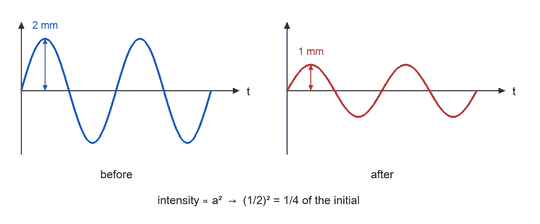
Watch out: Halving the amplitude quarters the intensity; it does not halve it.
Why the other options are wrong:
Therefore, the intensity becomes one fourth of the initial, option (D).