
Question 92 marksAsked 2017Easy
How is the frequency of a stretched string related to:
(i) its length?
(ii) its tension?
Confirming your payment
Sign up now and get 250 free tokens.
Previous Year Questions · Question 9 of 57
How is the frequency of a stretched string related to:
(i) its length?
(ii) its tension?
Solution:
Concept: The natural frequency of a stretched string is , where l is the vibrating length, T the tension and m the mass per unit length. So f ∝ 1/l (same tension and wire), f ∝ √T (same length and wire), and a thicker, heavier wire has a lower frequency.
Step 1 — Write the formula for the frequency.
The natural frequency of a stretched string depends on its vibrating length l and its tension T (m is its mass per unit length).
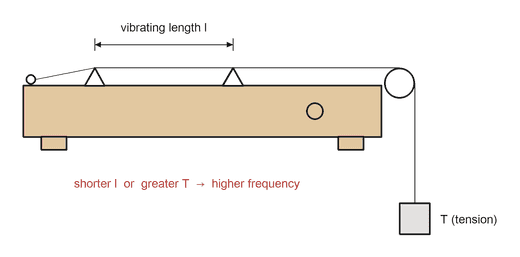
Step 2 — Relate the frequency to the length (part i).
The frequency is inversely proportional to the vibrating length, f ∝ 1/l, when the tension and the string are kept the same. Halving the length doubles the frequency.
Step 3 — Relate the frequency to the tension (part ii).
The frequency is directly proportional to the square root of the tension, f ∝ √T, when the length and the string are kept the same. Making the tension four times doubles the frequency.
Watch out: The relation with tension is with its SQUARE ROOT, not with the tension itself.
Therefore, (i) f ∝ 1/l (frequency inversely proportional to the length) and (ii) f ∝ √T (frequency proportional to the square root of the tension).