
Question 1353 marksEasy
Two musical notes of the same pitch and same loudness are played on two different instruments. Their wave patterns are shown in Fig. 7.27.
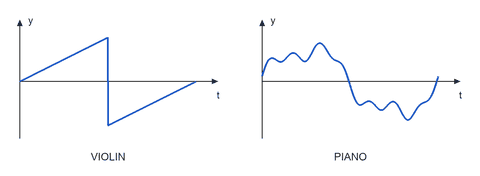
Explain why are the wave patterns different.
Confirming your payment
Sign up now and get 250 free tokens.
Sound · Question 135 of 137
Two musical notes of the same pitch and same loudness are played on two different instruments. Their wave patterns are shown in Fig. 7.27.
Explain why are the wave patterns different.
Solution:
Concept: Quality (timbre) is the characteristic by which two sounds of the same loudness and pitch are told apart. It depends on the waveform, which is set by the subsidiary notes produced with the principal note and by their relative amplitudes. Same pitch means the same frequency, and same loudness means the same amplitude.
Step 1 — See what each instrument produces.
Neither instrument gives a pure note of a single frequency. Each produces the principal note along with subsidiary notes of higher frequencies.
Step 2 — Compare the subsidiary notes.
The violin and the piano produce different subsidiary notes, in different relative amplitudes.
Step 3 — Explain the patterns.
The principal note adds up with the subsidiary notes to give the resultant waveform. Because the subsidiary notes differ, the resultant waveforms differ: sawtooth-like for the violin, rounded and irregular for the piano.
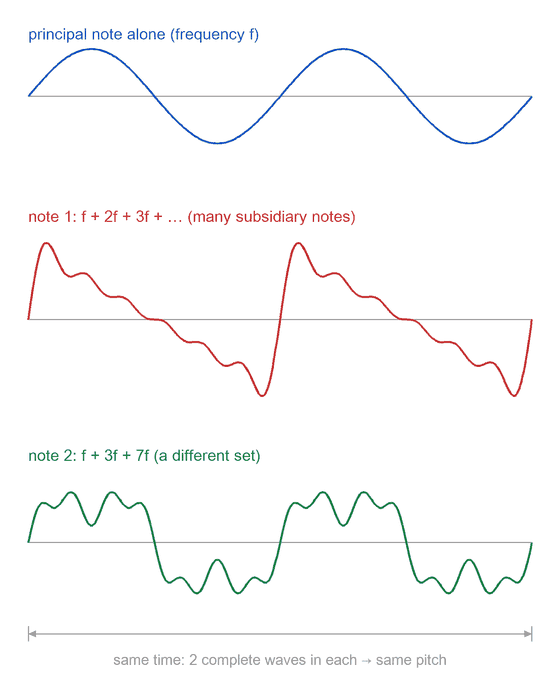
Therefore, the wave patterns are different because the two notes differ in quality: the instruments produce different subsidiary notes with the same principal note.