Answer: (C) 1, 2, 3
Concept: A wave is described by the motion of ONE particle of the medium: its amplitude, time period and frequency. That particle is made to vibrate by the source, so it vibrates at the source's frequency.
Step 1 — Judge statement 1.
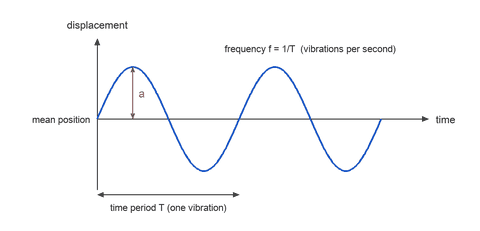
The amplitude is the maximum displacement of a particle on either side of its mean position. Statement 1 is the book's definition, so it is true.
Step 2 — Judge statement 2.
The time period T is the time a particle of the medium takes to complete one vibration. Statement 2 is true.
Step 3 — Judge statement 3.
The frequency f is the number of vibrations a particle makes in one second, so f = 1 ÷ T. Statement 3 is true.
Step 4 — Judge statement 4.
The particles of the medium are forced to vibrate by the source, so they vibrate at the same frequency as the source. The frequency of a wave is therefore EQUAL to the frequency of its source, and statement 4 is false.
Watch out: The frequency of a wave never differs from that of its source; it stays the same even when the wave enters a new medium.
Why the other options are wrong:
- (A) 1: it keeps only statement 1, but statements 2 and 3 are true as well.
- (B) 1, 2: it leaves out statement 3, which is also true.
- (D) 1, 2, 3 and 4: it includes statement 4, which is false: the wave has the same frequency as its source.
Therefore, the correct statements are 1, 2 and 3, option (C).
