
Opening your dashboard
Class 10 Physics Chapter 7 Sound: Competency-Based Questions (CBQ)
40 questions on Chapter 7, each worked through on its own page with the AI tutor. Class 10 Physics, ICSE 2026-27.
40 questions
1–5 marks · Mixed difficulty
- 11 mark
Question 1
Competency: Analysis
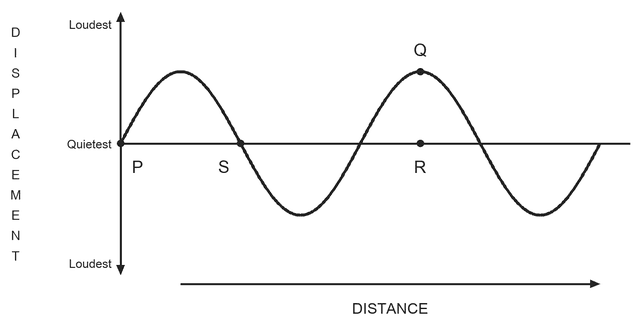
Sumit, a teenager, enjoys playing his music loudly. However, his grandmother consistently lowers the volume of the music player. Analyse the wave to identify which characteristic of the wave has been altered when the grandmother reduces the volume.
- 21 mark
Question 2
Competency: Analysis & Application
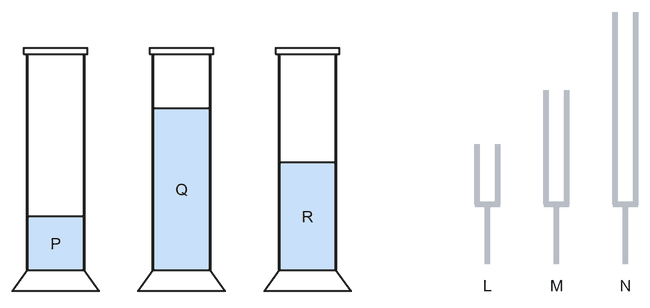
The above picture shows three cylinders filled with water to a different extent. The tuning forks L, M and N in vibration produce louder sound when held above the mouth of the cylinders. Which combination is correct for hearing a louder sound of the tuning fork?
- 31 mark
Question 3
Competency: Analysis & Application

The diagram shows the magnificent dome at Gol Ghumbaz at Bijapur. A boy standing at A whispers, and it is clearly heard at B across the huge dome.
[Speed of sound is 330 ]
Assertion (A): The distance travelled by sound waves should be m.
Reason (R): Sound reflected within 0.1 s is not heard by humans.
- 41 mark
Question 4
Competency: Recall & Analysis
Which of the following statement is CORRECT?
The frequency of a stretched string is:
- 51 mark
Question 5
Competency: Analysis & Application

What is the ratio of wavelengths between P, Q and R?
- 62 marks
Question 6
Competency: Analysis
John is trying to create musical notes using water-filled bottles, as shown in the picture.
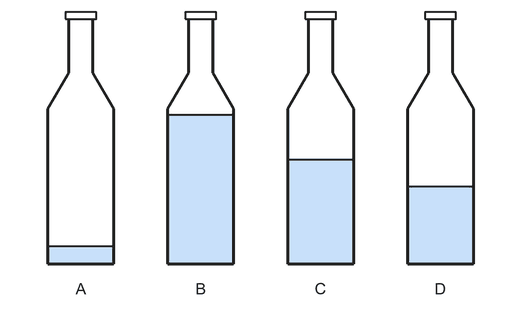
Which of the bottles is likely to produce a musical note with the highest pitch? Give reasons.
- 72 marks
Question 7
Competency: Application
When Shyam, the band leader, struck both the bass drum and the kettle drum with equal force, the bass drum emitted a sound measuring 120dB, whereas the kettle drum produced a sound of 90dB. Explain this discrepancy in the loudness.
- 82 marks
Question 8
Competency: Understanding
Seismic waves have different frequencies. During earthquakes, why are short-length buildings more prone to damage caused by high-frequency seismic waves?
- 92 marks
Question 9
Competency: Application
Ashish, Sameer, Aditya and Mohit were sitting on the terrace of Ashish’s house listening to the songs playing on Aditya’s mobile phone. Mohit, sitting in one corner, a little distance away from the others, requests to increase the volume of the songs. But Aditya says the volume is full. Sameer, being a smart guy, gets up, goes into the kitchen, brings an empty steel glass, places the mobile phone inside it and solves the problem. What is the reason for Sameer to keep the mobile phone in the glass?
- 103 marks
Question 10
Competency: Analysis
Study the diagram and answer the following:
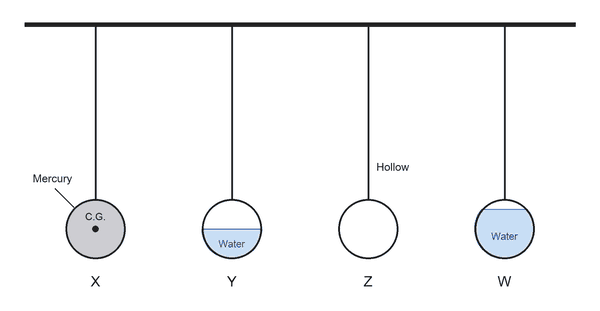
(a) Arrange the following pendulums according to their natural frequencies (use < > =).
(b) If Pendulum Z is initiated into oscillation, which pendulum among the others will exhibit the highest amplitude of vibration?
(c) Give reasons for your answer.
- 114 marks
Question 11
Competency: Analysis
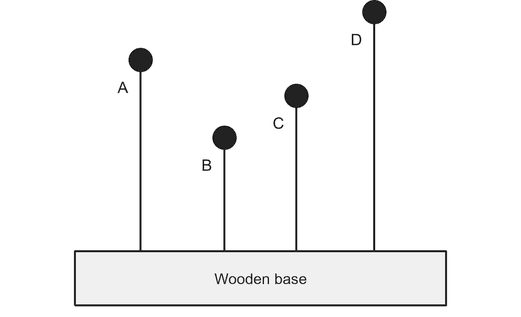
The adjacent diagram shows four solid plastic balls with wires fitted on a wooden base. A person shakes the wooden base to and fro (forward and backward) periodically. It is observed that even the balls start vibrating. It is also observed that all balls vibrate, but only one ball vibrates vigorously.
(a) Explain why only one ball vibrates vigorously.
(b) If , , , and are the natural frequencies of vibration of the wires, then arrange them in the increasing order of their frequencies and give reasons for the same.
- 124 marks
Question 12
Competency: Recall & Evaluation
Examine the graph depicting the transmitted (T) and reflected (R) waves from submarines A and B, which are equipped with a device emitting ultrasonic sounds. Study the graph and answer the following. (Speed of sound in water is 1500 m/s)
(a) Name the device used here.
(b) Why is ultrasonic sound used in this device?
(c) Which submarine is closer to the ship? Calculate the distance of the closest submarine.

- 131 mark
Question 13
Competency: Application & Analysis
Assertion (A): A sound wave of wavelength 0.5 m in air has a wavelength of 2.0 m after it passes into water, if the speed of sound is 350 m s in air and 1400 m s in water.
Reason (R): When a wave passes from one medium into another, its frequency does not change.
- 144 marks
Question 14
Competency: Analysis & Application
Case study: Meera wants to find the speed of sound in air. On a calm afternoon she stands in front of the tall, flat wall of a warehouse, claps two wooden blocks together once and records the sound on her phone. From the recording she reads the time between the clap and its echo. She repeats this at three distances from the wall.
Her readings are given in the table.
Distance from the wall (m) Time between the clap and its echo (s) 51 0.30 85 0.50 119 0.70 (a) Calculate the speed of sound in air from each reading. What do the three results show ?
(b) Meera now stands 15.3 m from the wall and claps once. Show by calculation whether she will hear a distinct echo. Find the least distance from the wall at which she can hear a distinct echo that afternoon.
(c) On a cold morning she stands 82.5 m from the same wall and finds that the echo arrives 0.50 s after the clap. Find the speed of sound that morning and give a reason for the change. How does the least distance for a distinct echo change ?
- 154 marks
Question 15
Competency: Analysis & Evaluation
Case study: Kabir clamps one end of a hacksaw blade to a table and fixes a small lump of clay to its free end. He pulls the free end 8 cm to one side and lets it go. A motion sensor records the displacement of the free end, and a computer plots the graph shown below.

(a) From the graph, find the time period and the frequency of the vibrations. Kabir sees the blade moving but hears no note from it. Why ?
(b) Name this kind of vibrations. Read the amplitude at 0 s, 0.5 s, 1.0 s and 1.5 s and describe the pattern in these values. What happens to the energy that the blade loses ?
(c) Kabir says, "As the vibrations die away, each vibration takes longer, so the frequency keeps decreasing." Use the graph to judge his statement. Predict the amplitude at 2.5 s if the pattern continues.
- 164 marks
Question 16
Competency: Application & Creation
Case study: On sports day the announcer has no loudspeaker, and students at the far end of the ground cannot hear him clearly. The science club rolls a sheet of chart paper into a cone 60 cm long with a mouth 20 cm wide. The announcer speaks into its narrow end. The club tests the cone with a sound-level meter while the announcer speaks equally loudly each time.
The readings are given in the table.
Position of the meter Without the cone With the cone 30 m in front of the announcer 52 dB 60 dB 30 m to one side of the announcer 52 dB 47 dB (a) Explain how the cone makes the voice louder in front. Why does the reading at the side fall when the cone is used ?
(b) A sound wave is reflected well only by a surface that is bigger than its wavelength. Taking the speed of sound in air as 340 m s, calculate the wavelengths of a 170 Hz note and of a 3400 Hz note. Which of the two notes is sent forward better by this cone ? Give a reason.
(c) The club wants to find out how the length of the cone affects the loudness in front. Design a fair test for this. State what you would change, what you would keep the same, what you would measure, and how you would make the result reliable.
- 171 mark
Question 17
Competency: Analysis
Pooja stands at A and claps once in front of a long, rough brick wall. Her friend Rohan stands at B. The figure shows A and B, each 8 m from the wall and 12 m apart along a line parallel to the wall. Take the speed of sound in air as and the sensation of a sound as lasting . (Hypothetical data.)
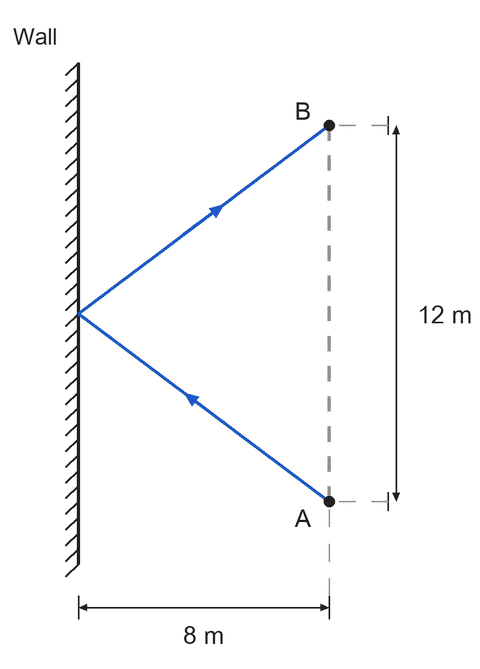
Which statement about what Rohan hears is correct?
- 181 mark
Question 18
Competency: Application
Assertion (A): A simple pendulum has a lower natural frequency on the Moon than on the Earth, when its length is the same.
Reason (R): The natural frequency of a simple pendulum is , and the acceleration due to gravity on the Moon is less than on the Earth.
- 191 mark
Question 19
Competency: Application
A railway worker strikes a steel rail with a hammer on a quiet night. A colleague 510 m away along the track keeps one ear close to the rail and hears the sound twice: first through the rail, and then through the air. Take the speed of sound as in steel and in air. (Hypothetical data.)
How long after the first sound does the colleague hear the second sound?
- 201 mark
Question 20
Competency: Analysis
A music teacher compares four strings of the same material and the same vibrating length. Each is stretched under the tension in the table and plucked in the same way. (Hypothetical data.)
String Radius (mm) Tension (N) A 0.3 9 B 0.5 16 C 0.8 36 D 0.2 1 Which string gives the note of the highest pitch?
- 211 mark
Question 21
Competency: Analysis
A student plays four notes M, N, O and P on an electronic keyboard, switching between its sound settings, and records them with a phone app. The app gives the frequency, the amplitude (on its own scale) and the shape of the waveform of each note. (Hypothetical data.)
Note Frequency (Hz) Amplitude (units) Waveform M 256 2 sine wave N 256 2 triangular wave O 512 2 sine wave P 256 4 sine wave Which two notes have the same pitch and the same loudness, but a different quality?
- 221 mark
Question 22
Competency: Application
A hostel yard has a diesel generator that produces a sound level of 70 dB at a point near the gate. A second identical generator is switched on beside it. Assume that the intensities of the two generators add up at that point. Take . (Hypothetical data.)
What is the sound level at the same point with both generators running?
- 231 mark
Question 23
Competency: Evaluation
A small wind-up music box plays a tune when the steel teeth of a comb inside it are plucked one after another. Held in the hand, the tune is faint. When the box is placed on a wooden table top, the same tune becomes much louder, and every note keeps the same pitch. Four students explain this. Which student gives the correct explanation?
- 241 mark
Question 24
Competency: Evaluation
A new school auditorium has bare concrete walls, a bare tiled floor and hard plastic seats. During a talk, every word is followed by a rumble of repeated reflections, which blurs the speech. (Hypothetical situation.)
Which change is most suitable for improving the hearing in the auditorium?
- 251 mark
Question 25
Competency: Understanding
Assertion (A): A ship's SONAR uses ultrasonic waves, and not audible sound, to measure the depth of the sea.
Reason (R): Ultrasonic waves travel faster than audible sound in sea water, so their echo returns sooner.
- 261 mark
Question 26
Competency: Application
An organ pipe is closed at one end and open at the other. Its principal note has a frequency of 128 Hz. (Hypothetical data.)
Which list shows the frequencies of the principal note and the next two modes of vibration of this pipe?
- 272 marks
Question 27
Competency: Understanding
A drummer strikes a cymbal, and it rings for several seconds. When he lays the palm of his hand on the cymbal, the ringing stops almost at once.
(a) Name the kind of vibrations the cymbal executes while it rings freely in air.
(b) Explain, in terms of energy, why the ringing stops almost at once when the palm touches the cymbal.
- 282 marks
Question 28
Competency: Analysis
The thin diaphragm of a microphone vibrates when people speak near it. It reproduces a deep drum beat and a shrill flute note equally well, although it is only one piece of material.
(a) Name the kind of vibrations executed by the diaphragm.
(b) Why does the diaphragm follow every note, instead of vibrating only with its own natural frequency?
- 292 marks
Question 29
Competency: Evaluation
Meena says, "An echo can come only from a smooth, shiny wall, like a mirror that reflects light. A rough rocky hillside cannot give an echo."
(a) Is Meena correct? Give a reason.
(b) State the condition on the size of a surface that reflects sound well.
- 302 marks
Question 30
Competency: Application
The body of a car rests on strong springs, so it bounces up and down after the car goes over a speed-breaker. Each spring is fitted with a shock absorber, in which a piston has to push its way through thick oil whenever the car body moves up or down.
(a) Explain how the shock absorber makes the bouncing stop after only one or two bounces.
(b) The oil leaks out of one shock absorber. Predict what the passengers feel after the next speed-breaker, and give a reason.
- 312 marks
Question 31
Competency: Analysis
Rohit holds a stiff card against the spokes of the front wheel of his bicycle, which has 36 spokes. Each spoke flicks the card once as it passes, and the card gives a buzzing note. (Hypothetical data.)
(a) Find the frequency of the note when the wheel turns 2 times per second, and when it turns 5 times per second.
(b) Which characteristic of the note changes as the wheel speeds up? Which characteristic changes if Rohit presses the card harder against the spokes while the speed stays the same? Give a reason for each.
- 322 marks
Question 32
Competency: Evaluation
A student says, "Every loud sound is noise, and every soft sound is a musical note."
(a) Give one example to show that a loud sound need not be noise.
(b) Give one example to show that a soft sound need not be a musical note.
- 333 marks
Question 33
Competency: Analysis
On a calm day, a train moves at a steady straight towards a tall rocky hill. The driver sounds the whistle once and hears its echo from the hill 3.0 s later. Take the speed of sound in air as . (Hypothetical data.)
(a) How far does the train move during the 3.0 s, and how far does the sound travel in that time?
(b) Find the distance of the train from the hill at the moment the whistle was sounded.
(c) The guard says, "The hill was 510 m away, because ." Explain his mistake, and find how far the train is from the hill when the echo is heard.
- 343 marks
Question 34
Competency: Application
A load of 0.20 kg hung from a spring and set vibrating up and down has a natural frequency of 2.0 Hz. The same spring is used for the following. (Hypothetical data.)
(a) Find the natural frequency when a load of 0.80 kg is hung from the spring.
(b) What load would make the natural frequency 4.0 Hz?
(c) The 0.20 kg load is pulled down 2 cm and released, and then another time 4 cm and released. Does the natural frequency change? Give a reason.
- 353 marks
Question 35
Competency: Application
A small loudspeaker in an open field gives a sound intensity of at a distance of 2.0 m. Assume that the loudspeaker sends sound equally in all directions and that the intensity varies inversely as the square of the distance. Take and . (Hypothetical data.)
(a) Find the intensity at a distance of 6.0 m.
(b) Find the sound level in dB at 6.0 m.
(c) Find the sound level at 2.0 m, and hence the fall in the level between 2.0 m and 6.0 m.
- 363 marks
Question 36
Competency: Application
Aarav's swing takes 2.0 s to make one complete to-and-fro swing. His father pushes it gently, with the same small force, at regular intervals. (Hypothetical data.)
(a) Find the natural frequency of the swing.
(b) The father tries intervals of 3.0 s, 2.0 s and 1.3 s between pushes. At which interval does the swing reach the largest amplitude? Name the phenomenon.
(c) Why does the amplitude not grow without limit, even at this interval?
- 374 marks
Question 37
Competency: Creativity
Case study: A school has a new music room beside a busy lane. Its walls are bare and its floor is tiled. The principal asks the science club to find out how the noise of the lane inside the room can be reduced. The club plays a recording of lane noise outside the room, tries different treatments one at a time, and measures the sound level in the middle of the room with a sound-level meter. (Hypothetical data.)
Treatment of the music room Sound level of the lane noise inside (dB) None (bare walls, tiled floor) 74 Thick curtains on the windows only 68 Carpet on the floor only 70 Curtains, carpet and cushioned wall panels together 58 (a) Which single treatment lowers the level most? By how many dB, and by what factor does the sound intensity fall? (Take .)
(b) Explain how soft materials such as curtains, carpets and cushions lower the sound level in a room.
(c) Suggest a plan for the school to make the music room quiet. Support it with the table, and add one more measure that is not in the table.
- 384 marks
Question 38
Competency: Analysis
Case study: Neha hangs a load from a spring and shakes the top of the spring up and down with a small motor. She keeps the shaking small and changes the frequency of the motor in steps. She measures the amplitude of the load's vibrations at each driving frequency and plots the graph shown below. Her teacher says that this simple set-up behaves like a machine fixed to a floor, or a bridge shaken by traffic. (Hypothetical data.)
Driving frequency (Hz) 1.0 1.5 2.0 2.5 3.0 Amplitude (cm) 0.8 1.6 8.0 1.4 0.7 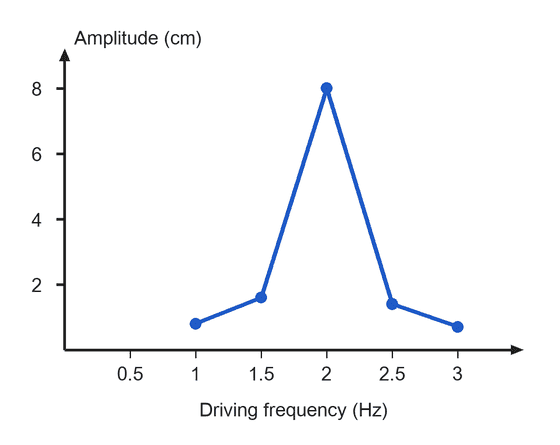
(a) At which driving frequency is the amplitude the largest? What does this tell you about the load and spring, and what is the phenomenon called?
(b) The amplitude at this frequency is large, but not infinite. Why? How would the peak change if the load hung in oil?
(c) The motor shakes the spring once in every revolution, and Neha sets it to 120 revolutions per minute. Calculate the driving frequency and predict what she sees. Without changing the motor speed, suggest one change to the set-up that would make the amplitude small, and give a reason.
- 395 marks
Question 39
Competency: Analysis
Case study: A survey ship moves in a straight line over a part of the sea and stops at the five positions A, B, C, D and E, 200 m apart, as shown in the diagram. At each position it sends one ultrasonic pulse straight down and records the time for the echo from the sea bed to return. The speed of ultrasonic waves in sea water is . (Hypothetical data.)
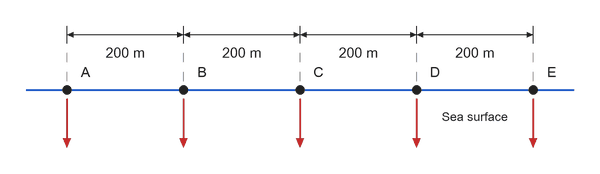
Position A B C D E Time for the echo (s) 0.40 0.36 0.20 0.22 0.40 (a) Calculate the depth of the sea at each of the five positions.
(b) What do the depths tell you about the sea bed along the track? State how high the feature rises above the sea bed at A and E.
(c) A submarine has to travel along this track 200 m below the sea surface. At which of the five positions would the sea bed lie above its path? What depth would the ship have recorded at A if it had wrongly used the speed of sound in air, ?
- 404 marks
Question 40
Competency: Evaluation
Case study: Ravi buys a dog whistle marked 25 kHz. He says that nobody can hear it, but a dog can. His friend reads that elephants call to one another with deep rumbles of about 18 Hz, and says that we cannot hear these calls only because they are too faint. The table gives the approximate range of hearing of some animals. Take the speed of sound in air as .
Animal Human Dog Bat Elephant Range of hearing (Hz) 20 to 20 000 67 to 45 000 2000 to 110 000 16 to 12 000 (a) Which of the four animals can hear the 25 kHz whistle? Explain why Ravi is right about the human.
(b) Calculate the wavelength of the whistle's sound in air. Compare it with the shortest wavelength a human can hear.
(c) Evaluate the friend's statement about the elephant calls. Find the wavelength of an 18 Hz rumble in air and compare it with the longest wavelength a human can hear.