
Competency: Analysis
Case study: Neha hangs a load from a spring and shakes the top of the spring up and down with a small motor. She keeps the shaking small and changes the frequency of the motor in steps. She measures the amplitude of the load's vibrations at each driving frequency and plots the graph shown below. Her teacher says that this simple set-up behaves like a machine fixed to a floor, or a bridge shaken by traffic. (Hypothetical data.)
| Driving frequency (Hz) | 1.0 | 1.5 | 2.0 | 2.5 | 3.0 |
|---|---|---|---|---|---|
| Amplitude (cm) | 0.8 | 1.6 | 8.0 | 1.4 | 0.7 |
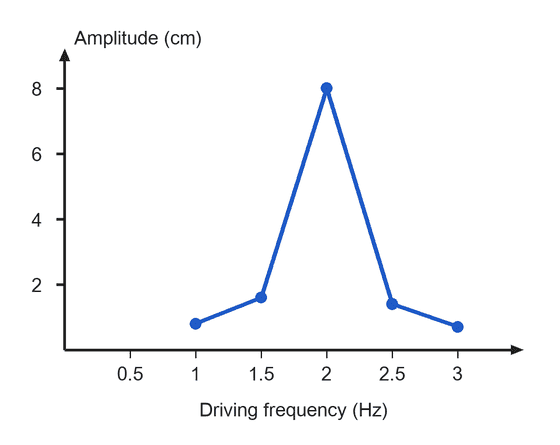
(a) At which driving frequency is the amplitude the largest? What does this tell you about the load and spring, and what is the phenomenon called?
(b) The amplitude at this frequency is large, but not infinite. Why? How would the peak change if the load hung in oil?
(c) The motor shakes the spring once in every revolution, and Neha sets it to 120 revolutions per minute. Calculate the driving frequency and predict what she sees. Without changing the motor speed, suggest one change to the set-up that would make the amplitude small, and give a reason.