
Opening your dashboard
Class 10 Physics Chapter 7 Sound: Practice Questions
42 questions on Chapter 7, each worked through on its own page with the AI tutor. Class 10 Physics, ICSE 2026-27.
42 questions
1–5 marks · Mixed difficulty
- 11 mark
Question 1
Bloom's level: Remember
A normal human ear can hear sounds whose frequencies lie in the range :
- 21 mark
Question 2
Bloom's level: Remember
In damped vibrations, the quantity that goes on decreasing with time is the :
- 31 mark
Question 3
Bloom's level: Understand
A sound of wavelength 1.5 m is hardly reflected by a small metal plate 20 cm wide, but it is reflected well by the wall of a building. This is because, for good reflection of sound :
- 41 mark
Question 4
Bloom's level: Understand
A body whose natural frequency is 80 Hz is acted upon by a periodic force of frequency 50 Hz. The body vibrates with a frequency of :
- 51 mark
Question 5
Bloom's level: Apply
Tanvi stands 85 m in front of a tall wall and claps once. If the speed of sound in air is 340 m s⁻¹, she hears the echo after :
- 61 mark
Question 6
Bloom's level: Apply
A tuning fork of frequency 512 Hz produces sound waves of wavelength 0.65 m in air. The speed of sound in air is :
- 71 mark
Question 7
Bloom's level: Apply
A stretched wire gives a note of 300 Hz. Keeping the tension the same, its vibrating length is reduced to of the original. The new frequency is :
- 81 mark
Question 8
Bloom's level: Analyse
Two sound waves travel in air. Wave P has amplitude 2 mm and frequency 400 Hz; wave Q has amplitude 4 mm and frequency 200 Hz. Which statement is correct ?
- 91 mark
Question 9
Bloom's level: Evaluate
Nikhil writes, "Bats find obstacles in the dark by sending out infrasonic waves, because these waves have a long wavelength and travel far." Which is the best judgement ?
- 101 mark
Question 10
Bloom's level: Understand
Read the Assertion (A) and the Reason (R) and choose the correct option.
Assertion (A): A distinct echo of a clap is not heard in a small room.
Reason (R): In a small room the reflected sound reaches the ear in less than 0.1 s, while the sensation of the original sound still persists.
- 111 mark
Question 11
Bloom's level: Understand
Read the Assertion (A) and the Reason (R) and choose the correct option.
Assertion (A): The amplitude of a simple pendulum swinging in air decreases gradually.
Reason (R): The frequency of the pendulum also decreases gradually as it swings.
- 121 mark
Question 12
Bloom's level: Apply
Read the Assertion (A) and the Reason (R) and choose the correct option.
Assertion (A): An echo is heard 0.4 s after a clap. If the speed of sound is 340 m s⁻¹, the reflecting wall is 68 m away.
Reason (R): The distance of the wall from the listener is equal to the speed of sound multiplied by the time after which the echo is heard.
- 131 mark
Question 13
Bloom's level: Remember
How long does the sensation of a sound persist in our ear ? What is the least distance of the reflecting surface in air (speed 340 m s⁻¹) for an echo to be heard ?
- 141 mark
Question 14
Bloom's level: Remember
Name two devices that work on the reflection of sound.
- 152 marks
Question 15
Bloom's level: Understand
A stone dropped in a pond makes ripples on the water surface, while a person speaking sends sound through the air. Compare the motion of the particles of the medium in the two waves, and name the kind of wave in each case.
- 162 marks
Question 16
Bloom's level: Understand
A sitar player turns a peg to tighten a string, and then presses the string at different points on the fingerboard while playing. Explain how each action changes the natural frequency of the string, and hence the note.
- 172 marks
Question 17
Bloom's level: Understand
A school is built next to a busy highway. Explain two harmful effects of the traffic noise on the students, and suggest two ways to reduce the noise reaching the classrooms.
- 182 marks
Question 18
Bloom's level: Apply
A boy stands between two tall buildings that are 255 m apart, at 85 m from the nearer one, and claps once.
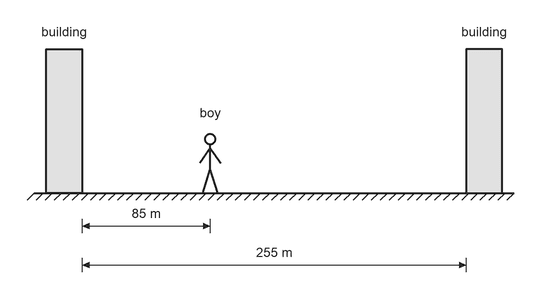
Find the times at which he hears the first and the second echo. (Speed of sound = 340 m s⁻¹)
- 192 marks
Question 19
Bloom's level: Apply
A survey ship sends an ultrasonic pulse of frequency 50 kHz straight down. The echo from the sea bed is received after 1.6 s. The speed of sound in sea water is 1530 m s⁻¹. Find (a) the depth of the sea, and (b) the wavelength of the pulse in water.
- 202 marks
Question 20
Bloom's level: Apply
A flute plays a note of frequency 528 Hz. (a) Find the wavelength of this note in air, where sound travels at 330 m s⁻¹. (b) The flautist then plays a note of twice this frequency. State its wavelength and how its pitch compares with the first note.
- 212 marks
Question 21
Bloom's level: Analyse
A washing machine shakes violently and noisily at one particular speed of its drum while it speeds up, but runs smoothly at both lower and higher speeds. Analyse the reason.
- 222 marks
Question 22
Bloom's level: Analyse
The same pendulum is set swinging with an amplitude of 10 cm, first in air and then with its bob dipped in oil. The amplitude after each complete swing is :
Swing number 0 1 2 3 Amplitude in air (cm) 10 8 6.4 5.12 Amplitude in oil (cm) 10 5 2.5 1.25 (a) Name the kind of vibrations and find the fraction of amplitude kept after each swing in each case.
(b) What do the readings tell you about the effect of the medium ?
- 234 marks
Question 23
Bloom's level: Apply
To measure the speed of sound, Ishita stands 99 m from a large wall and claps steadily, adjusting her rhythm until each clap coincides exactly with the echo of the previous clap. Her friend starts a stopwatch at one clap, counting it as clap 0, and stops it at clap 30. The stopwatch reads 18 s.
(a) Find the time interval between two successive claps.
(b) Calculate the speed of sound in air.
(c) Why should she stand at least about 17 m from the wall, and why is it better to time many claps rather than one ?
- 244 marks
Question 24
Bloom's level: Apply
Case study: A fishing boat uses SONAR to find shoals of fish. A pulse sent straight down returns from a shoal after 0.4 s. A second pulse sent 5 minutes later returns from the same shoal after 0.3 s. The speed of sound in sea water is 1500 m s⁻¹.
(a) Name the waves used in SONAR and give one reason why they are used.
(b) Find the depth of the shoal at the first pulse and at the second pulse.
(c) Is the shoal rising or sinking ? Find its average speed in that direction.
- 255 marks
Question 25
Bloom's level: Analyse
A student uses a sonometer wire under a fixed tension and finds the vibrating length that is in tune with different tuning forks :
Frequency of fork (Hz) 200 250 400 500 Vibrating length (cm) 100 80 50 40 (a) Use the readings to find how the natural frequency of the wire depends on its length. Show your working.
(b) Find the length that would be in tune with a fork of 320 Hz.
(c) Keeping the length 100 cm, by what factor must the tension be changed for the wire to give 400 Hz ?
(d) Use these ideas to explain why the strings for high notes on a guitar are thinner.
- 264 marks
Question 26
Bloom's level: Evaluate
Judge whether each statement is true or false. Correct the false ones.
(a) Loudness and intensity of a sound mean exactly the same thing.
(b) If the amplitude of a sound wave is doubled, its loudness is doubled.
(c) Two sounds of equal intensity, one of 30 Hz and one of 1000 Hz, sound equally loud to us.
(d) Two different instruments playing a note of the same pitch and loudness sound exactly alike.
- 274 marks
Question 27
Bloom's level: Evaluate
(a) A group of soldiers is told to break step while crossing a suspension bridge. An engineer suggests instead that bridges should be designed so that their natural frequency is very different from the frequency of marching. Evaluate the engineer's suggestion.
(b) Riya says, "Resonance is always harmful, so it should always be avoided." Do you agree ? Support your judgement with two examples where resonance is useful.
- 284 marks
Question 28
Bloom's level: Analyse
Case study: A class measures sound levels with a sound-level meter: school library 40 dB, classroom during a lesson 60 dB, busy road 85 dB, construction drill 110 dB, bursting firecracker nearby 140 dB.
(a) Which of these sources are within the safe limit for our ears, and which are not ?
(b) Which source(s) can cause pain in the ears straight away ? Explain why the drill is noise and not music.
(c) Analyse which sources are the biggest risk to the students' hearing, and suggest one precaution for each.
- 295 marks
Question 29
Bloom's level: Create
Using a long spring (slinky), a stopwatch and a measuring tape, design a classroom demonstration to show (a) a transverse wave and a longitudinal wave, and (b) how the speed of a wave, its frequency and its wavelength are related. Describe what you will do, what you will measure, how you will calculate, and one way to show that the wave carries energy but the coils do not travel with the wave.
- 304 marks
Question 30
Bloom's level: Create
Case study: For a science exhibition, your group wants to show the difference between forced vibrations and resonance using pendulums. You have a stretched string tied between two stands, some thread and five small bobs.
(a) Plan the set-up: how many pendulums, what lengths you will choose, and which one will be the 'driver'.
(b) Predict what will happen to the other pendulums when the driver is set swinging.
(c) Explain your prediction, and suggest one change that would make a different pendulum swing the most.
- 312 marks
Question 31
Sketch a diagram to show the propagation of sound in air, and mark the compressions and the rarefactions on it.
- 323 marks
Question 32
A girl, standing 150 m in front of a tall building, fires a shot using a starting pistol. A boy, standing 350 m behind her (in the same straight line, so that he is 500 m from the building), hears two bangs 1 s apart.
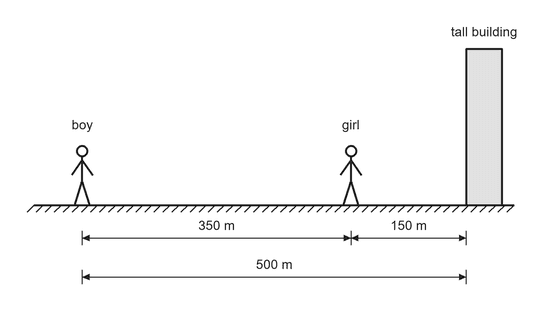
From this information, find :
(i) how much farther the second sound travels than the first to reach the boy
(ii) the speed of sound in air
- 331 mark
Question 33
On a cold morning the speed of sound in air is 320 m s. If the sensation of a sound persists in the ear for 0.1 s, the minimum distance of a wall from a person for him to hear a distinct echo of his own clap is :
- 341 mark
Question 34
The amplitude of a sound wave is made three times its initial value, while its frequency and waveform are kept the same. As a result :
- 351 mark
Question 35
Assertion (A): When a tuning fork is struck once and left to vibrate in air, the sound heard from it becomes fainter and fainter and finally dies out.
Reason (R): In damped vibrations, the frequency of the vibrating body goes on decreasing with time.
- 362 marks
Question 36
A sound wave of frequency 500 Hz travels in air with a speed of 340 m s.
(i) Calculate its wavelength in air.
(ii) The wave now passes from air into water, in which the speed of sound is 1500 m s. Calculate its wavelength in water.
- 372 marks
Question 37
A fishing boat sends an ultrasonic pulse vertically down into the sea. Two echoes are received : one from a shoal of fish 0.2 s after the pulse is sent, and one from the sea bed 0.8 s after the pulse is sent. The speed of ultrasonic waves in sea water is 1500 m s.
(i) Calculate the depth of the sea bed below the boat.
(ii) Calculate the height of the shoal of fish above the sea bed.
- 382 marks
Question 38
A tuning fork of frequency 256 Hz is set into vibration.
(i) Its stem is pressed against a table top and a louder sound is heard. Name the vibrations of the table top and state their frequency.
(ii) The fork is then held over the mouth of a tube containing an air column whose natural frequency is 256 Hz. A very loud sound is heard. Name this phenomenon and state why the sound is so loud.
- 392 marks
Question 39
(i) State one difference between the waveform of a musical note and the waveform of a noise.
(ii) A sound level meter reads 60 dB inside a classroom and 95 dB beside a diesel generator. At which of the two places is it unsafe to stay for a long time ? Give a reason.
- 404 marks
Question 40
A man stands between two parallel cliffs which are 850 m apart. He is 340 m from the nearer cliff and fires a gun.

The speed of sound in air is 340 m s.
(i) After how much time does he hear the first echo ?
(ii) After how much time, from the firing of the gun, does he hear the second echo ?
(iii) Where should he stand between the cliffs so that the echoes from the two cliffs reach him at the same time ? Calculate the time after which he then hears this echo.
- 413 marks
Question 41
A stretched wire of length 60 cm, plucked in the middle, vibrates in its fundamental mode and gives a note of frequency 200 Hz.
(i) State how the frequency of the note depends on the length of the wire and on the tension in it.
(ii) Keeping the tension the same, what length of the same wire will give a note of frequency 300 Hz ?
(iii) The length is kept 60 cm and the tension is made four times. Calculate the new frequency.
- 424 marks
Question 42
The diagram shows the displacement–time graphs of three sound waves P, Q and R in air, drawn on the same scales.

(i) Which two waves have the same pitch ? Give a reason for your answer.
(ii) Calculate the frequency of the wave R.
(iii) Which wave is the loudest ? Find the ratio of the loudness of this wave to the loudness of the wave P.