
Question 921 markMCQEasy
By reducing the amplitude of a sound wave, its :
Confirming your payment
Sign up now and get 250 free tokens.
Sound · Question 92 of 137
By reducing the amplitude of a sound wave, its :
(A) pitch decreases
(B) loudness decreases
(C) loudness increases
(D) pitch increases
Answer: (B) loudness decreases
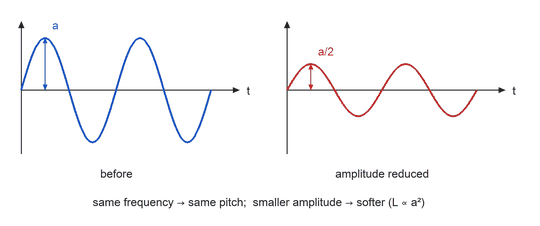
Concept: Loudness depends on the amplitude of the wave: loudness ∝ (amplitude)². A body vibrating with a larger amplitude sends more energy into the medium, so the sound is louder. Pitch depends only on the frequency.
Step 1 — See what a smaller amplitude does.
A smaller amplitude means the wave carries less energy to the ear, so the sound is softer: its loudness decreases.
Step 2 — See what does not change.
Reducing the amplitude does not change the number of vibrations per second, so the frequency, and with it the pitch, stays the same.
Watch out: Amplitude and pitch are independent; a softer note can still be shrill.
Why the other options are wrong:
Therefore, reducing the amplitude decreases the loudness, option (B).