
Question 931 markMCQEasy
Sounds above ............... are termed as noise pollution.
Confirming your payment
Sign up now and get 250 free tokens.
Sound · Question 93 of 137
Sounds above ............... are termed as noise pollution.
(A) 75 dB
(B) 120 dB
(C) 100 dB
(D) 80 dB
Answer: (B) 120 dB
Concept: The sound level is measured in decibel (dB): L = 10 log₁₀(I ÷ I₀) dB, where I₀ = 10⁻¹² W m⁻² is the faintest sound a normal ear can hear (0 dB, the threshold of hearing). The book takes 0 to 80 dB as safe for our ears and sound above 120 dB as noise pollution.
Step 1 — Recall the book's definition.
Noise pollution is the disturbance caused in the environment by undesirable, loud and harsh sound. The book puts it at sound levels above 120 dB, from sources such as loudspeakers, sirens and moving vehicles.
Step 2 — Place the options on the scale.
The safe limit for our ears is 0 to 80 dB, and a police siren is about 120 dB.
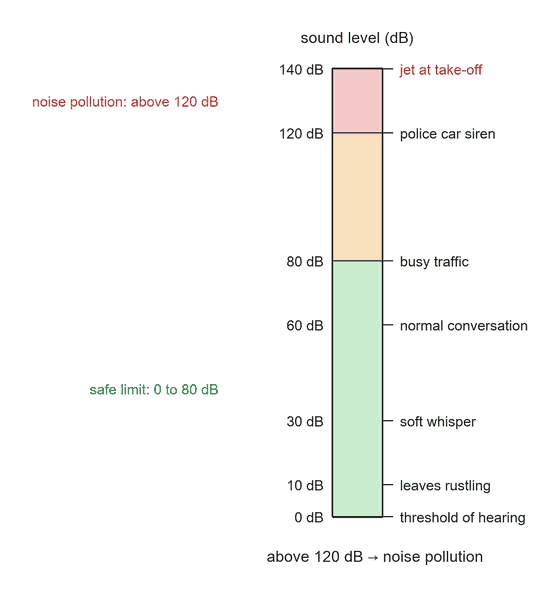
Watch out: 80 dB is the upper end of the SAFE range in the book; noise pollution begins above 120 dB.
Why the other options are wrong:
Therefore, sounds above 120 dB are termed noise pollution, option (B).