
Question 51 markMCQEasy
Due to vibrations of medium particles, the energy transformation is from :
Confirming your payment
Sign up now and get 250 free tokens.
Sound · Question 5 of 137
Due to vibrations of medium particles, the energy transformation is from :
(A) heat energy to kinetic energy and vice versa
(B) kinetic energy to potential energy and vice versa
(C) heat energy to potential energy and vice versa
(D) potential energy to nuclear energy and vice versa
Answer: (B) kinetic energy to potential energy and vice versa
Concept: When a wave passes, each particle of the medium vibrates about its mean position, like a small pendulum. During each vibration its energy keeps changing form, and it passes the energy on to the next particle.
Step 1 — At the mean position.
The particle moves fastest at its mean position, so there its energy is all kinetic energy (its potential energy is least).
Step 2 — At an extreme position.
The particle stops for an instant at each extreme position, so there its kinetic energy is zero and its energy is all potential energy.
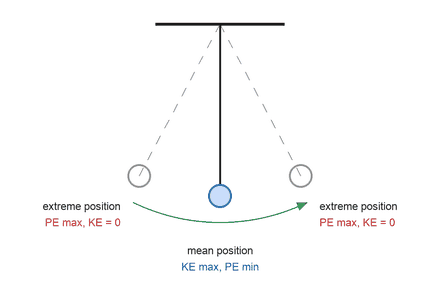
Step 3 — In between.
Between these positions kinetic energy changes into potential energy and back again, over and over, in every vibration.
Watch out: Heat is not part of this exchange; the wave passes through without warming the medium noticeably.
Why the other options are wrong:
Therefore, the energy changes from kinetic energy to potential energy and back, option (B).