Solution:
Concept: The sensation of a sound stays in our ear for about 0.1 s after the sound stops (persistence of hearing). An echo is heard as a separate sound only if the reflected sound arrives at least 0.1 s after the original. Sound goes to the reflector and back, a total distance 2d, so 2d = Vt, that is d = Vt ÷ 2.
Given: distance from the wall d = 25 m; speed of sound V = 350 m s⁻¹
(a) Time after which the reflected sound is received
Step 1 — Write the relation.
The reflected sound covers 2d at speed V.
t=V2d
Step 2 — Put in the values.
Use d = 25 m and V = 350 m s⁻¹.
t=350 m s−12×25 m=71 s≈0.143 s
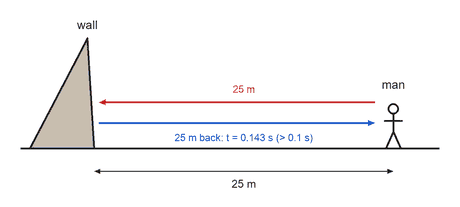
(b) Will he hear a distinct echo?
Step 3 — Compare with 0.1 s.
The reflected sound arrives 0.143 s after the original sound, which is more than 0.1 s. By then the sensation of the original sound has died out, so the reflected sound is heard separately, as a distinct echo. (The wall is farther than the minimum of 17.5 m at this speed.)
Watch out: Compare the time with 0.1 s, or the distance with 17.5 m (not 17 m, since here V = 350 m s⁻¹).
Therefore, (a) he receives the reflected sound after about 0.143 s, and (b) yes, he hears a distinct echo, because 0.143 s is more than 0.1 s.
