Solution:
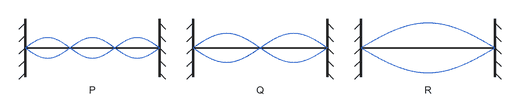
Concept: For the same string, loudness depends on the amplitude of vibration, and the frequency rises with the number of loops: with n loops on a string of length l, each loop is half a wavelength, so λ = 2l ÷ n and f = V ÷ λ is proportional to n.
(a) Louder sound
Step 1 — Find the louder vibration.
R vibrates with the maximum amplitude, and loudness ∝ (amplitude)², so R produces the loudest sound.
(b) Maximum shrillness
Step 2 — Find the shrillest vibration.
P vibrates in the most loops (three), so its wavelength is the shortest and its frequency the highest. Pitch rises with frequency, so P is the shrillest.
(c) Ratio of wavelengths
Step 3 — Find each wavelength.
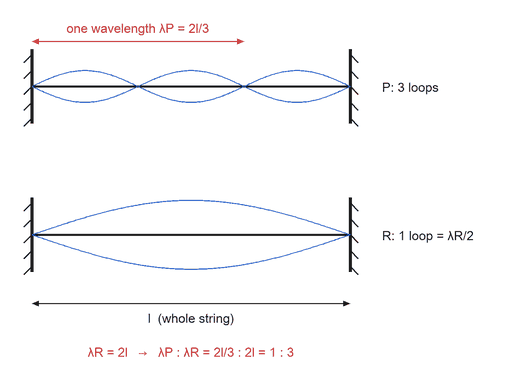
P has 3 loops and R has 1 loop on the same length l.
λP=32l
λR=12l=2l
Step 4 — Divide.
Divide the two wavelengths.
λRλP=2l2l/3=31
Watch out: More loops give a higher pitch but a SHORTER wavelength.
Therefore, (a) R gives the louder sound (largest amplitude), (b) P gives the shrillest sound (most loops, highest frequency), and (c) λP:λR = 1 : 3.