
Question 333 marksEasy
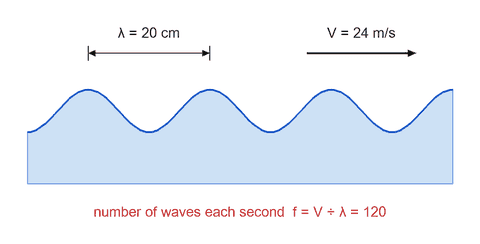
The wavelength of waves produced on the surface of water is 20 cm. If the wave velocity is 24 m s, calculate : (i) the number of waves produced in one second, and (ii) the time in which one wave is produced.
Confirming your payment
Sign up now and get 250 free tokens.
Sound · Question 33 of 137
The wavelength of waves produced on the surface of water is 20 cm. If the wave velocity is 24 m s, calculate : (i) the number of waves produced in one second, and (ii) the time in which one wave is produced.
Solution:
Concept: In the time T of one vibration of a particle, the wave moves forward by one wavelength λ. So its speed is λ ÷ T, and since the frequency (vibrations per second, unit hertz) is f = 1 ÷ T, the wave equation is V = fλ. The number of waves produced in one second is the frequency f, and the time for one wave is the time period T = 1 ÷ f.
Given: wavelength λ = 20 cm; wave velocity V = 24 m s⁻¹
(i) Number of waves produced in one second
Step 1 — Change the wavelength into metres.
The speed is in m s⁻¹, so the wavelength must be in metres.
Step 2 — Find the frequency.
Rearrange V = fλ for f and put in the values.
(ii) Time in which one wave is produced
Step 3 — Find the time period.
One wave is produced in one time period, the reciprocal of the frequency.
Watch out: Change 20 cm into 0.2 m before dividing; using 20 gives 1.2, which is wrong.
Therefore, (i) 120 waves are produced in one second, and (ii) one wave is produced in 1/120 s ≈ 8.3 × 10⁻³ s.