
Question 194 marksEasy
Define the following terms in relation to a wave : (a) amplitude, (b) frequency, (c) wavelength, and (d) wave velocity.
Confirming your payment
Sign up now and get 250 free tokens.
Sound · Question 19 of 137
Define the following terms in relation to a wave : (a) amplitude, (b) frequency, (c) wavelength, and (d) wave velocity.
Solution:
Concept: A wave is a disturbance that carries energy from one place to another through a medium. The particles of the medium only vibrate about their mean positions; they do not travel with the wave. Amplitude and frequency describe one particle; wavelength and wave velocity describe the wave as a whole.
(a) Amplitude (a)
Step 1 — Define amplitude.
The amplitude is the maximum displacement of a particle of the medium on either side of its mean position. Its S.I. unit is the metre (m).
(b) Frequency (f)
Step 2 — Define frequency.
The frequency is the number of vibrations made by a particle of the medium in one second. Its unit is the hertz (Hz), and f = 1 ÷ T, where T is the time period.
(c) Wavelength (λ)
Step 3 — Define wavelength.
The wavelength is the distance travelled by the wave in the time a particle of the medium completes one vibration. It equals the distance between two successive crests (or two successive compressions). Its unit is the metre (m).
(d) Wave velocity (V)
Step 4 — Define wave velocity.
The wave velocity is the distance travelled by the wave in one second. Its unit is m s⁻¹. The wave moves one wavelength in each vibration, and there are f vibrations each second, so
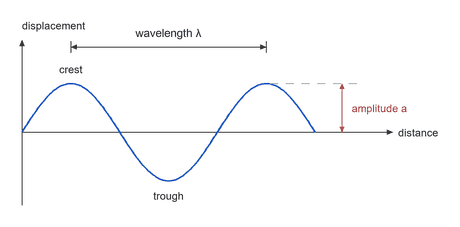
Watch out: The amplitude is measured from the MEAN position to a crest, not from a crest to a trough (that is 2a).
Therefore, (a) amplitude = maximum displacement from the mean position, (b) frequency = vibrations per second, (c) wavelength = distance moved by the wave in one vibration, and (d) wave velocity = distance moved by the wave in one second, V = fλ.