
Opening your dashboard
Class 10 Chemistry Chapter 9: Study of Compounds – Ammonia Solutions
67 textbook questions with step-by-step answers, free to read, for ICSE 2026-27.
Get talked through Ch 9, not just shown the answer
Reading a finished solution is not the same as being able to do it. The AI tutor takes one question at a time and works it with you, in your own words, until you can.
- Ask it out loud, in your own words
- It gives you the next step, not the answer
- Stuck on part (ii)? Start there
67 questions with solutions
1–5 marks · Mixed difficulty
- 14 marks
Question 1
(a) State the type of bonding present in ammonia, show by a diagram.
(b) What is the formula of liquid ammonia ? Account for the basic nature of this compound.
Solve with AIWritten solution
Solution:
Concept: Nitrogen (electronic configuration 2, 5) needs three more electrons for an octet, and each hydrogen needs one more for a duplet. They reach these by sharing electron pairs, so the bonds are covalent. The pair of electrons that nitrogen does not share is called a lone pair, and it is the reason ammonia is basic.
Step 1 — (a) Name the type of bonding.
Nitrogen shares one of its five valence electrons with each of three hydrogen atoms, and each hydrogen gives one electron to the pair. This gives three N–H single covalent bonds. Nitrogen is more electronegative than hydrogen, so each bond is slightly polar.
Step 2 — (a) Draw the electron-dot structure.
In the diagram, the dots are nitrogen's electrons and the crosses are hydrogen's. Count them: nitrogen 5 + three hydrogens 3 = 8 valence electrons, arranged as 3 bond pairs + 1 lone pair. So nitrogen has an octet and each hydrogen a duplet.

Step 3 — (b) Write the formula of liquid ammonia.
Liquid ammonia is simply dry ammonia gas turned into a liquid by high pressure (and cooling). It is the same substance, not a solution, so its formula is .
Step 4 — (b) Explain the basic nature.
A base accepts a proton (hydrogen ion, ). The lone pair on nitrogen is donated to a proton taken from a water molecule, forming a coordinate bond. This makes the ammonium ion and leaves a hydroxyl ion behind:

The ions make the solution alkaline, so it turns moist red litmus blue. Only a small part of the ammonia reacts in this way, so aqueous ammonia is a weak base.
Watch out: Liquid ammonia (pure NH₃) is not the same as liquor ammonia (a solution of ammonia in water). Only the solution contains OH⁻ ions.
Therefore, (a) ammonia has three polar N–H covalent bonds and one lone pair on nitrogen; (b) liquid ammonia is NH₃, and ammonia is basic because the lone pair on nitrogen accepts H⁺ from water, leaving OH⁻ ions.
- 25 marks
Question 2
(a) Write a balanced chemical equation for the lab preparation of ammonia. (2018)
(b) How is ammonia dried and collected in the laboratory?
(c) Ammonia cannot be collected over water. Give reason.
Solve with AIWritten solution
Solution:
Concept: In the laboratory, ammonia is made by heating an ammonium salt with an alkali. The alkali's hydroxide ion takes a proton from the ammonium ion, and ammonia gas is driven off. Three properties decide how the gas is handled: it is basic, it is lighter than air and it is very soluble in water.
Step 1 — (a) Write the equation.
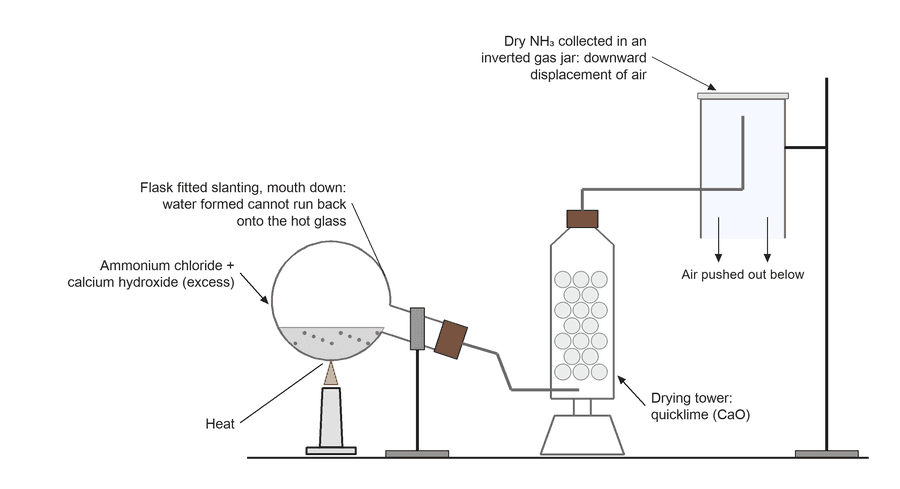
Ammonium chloride is heated with excess slaked lime (calcium hydroxide). Count each atom: N 2 = 2, H 8 + 2 = 4 + 6, Cl 2 = 2, Ca 1 = 1, O 2 = 2, so the equation is balanced.
Step 2 — (b) Dry the gas.
The gas is passed through a drying tower packed with lumps of quicklime (CaO). Quicklime is a basic drying agent: it absorbs the water vapour but does not react with ammonia, which is also basic.
Step 3 — (b) Collect the gas.
Ammonia is collected in inverted gas jars by downward displacement of air. Its vapour density (8.5) is less than that of air (14.4), so ammonia rises to the top of the jar and pushes the air out at the mouth below.
Step 4 — (c) Explain why it is not collected over water.
Ammonia is extremely soluble in water: about 702 volumes of ammonia dissolve in 1 volume of water at 20 °C. Bubbled into water, the gas would dissolve instead of collecting in the jar.
Watch out: Do not dry ammonia with conc. sulphuric acid, phosphorus pentoxide or anhydrous calcium chloride; each of them reacts with ammonia.
Therefore, ammonia is made by heating NH₄Cl with Ca(OH)₂, dried over quicklime, collected by downward displacement of air, and never collected over water because it is highly soluble in water.
- 34 marks
Question 3
(a) Explain with a diagram the preparation of aqueous ammonia.
(b) Why drying agents such as, PO and CaCl are not used to dry NH ?
Solve with AIWritten solution
Solution:
Concept: Ammonia dissolves in water so quickly that the water can be sucked back into the hot apparatus (back suction). An inverted funnel prevents this. Because ammonia is basic, it reacts with acidic or neutral drying agents.
Step 1 — (a) Lead the gas to an inverted funnel.
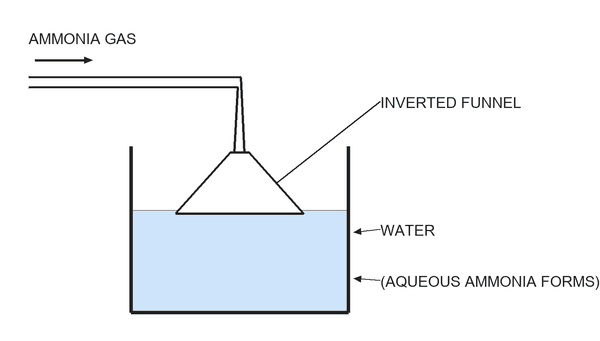
Ammonia from the laboratory preparation is passed through a delivery tube that ends in an inverted funnel. The rim of the funnel just dips into water in a beaker, and the gas dissolves to form aqueous ammonia (ammonium hydroxide):
Step 2 — (a) See how the funnel stops back suction.
As ammonia dissolves, the pressure inside the funnel falls and water rises into it. The water level in the beaker then drops below the rim, so the rim loses contact with the water and the water in the funnel falls back. The rim dips again and dissolving continues, so the water can never be sucked back into the flask. The wide funnel also gives a large surface for the gas to dissolve.
Step 3 — (b) Explain why phosphorus pentoxide is not used.
Phosphorus pentoxide is an acidic oxide. Ammonia, a base, reacts with it in the presence of moisture to form ammonium phosphate, so the ammonia itself would be absorbed:
Step 4 — (b) Explain why calcium chloride is not used.
Anhydrous calcium chloride combines with ammonia to form an addition compound, so it too would absorb the gas:
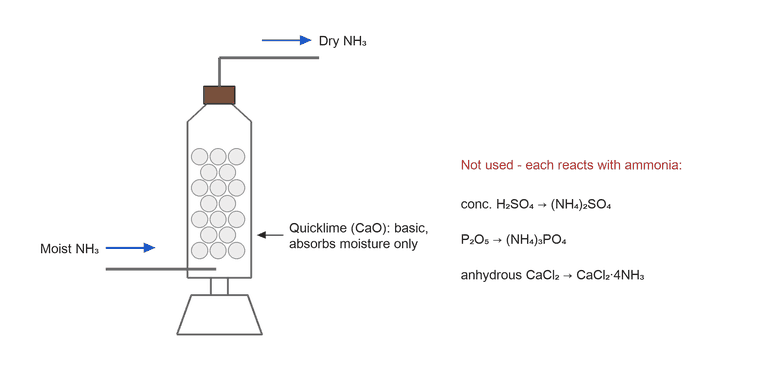
Ammonia is therefore dried over quicklime (CaO), a basic drying agent that does not react with it.
Watch out: The funnel's rim must only just touch the water. If the funnel is pushed deep under the water, back suction can still happen.
Therefore, aqueous ammonia is made by dissolving the gas in water through an inverted funnel (no back suction), and P₂O₅ and CaCl₂ are not used because they react with ammonia.
- 42 marks
Question 4
A substance 'A' was heated with slaked lime and a gas 'B' with a pungent smell was obtained. Name the substances A and B and give a balanced equation.
Solve with AIWritten solution
Solution:
Concept: An ammonium salt heated with an alkali (here slaked lime, calcium hydroxide) always gives ammonia, the common gas with a sharp pungent smell.
Step 1 — Identify the gas B.
The gas has a pungent smell and is formed from slaked lime, an alkali, so it is ammonia, .
Step 2 — Identify the substance A.
Only an ammonium salt gives ammonia with an alkali. The usual salt for this preparation is ammonium chloride, .
Step 3 — Write the balanced equation.
Count each atom: N 2 = 2, H 8 + 2 = 4 + 6, Cl 2 = 2, Ca 1 = 1 and O 2 = 2, so the equation is balanced.
B can be confirmed: it turns moist red litmus blue and gives dense white fumes with a glass rod dipped in conc. hydrochloric acid.
Watch out: Slaked lime is calcium hydroxide, Ca(OH)₂; quicklime is calcium oxide, CaO.
Therefore, A is ammonium chloride (NH₄Cl) and B is ammonia (NH₃).
- 55 marks
Question 5
Ammonia is manufactured by Haber Process.
(a) Under what conditions do the reactants combine to form ammonia ? Give a balanced equation for the reaction.
(b) In what ratio by volume, are the above gases used ?
(c) State one possible source of each reactant used in Haber Process.
(d) State whether the formation of ammonia is promoted by the use of high pressure or low pressure?
(e) Mention two possible ways by which ammonia produced is removed from unchanged gases.
(f) What is the function of :
(i) finely divided iron,
(ii) molybdenum in the above process ?
(g) What is the percentage formation of ammonia ?
(h) How can this percentage formation be increased ?
Solve with AIWritten solution
Solution:
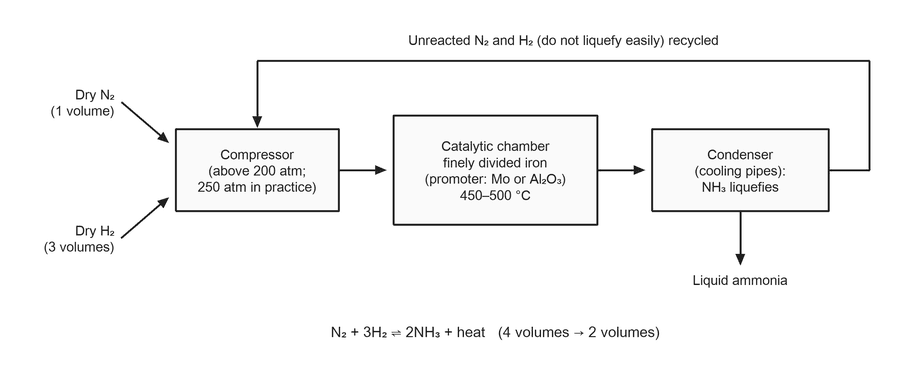
Concept: In the Haber process, nitrogen and hydrogen combine in a reversible, exothermic reaction in which 4 volumes of gas (1 + 3) become 2 volumes of ammonia. The conditions are a balance between getting enough ammonia and getting it fast enough.
Step 1 — (a) State the conditions and the equation.
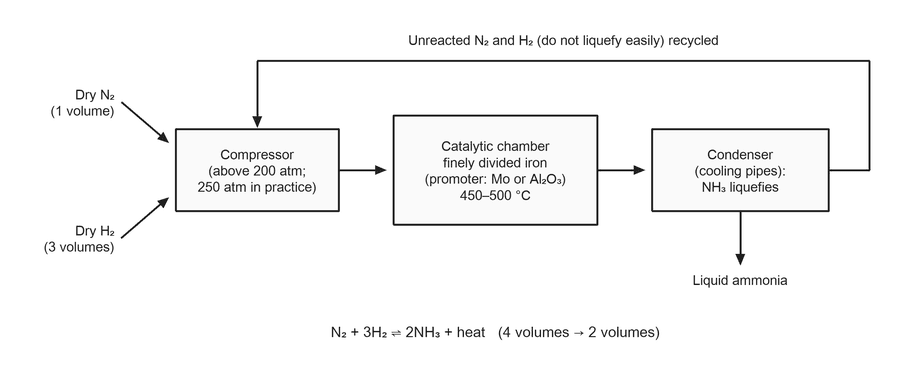
The gases combine at a temperature of 450–500 °C, a pressure above 200 atm (about 250 atm in practice), over a catalyst of finely divided iron with molybdenum (or aluminium oxide) as promoter:
Step 2 — (b) Give the ratio by volume.
Gases react in the same volume ratio as their coefficients in the equation (Gay-Lussac's law). So nitrogen : hydrogen = 1 : 3 by volume.
Step 3 — (c) Name a source of each reactant.
Nitrogen comes from the fractional distillation of liquid air. Hydrogen comes from water gas by the Bosch process (or from natural gas).
Step 4 — (d) Decide on the pressure.
High pressure favours ammonia, because the forward reaction reduces 4 volumes of gas to 2 volumes, and high pressure favours the side with fewer volumes.
Step 5 — (e) Remove the ammonia from the unchanged gases.
Two ways are used:
- liquefaction: on cooling, ammonia liquefies easily, while nitrogen and hydrogen do not;
- dissolving in water: ammonia is very soluble in water, while nitrogen and hydrogen are almost insoluble.
Step 6 — (f) Give the functions of iron and molybdenum.
(i) Finely divided iron is the catalyst. It speeds up the reaction, and being finely divided it offers a large surface area. (ii) Molybdenum is the promoter. It increases the efficiency of the iron catalyst.
Step 7 — (g) State the percentage formation.
Only about 15% of the gas mixture is changed into ammonia in one pass through the catalytic chamber.
Step 8 — (h) Increase the percentage formation.
The unreacted nitrogen and hydrogen are recirculated over the catalyst again and again, until nearly all of them (about 98%) has been converted. Using high pressure and removing ammonia as soon as it forms also favour more ammonia.
Watch out: Molybdenum is not the catalyst; it is the promoter. Platinum is the catalyst of the Ostwald process, not of the Haber process.
Therefore, ammonia is made from N₂ and H₂ (1 : 3) at 450–500 °C and above 200 atm over finely divided iron with a molybdenum promoter; high pressure, removal of ammonia and recirculation raise the yield from about 15%.
- 65 marks
Question 6
Give reasons :
(a) Ammonium compounds do not occur as minerals.
(b) Ammonium nitrate is not used in the preparation of ammonia.
(c) Conc HSO is a good drying agent, yet it is not used to dry NH.
(d) In the lab. preparation of ammonia
(i) calcium hydroxide is used in excess.
(ii) Flask is fitted in slanting position.
Solve with AIWritten solution
Solution:
Concept: Each reason comes from one property: ammonium compounds are very soluble, ammonium nitrate is explosive, ammonia is basic, ammonium chloride sublimes, and water is formed in the preparation.
Step 1 — (a) Explain why ammonium compounds are not minerals.
Ammonium compounds are highly soluble in water. Any that formed in the ground would be dissolved by rain water and washed away, so they do not occur as minerals.
Step 2 — (b) Explain why ammonium nitrate is not used.
Ammonium nitrate is explosive on heating. Instead of giving ammonia, it decomposes into nitrous oxide and steam:
Step 3 — (c) Explain why conc. sulphuric acid is not used.
Conc. sulphuric acid is a good drying agent, but ammonia is basic and reacts with the acid to form ammonium sulphate. The ammonia itself would be absorbed:
Step 4 — (d)(i) Explain the excess of calcium hydroxide.
Ammonium chloride sublimes on heating. Taking an excess of the alkali makes sure that all the ammonium chloride reacts before any of it is lost by sublimation.
Step 5 — (d)(ii) Explain the slanting flask.
Water is formed in the reaction. The flask is fitted slanting, mouth downwards, so this water runs towards the mouth. It cannot trickle back onto the hot bottom of the flask, which could crack the glass.
Watch out: The flask slants downwards towards the mouth, so the water runs away from the heated part.
Therefore, (a) ammonium compounds are too soluble to stay in the ground; (b) NH₄NO₃ is explosive; (c) conc. H₂SO₄ reacts with ammonia; (d)(i) excess Ca(OH)₂ uses up all the subliming NH₄Cl; (d)(ii) the slant stops water running back onto the hot glass.
- 73 marks
Question 7
State the following conditions required in the Habers process
(a) Temperature (b) Pressure (c) Catalyst
Solve with AIWritten solution
Solution:
Concept: The Haber reaction is exothermic and reduces the volume of gas. A low temperature would give more ammonia but far too slowly, and a high pressure gives more ammonia:
Step 1 — (a) Temperature.
The optimum temperature is 450–500 °C. It is a compromise: hot enough for a fast reaction, but not so hot that the reverse reaction takes over.
Step 2 — (b) Pressure.
The pressure is above 200 atm (about 250 atm in practice). High pressure favours the side with fewer volumes of gas, which is ammonia.
Step 3 — (c) Catalyst.
The catalyst is finely divided iron, with a trace of molybdenum (or aluminium oxide) as promoter to increase its efficiency.
Watch out: The catalyst only makes equilibrium come faster; it does not increase the percentage of ammonia.
Therefore, the Haber process needs a temperature of 450–500 °C, a pressure above 200 atm and a catalyst of finely divided iron (molybdenum promoter).
- 83 marks
Question 8
Choose the correct word or phrase from the brackets to complete the following sentences and write balanced equations for the same.
(a) Ammonium chloride is a soluble salt prepared by .................................. [precipitation, neutralization].
(b) When ammonium chloride is heated, it undergoes ................ [thermal decomposition/dissociation].
(c) Heating ammonium chloride with sodium hydroxide produces .................... [ammonia, nitrogen].
Solve with AIWritten solution
Solution:
Concept: A soluble salt is made by neutralisation (acid + base). When a substance splits on heating and the parts join again on cooling, it is thermal dissociation (reversible); if they do not rejoin, it is thermal decomposition. Any ammonium salt heated with an alkali gives ammonia.
Step 1 — (a) Choose the method of preparation.
Ammonium chloride is soluble, so it cannot be collected as a precipitate; it is made by neutralization of ammonium hydroxide with hydrochloric acid:
Step 2 — (b) Choose dissociation or decomposition.
On heating, ammonium chloride splits into ammonia and hydrogen chloride, and the two gases recombine on the cooler part of the tube. So it undergoes thermal dissociation:
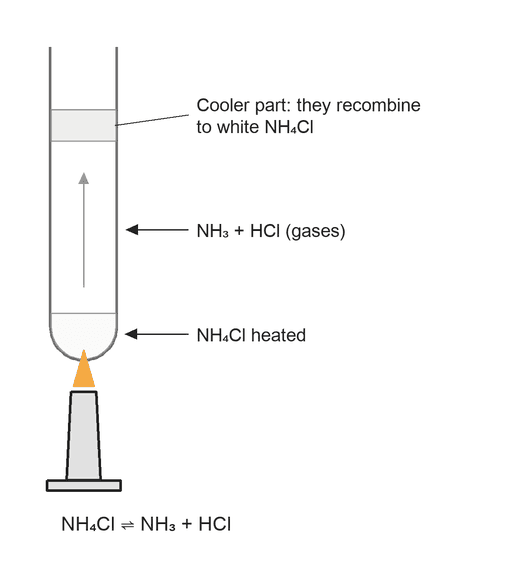
Step 3 — (c) Choose the product with sodium hydroxide.
Sodium hydroxide is an alkali, so warming it with ammonium chloride gives ammonia:
Watch out: Precipitation is used only for insoluble salts; ammonium salts are all soluble.
Therefore, (a) neutralization, (b) thermal dissociation and (c) ammonia complete the sentences.
- 92 marks
Question 9
An element has 2 electrons in its N shell. It reacts with a non-metal of atomic number 7. The compound formed reacts with warm water and produces a basic gas. Identify the elements and write the balanced chemical reactions.
Solve with AIWritten solution
Solution:
Concept: The shells are named K, L, M, N from the nucleus outwards, so the N shell is the fourth shell. A metal nitride reacts with warm water to give ammonia, the only common basic gas.
Step 1 — Identify the metal.
For an element with only two electrons in its fourth shell, the K, L and M shells hold 2, 8 and 8 electrons, so the configuration is 2, 8, 8, 2. The atomic number is 2 + 8 + 8 + 2 = 20, which is calcium (Ca).
Step 2 — Identify the non-metal.
Atomic number 7 has the configuration 2, 5. This is nitrogen (N).
Step 3 — Form the compound.
Calcium has valency 2 and nitrogen valency 3, so they combine as , calcium nitride:
Step 4 — React it with warm water.
The nitride is hydrolysed by warm water to calcium hydroxide and ammonia, the basic gas:
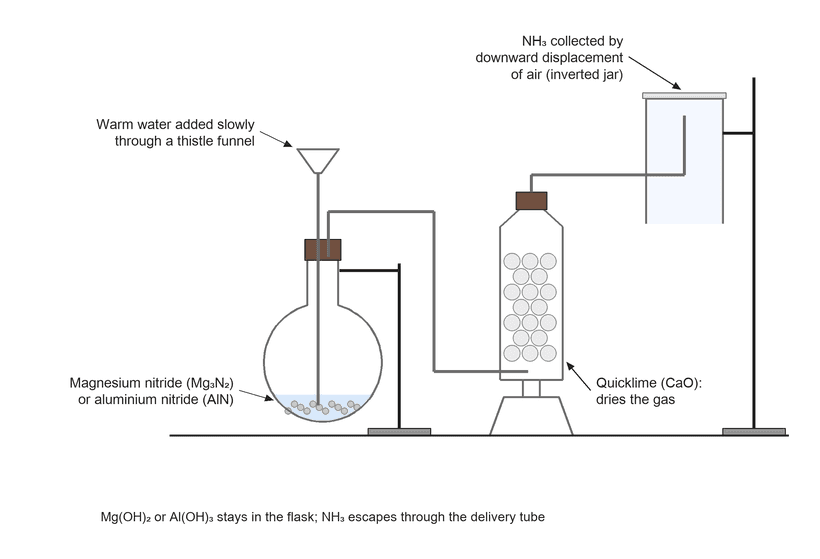
The same apparatus is used with magnesium nitride or aluminium nitride.
Watch out: The N shell is a shell name (the fourth shell), not the element nitrogen.
Therefore, the elements are calcium and nitrogen; they form Ca₃N₂, which gives ammonia with warm water.
- 105 marks
Question 10
The following reactions are carried out :
A : Nitrogen + metal compound X.
B : X + water ammonia + another compound.
C : Ammonia + metal oxide metal + water + N.
One metal that can be used for reaction A is magnesium.
(a) Write the formula of the compound X formed.
(b) Write the correctly balanced equation for reaction B where X is the compound formed.
(c) What property of ammonia is demonstrated by reaction C ?
Solve with AIWritten solution
Solution:
Concept: Magnesium burns in nitrogen to form magnesium nitride, which gives ammonia with water. When ammonia removes oxygen from a metal oxide, it is acting as a reducing agent.
Step 1 — (a) Write the formula of X.
Magnesium (valency 2) and nitrogen (valency 3) combine as , magnesium nitride:
Step 2 — (b) Write the equation for reaction B.
Magnesium nitride reacts with water to give magnesium hydroxide and ammonia. Count: Mg 3 = 3, N 2 = 2, H 12 = 6 + 6, O 6 = 6.
Step 3 — (c) Name the property shown by reaction C.
In reaction C the metal oxide loses oxygen and becomes the metal, so it is reduced; ammonia loses its hydrogen and becomes nitrogen, so it is oxidised. Ammonia is therefore a reducing agent. For example, with copper (II) oxide:
The black copper (II) oxide turns reddish brown (copper), water droplets form and nitrogen is given off.
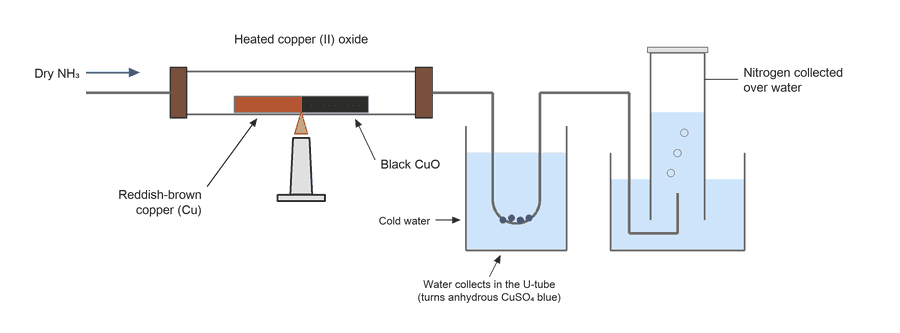
Watch out: Ammonia is oxidised in reaction C; the property shown is its reducing nature, not its basic nature.
Therefore, X is Mg₃N₂, reaction B is Mg₃N₂ + 6H₂O → 3Mg(OH)₂ + 2NH₃, and reaction C shows that ammonia is a reducing agent.
- 115 marks
Question 11
Correct the following :
(a) A reddish brown precipitate is obtained when ammonium hydroxide is added to ferrous sulphate.
(b) Liquid ammonia is a solution of NH.
(c) Finely divided platinum is used in Haber Process.
(d) Conc. HSO is a drying agent for NH.
(e) Ammonium salts, on heating, decompose to give ammonia.
Solve with AIWritten solution
Solution:
Concept: To correct a statement, find the one wrong fact in it (a colour, a name, a catalyst, a reagent or a missing condition) and replace it with the right one.
Step 1 — (a) Correct the colour.
Ferrous sulphate is an iron (II) salt, and iron (II) hydroxide is dirty green. Corrected: A dirty green precipitate is obtained when ammonium hydroxide is added to ferrous sulphate. (A reddish brown precipitate comes from a ferric salt.)
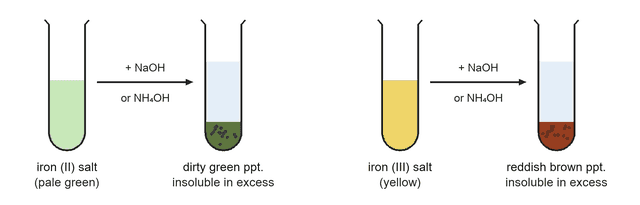
Step 2 — (b) Correct the description of liquid ammonia.
Liquid ammonia is pure ammonia gas liquefied by pressure. Corrected: Liquid ammonia is liquefied ammonia gas (pure NH₃); a solution of NH₃ in water is liquor ammonia (aqueous ammonia).
Step 3 — (c) Correct the catalyst.
Platinum is the catalyst of the Ostwald process. Corrected: Finely divided iron is used in the Haber process.
Step 4 — (d) Correct the drying agent.
Conc. sulphuric acid reacts with ammonia to form ammonium sulphate. Corrected: Quicklime (CaO) is a drying agent for NH₃.
Step 5 — (e) Add the missing reagent.
Ammonium salts give ammonia only when heated with an alkali; heated alone, they dissociate or decompose (ammonium nitrate gives nitrous oxide). Corrected: Ammonium salts, on heating with an alkali, give ammonia.
Watch out: A ferrous (iron (II)) salt gives a dirty green precipitate, and a ferric (iron (III)) salt a reddish brown one. Mixing up the two names is the commonest slip here.
Therefore, the corrected statements use dirty green, liquefied ammonia gas, finely divided iron, quicklime and heating with an alkali.
- 121 mark
Question 12
Choose the correct option from the following :
Ammonia can be obtained by adding water to
Solve with AIAnswer
(A) Ammonium chloride,
(B) Ammonium nitrite,
- Correct
(C) Magnesium nitride,
(D) Magnesium nitrate.
Answer: (C) Magnesium nitride,
Concept: A metal nitride is hydrolysed by warm water and gives ammonia. An ammonium salt gives ammonia only when heated with an alkali, never with water alone.
Step 1 — Find the compound that gives ammonia with water.
Magnesium nitride reacts with warm water, forming magnesium hydroxide and ammonia:
Step 2 — Check the other compounds.
Ammonium chloride and ammonium nitrite simply dissolve in water, and magnesium nitrate contains no nitrogen that can become ammonia. None of them gives ammonia with water alone.
Watch out: 'ammonium' in a name does not mean the salt gives ammonia with water; it needs an alkali and heat.
Why the other options are wrong:
- (A) Ammonium chloride,: ammonium chloride only dissolves in water; it gives ammonia when heated with an alkali such as slaked lime.
- (B) Ammonium nitrite,: ammonium nitrite gives nitrogen and water, not ammonia, when its solution is heated.
- (D) Magnesium nitrate: magnesium nitrate contains neither a nitride ion nor an ammonium ion, so it gives no ammonia with water.
Therefore, ammonia is obtained by adding water to magnesium nitride, option (C).
- 131 mark
Question 13
The catalyst used in Haber's process is :
Solve with AIAnswer
(A) Molybdenum
(B) Platinum
(C) Nickel
- Correct
(D) Iron
Answer: (D) Iron
Concept: A catalyst speeds up a reaction without being used up. In the Haber process the catalyst is finely divided iron; a trace of molybdenum is only the promoter, which makes the iron work better.
Step 1 — Recall the Haber reaction and its conditions.
Nitrogen and hydrogen combine only slowly at the temperature used, so a catalyst is needed:
Step 2 — Pick out the catalyst.
The equation shows iron as the catalyst. It is used finely divided so that it has a large surface area for the gases to react on.
Watch out: Molybdenum appears in the Haber process too, but as the promoter, not the catalyst.
Why the other options are wrong:
- (A) Molybdenum: molybdenum is the promoter that increases the efficiency of the iron catalyst; it is not the catalyst itself.
- (B) Platinum: platinum is the catalyst of the Ostwald process (catalytic oxidation of ammonia).
- (C) Nickel: nickel is the catalyst for the hydrogenation of oils, not for the Haber process.
Therefore, the catalyst used in Haber's process is iron, option (D).
- 141 mark
Question 14
Nitrogen gas can be obtained by heating :
Solve with AIAnswer
(A) Ammonium nitrate
- Correct
(B) Ammonium nitrite
(C) Magnesium nitride
(D) Ammonium chloride
Answer: (B) Ammonium nitrite
Concept: Ammonium nitrite and ammonium nitrate do not give ammonia on heating; they decompose. Ammonium nitrite gives nitrogen and water.
Step 1 — Heat ammonium nitrite.
Ammonium nitrite breaks down into nitrogen and steam. Count: N 2 = 2, H 4 = 4, O 2 = 2.
Step 2 — See how it is used in practice.
Solid ammonium nitrite is unstable, so it is made in the solution itself by warming sodium nitrite with ammonium chloride; it then decomposes as above:
Watch out: Ammonium nitrite (NH₄NO₂) gives nitrogen, but ammonium nitrate (NH₄NO₃) gives nitrous oxide. The two names differ by one letter.
Why the other options are wrong:
- (A) Ammonium nitrate: ammonium nitrate gives nitrous oxide (N₂O) and water on heating, not nitrogen.
- (C) Magnesium nitride: magnesium nitride is not decomposed by heat; with warm water it gives ammonia.
- (D) Ammonium chloride: ammonium chloride dissociates into ammonia and hydrogen chloride, which recombine on cooling.
Therefore, nitrogen gas is obtained by heating ammonium nitrite, option (B).
- 151 mark
Question 15
Ammonia can be obtained by adding water to :
Solve with AIAnswer
(A)
- Correct
(B)
(C)
(D)
Answer: (B)
Concept: A metal nitride is hydrolysed by warm water and gives ammonia. Ammonium salts give ammonia only when heated with an alkali.
Step 1 — React magnesium nitride with water.
Magnesium nitride and warm water give magnesium hydroxide and ammonia:
Step 2 — Check the salts.
Ammonium chloride and ammonium sulphate only dissolve in water, and magnesium nitrate has no nitride ion. So only magnesium nitride gives ammonia with water.
Watch out: Two of the options are ammonium salts; they contain the ammonium ion but still need an alkali to release ammonia.
Why the other options are wrong:
- (A) : ammonium chloride only dissolves in water; it must be heated with an alkali to release ammonia.
- (C) : magnesium nitrate has neither a nitride ion nor an ammonium ion, so it gives no ammonia.
- (D) : ammonium sulphate also only dissolves in water; it too needs an alkali to give ammonia.
Therefore, ammonia is obtained by adding water to magnesium nitride, option (B).
- 161 mark
Question 16
The gas collected by downward displacement of air is :
Solve with AIAnswer
(A) HCl
- Correct
(B)
(C)
(D)
Answer: (B)
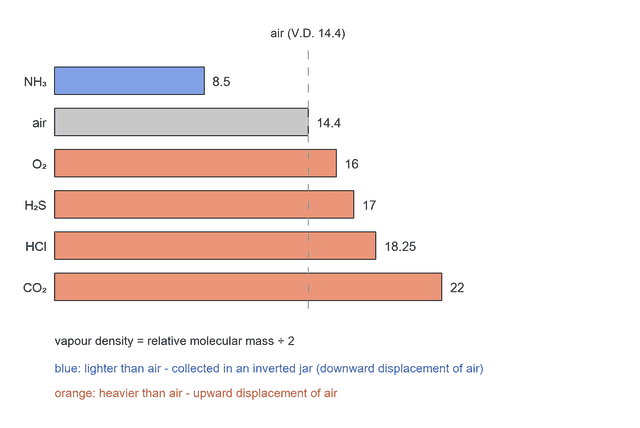
Concept: A gas lighter than air is collected by downward displacement of air: the jar is held mouth downwards and the gas pushes the air out at the bottom. The vapour density (V.D.) of a gas tells how heavy it is compared with hydrogen: V.D. = relative molecular mass ÷ 2. Air behaves like a gas of V.D. about 14.4. A gas with V.D. below 14.4 is lighter than air; above 14.4, heavier.
Step 1 — Find the vapour density of ammonia.
The relative molecular mass of ammonia is 14 + 3 = 17, so
\begin{aligned} \text{V.D. of NH_{3}} &= \dfrac{17}{2} \\ &= 8.5 \end{aligned}This is less than 14.4, so ammonia is lighter than air.
Step 2 — Compare the other gases.
Hydrogen chloride (18.25), carbon dioxide (22) and hydrogen sulphide (17) all have vapour densities above 14.4, so they are heavier than air.
Watch out: 'downward displacement of air' means the AIR is pushed down and out; it is used for light gases, with the jar upside down.
Why the other options are wrong:
- (A) HCl: HCl has V.D. 36.5 ÷ 2 = 18.25, so it is heavier than air and is collected by upward displacement of air.
- (C) : CO₂ has V.D. 44 ÷ 2 = 22, so it is heavier than air.
- (D) : H₂S has V.D. 34 ÷ 2 = 17, so it is heavier than air.
Therefore, the gas collected by downward displacement of air is ammonia, option (B).
- 171 mark
Question 17
In the Haber's process, the ratio of reactants nitrogen and hydrogen is :
Solve with AIAnswer
(A) 2 : 3
(B) 3 : 2
- Correct
(C) 1 : 3
(D) 3 : 1
Answer: (C) 1 : 3
Concept: For gases, the volumes that react are in the same ratio as the coefficients in the balanced equation (Gay-Lussac's law of combining volumes).
Step 1 — Write the balanced equation.
Nitrogen and hydrogen combine to form ammonia:
Step 2 — Read the ratio from the coefficients.
The coefficient of nitrogen is 1 and that of hydrogen is 3. So 1 volume of nitrogen reacts with 3 volumes of hydrogen: nitrogen : hydrogen = 1 : 3.
Watch out: Keep the order the question asks for: nitrogen first, then hydrogen.
Why the other options are wrong:
- (A) 2 : 3: 2 : 3 does not match the coefficients 1 and 3.
- (B) 3 : 2: 3 : 2 does not match the coefficients either.
- (D) 3 : 1: 3 : 1 is the reverse; it is the ratio hydrogen : nitrogen.
Therefore, nitrogen and hydrogen are taken in the ratio 1 : 3, option (C).
- 181 mark
Question 18
When ammonia reacts with an excess of chlorine, the main product formed is :
Solve with AIAnswer
(A)
- Correct
(B)
(C)
(D) HCl
Answer: (B)
Concept: Chlorine has a strong attraction for hydrogen. Which product forms depends on which gas is in excess.
Step 1 — Chlorine in excess.
Excess chlorine removes all three hydrogen atoms of ammonia, leaving nitrogen trichloride, a yellow, oily, highly explosive liquid:
Step 2 — Compare ammonia in excess.
When ammonia is in excess, the hydrogen chloride formed combines with the extra ammonia, giving white fumes of ammonium chloride and nitrogen:
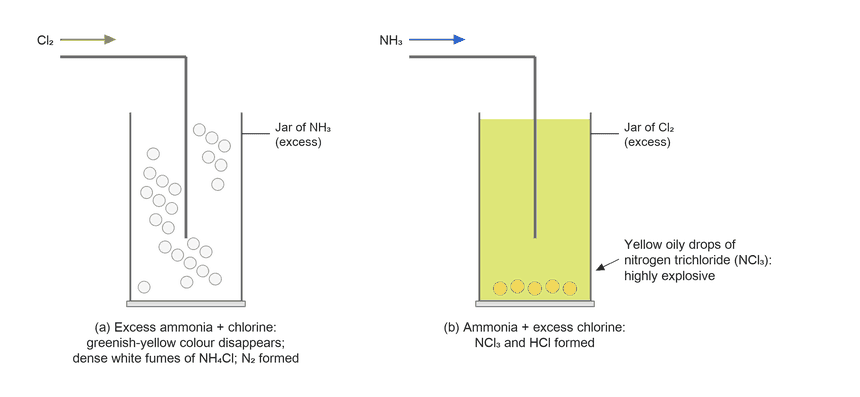
Watch out: Excess ammonia gives NH₄Cl and N₂; excess chlorine gives NCl₃ and HCl. Check which reactant is in excess.
Why the other options are wrong:
- (A) : NH₄Cl is the main product when ammonia, not chlorine, is in excess.
- (C) : Cl₂ is a reactant, not a product.
- (D) HCl: HCl is only the by-product; the main product with excess chlorine is NCl₃.
Therefore, with excess chlorine the main product is nitrogen trichloride, option (B).
- 191 mark
Question 19
Ammonia is used in :
Solve with AIAnswer
(A) Contact process
(B) Haber's process
- Correct
(C) Ostwald process
(D) Bayer's process
Answer: (C) Ostwald process
Concept: In the Ostwald process for nitric acid, ammonia is the starting material. It is oxidised over platinum at about 800 °C.
Step 1 — Oxidise ammonia over platinum.
Ammonia and oxygen react on hot platinum gauze to give nitric oxide:
Step 2 — Turn nitric oxide into nitric acid.
The nitric oxide combines with more oxygen to give nitrogen dioxide, which is then absorbed in water with air to give nitric acid:
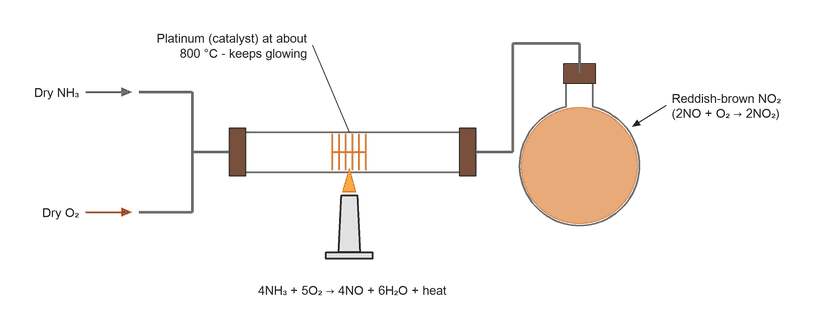
Watch out: Ammonia is MADE in Haber's process but USED in the Ostwald process.
Why the other options are wrong:
- (A) Contact process: the Contact process makes sulphuric acid from sulphur dioxide; ammonia is not used in it.
- (B) Haber's process: Haber's process produces ammonia; ammonia is its product, not a reactant.
- (D) Bayer's process: Bayer's process purifies bauxite with sodium hydroxide; ammonia is not used.
Therefore, ammonia is used in the Ostwald process, option (C).
- 201 mark
Question 20
In the following set up for burning ammonia in oxygen, ammonia tube is fitted higher and oxygen tube is kept lower because ?

P Oxygen is lighter than ammonia.
Q Ammonia is lighter than oxygen.
R Ammonia and oxygen mixture is explosive and by keeping them in this position, limited oxygen will react with ammonia.
Which of the following is true ?
Solve with AIAnswer
(A) Only P
(B) Only Q
- Correct
(C) Only R
(D) Both P and Q
Answer: (C) Only R
Concept: A mixture of ammonia and oxygen is explosive. In this apparatus the two gases are kept apart until they meet at the tip of the ammonia tube, where ammonia burns steadily in a limited supply of oxygen.
Step 1 — Look at the arrangement.
Ammonia comes out of the longer tube near the top, and oxygen enters through the shorter tube lower down. So the gases meet only at the tip of the ammonia tube, and no large explosive mixture is formed.
Step 2 — See what happens at the tip.
Ammonia burns there with a greenish yellow flame, giving nitrogen and water vapour:
Step 3 — Judge each statement.
P is false: oxygen (V.D. 16) is heavier than ammonia (V.D. 8.5). Q is a true fact, but it is not why the tubes are placed like this. R gives the actual reason. So the reason is only R.
Watch out: Read the question as 'which statement is the reason'. Q is true, but it does not explain the arrangement, and no option offers 'Q and R'.
Why the other options are wrong:
- (A) Only P: P is false: oxygen (V.D. 16) is heavier than ammonia (V.D. 8.5).
- (B) Only Q: Q is a true fact, but it is not the reason for this arrangement; the tubes are placed to avoid an explosive mixture.
- (D) Both P and Q: this includes P, which is false.
Therefore, the arrangement is explained by R only, option (C).
- 211 mark
Question 21
The following questions are Assertion-Reason based questions. Choose the answer based on the codes given below.
(1) Both A and R are true and R is the correct explanation of A.
(2) Both A and R are true but R is not the correct explanation of A.
(3) A is true but R is false.
(4) A is false but R is true.
Assertion (A) : Ammonia does not conduct electricity in gaseous or liquid state.
Reason (R) : Ions in ammonia gas or liquid ammonia are not free to move.
Solve with AIAnswer
(A) (1)
(B) (2)
- Correct
(C) (3)
(D) (4)
Answer: (C) (3)
Concept: In an assertion-reason question, first judge the Assertion (A) true or false, then the Reason (R), and only if both are true decide whether R correctly explains A. The codes are: (1) both true and R explains A; (2) both true but R does not explain A; (3) A true, R false; (4) A false, R true. Ammonia is a covalent compound: its gas and its liquid contain only molecules.
Step 1 — Judge the assertion.
Dry ammonia gas and liquid ammonia contain neutral molecules and no free ions, so they do not conduct electricity. A is true.
Step 2 — Judge the reason.
R says ions are present but not free to move, as in a solid ionic compound. That is wrong: there are no ions at all in ammonia gas or liquid ammonia. R is false.
Step 3 — Compare the aqueous solution.
Only in water does ammonia form ions, so only the solution conducts:
Watch out: 'ions not free to move' describes a solid ionic compound such as solid NaCl, not a covalent molecule.
Why the other options are wrong:
- (A) (1): code (1) needs R to be true, but R is false.
- (B) (2): code (2) also needs R to be true.
- (D) (4): code (4) says A is false, but A is true.
Therefore, A is true and R is false, so the answer is code (3), option (C).
- 221 mark
Question 22
The following questions are Assertion-Reason based questions. Choose the answer based on the codes given below.
(1) Both A and R are true and R is the correct explanation of A.
(2) Both A and R are true but R is not the correct explanation of A.
(3) A is true but R is false.
(4) A is false but R is true.
Assertion (A) : Ammonia is dried by passing through a drying tower containing CaO.
Reason (R) : Ammonia being basic in nature reacts with other drying agents.
Solve with AIAnswer
- Correct
(A) (1)
(B) (2)
(C) (3)
(D) (4)
Answer: (A) (1)
Concept: In an assertion-reason question, first judge the Assertion (A) true or false, then the Reason (R), and only if both are true decide whether R correctly explains A. The codes are: (1) both true and R explains A; (2) both true but R does not explain A; (3) A true, R false; (4) A false, R true. Ammonia is basic, so it reacts with acidic or neutral drying agents.
Step 1 — Judge the assertion.
Ammonia is dried by passing it through a tower of quicklime (CaO). A is true.
Step 2 — Judge the reason.
Being basic, ammonia reacts with the other common drying agents. For example, conc. sulphuric acid and anhydrous calcium chloride both absorb it:
R is true.
Step 3 — Decide whether R explains A.
Quicklime is chosen precisely because it is basic and does not react with ammonia, while the others do. So R explains A.
Why the other options are wrong:
- (B) (2): code (2) says R does not explain A, but R is exactly why CaO is chosen.
- (C) (3): code (3) says R is false, but R is true.
- (D) (4): code (4) says A is false, but A is true.
Therefore, both statements are true and R explains A, so the answer is code (1), option (A).
- 231 mark
Question 23
The following questions are Assertion-Reason based questions. Choose the answer based on the codes given below.
(1) Both A and R are true and R is the correct explanation of A.
(2) Both A and R are true but R is not the correct explanation of A.
(3) A is true but R is false.
(4) A is false but R is true.
Assertion (A) : Ammonia and its compounds do not occur in minerals.
Reason (R) : Ammonia is not soluble in water.
Solve with AIAnswer
(A) (1)
(B) (2)
- Correct
(C) (3)
(D) (4)
Answer: (C) (3)
Concept: In an assertion-reason question, first judge the Assertion (A) true or false, then the Reason (R), and only if both are true decide whether R correctly explains A. The codes are: (1) both true and R explains A; (2) both true but R does not explain A; (3) A true, R false; (4) A false, R true. Ammonia and ammonium compounds are very soluble in water.
Step 1 — Judge the assertion.
Ammonium compounds are dissolved by rain water and washed away, so they do not occur as minerals. A is true.
Step 2 — Judge the reason.
Ammonia is extremely soluble in water: about 702 volumes dissolve in 1 volume of water at 20 °C. R says the opposite. R is false.
Watch out: The real reason for A is high solubility, the opposite of what R states.
Why the other options are wrong:
- (A) (1): code (1) needs R to be true, but R is false.
- (B) (2): code (2) also needs R to be true.
- (D) (4): code (4) says A is false, but A is true.
Therefore, A is true and R is false, so the answer is code (3), option (C).
- 241 mark
Question 24
The following questions are Assertion-Reason based questions. Choose the answer based on the codes given below.
(1) Both A and R are true and R is the correct explanation of A.
(2) Both A and R are true but R is not the correct explanation of A.
(3) A is true but R is false.
(4) A is false but R is true.
Assertion (A) : In the preparation of ammonia, hydrogen is obtained by Bosch process.
Reason (R) : Hydrogen and nitrogen are used in the ratio 1 : 3.
Solve with AIAnswer
(A) (1)
(B) (2)
- Correct
(C) (3)
(D) (4)
Answer: (C) (3)
Concept: In an assertion-reason question, first judge the Assertion (A) true or false, then the Reason (R), and only if both are true decide whether R correctly explains A. The codes are: (1) both true and R explains A; (2) both true but R does not explain A; (3) A true, R false; (4) A false, R true. In the Haber process, hydrogen comes from water gas by the Bosch process and nitrogen from liquid air; they are mixed in the ratio of their coefficients:
Step 1 — Judge the assertion.
Hydrogen for the Haber process is obtained from water gas by the Bosch process. A is true.
Step 2 — Judge the reason.
R says hydrogen : nitrogen = 1 : 3. From the equation, 1 volume of nitrogen reacts with 3 volumes of hydrogen, so hydrogen : nitrogen = 3 : 1. R is false as written.
Watch out: Read the order of the gases in a ratio carefully; 1 : 3 is nitrogen : hydrogen, not hydrogen : nitrogen.
Why the other options are wrong:
- (A) (1): code (1) needs R to be true, but R gives the ratio the wrong way round.
- (B) (2): code (2) also needs R to be true.
- (D) (4): code (4) says A is false, but A is true.
Therefore, A is true and R is false, so the answer is code (3), option (C).
- 251 mark
Question 25
The following questions are Assertion-Reason based questions. Choose the answer based on the codes given below.
(1) Both A and R are true and R is the correct explanation of A.
(2) Both A and R are true but R is not the correct explanation of A.
(3) A is true but R is false.
(4) A is false but R is true.
Assertion (A) : Haber's process is used to manufacture ammonia.
Reason (R) : The catalyst used in this process is vanadium oxide or platinum.
Solve with AIAnswer
(A) (1)
(B) (2)
- Correct
(C) (3)
(D) (4)
Answer: (C) (3)
Concept: In an assertion-reason question, first judge the Assertion (A) true or false, then the Reason (R), and only if both are true decide whether R correctly explains A. The codes are: (1) both true and R explains A; (2) both true but R does not explain A; (3) A true, R false; (4) A false, R true. The Haber catalyst is finely divided iron (molybdenum promoter); vanadium pentoxide and platinum are the catalysts of other processes.
Step 1 — Judge the assertion.
Ammonia is manufactured by the Haber process. A is true.
Step 2 — Judge the reason.
Vanadium pentoxide (or platinum) is the catalyst of the Contact process for sulphuric acid, and platinum is the catalyst of the Ostwald process for nitric acid. Neither is used in the Haber process. R is false.
Watch out: Match each catalyst to its process: Haber, iron; Contact, V₂O₅; Ostwald, platinum.
Why the other options are wrong:
- (A) (1): code (1) needs R to be true, but the Haber catalyst is iron.
- (B) (2): code (2) also needs R to be true.
- (D) (4): code (4) says A is false, but A is true.
Therefore, A is true and R is false, so the answer is code (3), option (C).
- 261 mark
Question 26
The following questions are Assertion-Reason based questions. Choose the answer based on the codes given below.
(1) Both A and R are true and R is the correct explanation of A.
(2) Both A and R are true but R is not the correct explanation of A.
(3) A is true but R is false.
(4) A is false but R is true.
Assertion (A) : Ammonia is recovered by liquification process in Haber's process.
Reason (R) : Nitrogen and hydrogen liquify with difficulty as compared to ammonia.
Solve with AIAnswer
- Correct
(A) (1)
(B) (2)
(C) (3)
(D) (4)
Answer: (A) (1)
Concept: In an assertion-reason question, first judge the Assertion (A) true or false, then the Reason (R), and only if both are true decide whether R correctly explains A. The codes are: (1) both true and R explains A; (2) both true but R does not explain A; (3) A true, R false; (4) A false, R true. The gas leaving the catalytic chamber holds only about 15% ammonia, and it must be separated from the unreacted nitrogen and hydrogen.
Step 1 — Judge the assertion.
The gas mixture is cooled in the condenser, where ammonia liquefies and is drawn off. A is true.
Step 2 — Judge the reason.
Nitrogen and hydrogen liquefy only with great difficulty, while ammonia liquefies easily on cooling. R is true.
Step 3 — Decide whether R explains A.
Cooling separates ammonia because it alone liquefies, while the other two stay as gases and are recycled. So R explains A.
Why the other options are wrong:
- (B) (2): code (2) says R does not explain A, but the difference in liquefaction is exactly how ammonia is separated.
- (C) (3): code (3) says R is false, but R is true.
- (D) (4): code (4) says A is false, but A is true.
Therefore, both statements are true and R explains A, so the answer is code (1), option (A).
- 271 mark
Question 27
The following questions are Assertion-Reason based questions. Choose the answer based on the codes given below.
(1) Both A and R are true and R is the correct explanation of A.
(2) Both A and R are true but R is not the correct explanation of A.
(3) A is true but R is false.
(4) A is false but R is true.
Assertion (A) : Liquid ammonia is used as a refrigerant in ice plants.
Reason (R) : CFC, the main refrigerant, causes global warming.
Solve with AIAnswer
(A) (1)
- Correct
(B) (2)
(C) (3)
(D) (4)
Answer: (B) (2)
Concept: In an assertion-reason question, first judge the Assertion (A) true or false, then the Reason (R), and only if both are true decide whether R correctly explains A. The codes are: (1) both true and R explains A; (2) both true but R does not explain A; (3) A true, R false; (4) A false, R true. Liquid ammonia works as a refrigerant because it absorbs a lot of heat when it evaporates (high latent heat of vaporisation); that heat is drawn from the surroundings, which cool down.
Step 1 — Judge the assertion.
Liquid ammonia is used as a refrigerant in ice plants and cold storages. A is true.
Step 2 — Judge the reason.
CFCs, the common refrigerants, add to global warming and also deplete the ozone layer. R is true.
Step 3 — Decide whether R explains A.
R tells us why ammonia is a good replacement for CFCs, but not how ammonia cools; that is its high latent heat of vaporisation. So R does not explain A.
Watch out: A true statement that is related to A is not automatically its explanation; ask whether R says WHY A happens.
Why the other options are wrong:
- (A) (1): code (1) needs R to explain why ammonia cools, which it does not.
- (C) (3): code (3) says R is false, but R is true.
- (D) (4): code (4) says A is false, but A is true.
Therefore, both statements are true but R does not explain A, so the answer is code (2), option (B).
- 285 marks
Question 28
Name :
(a) the gas which is prepared by Haber's Process,
(b) two gases which give dense white fumes with ammonia,
(c) one salt of ammonia in each case which is used in : (i) dry cell (ii) explosives (iii) medicine,
(d) an acidic gas which reacts with a basic gas liberating a neutral gas,
(e) a metallic chloride soluble in ammonium hydroxide,
(f) the gas obtained when ammonia burns in an atmosphere of oxygen without any catalyst,
(g) a nitride of a divalent metal which reacts with warm water liberating ammonia,
(h) an amphoteric oxide reduced by the basic gas,
(i) a white salt produced by an acidic gas and a basic gas.
(j) The gas that burns in oxygen with a green flame.
(k) The gas produced when excess ammonia reacts with chlorine.
(l) The white crystalline solid that is soluble in water which liberates a pungent smelling gas when heated with sodium hydroxide solution.
(m) An alkaline gas which produces dense white fumes when reacted with HCl gas.
Solve with AIWritten solution
Solution:
Concept: Every answer comes from the preparation, reactions and uses of ammonia. Ammonia is the common basic gas, it is a reducing agent, and its salts are used in dry cells, explosives and medicine.
Step 1 — (a) The gas made by Haber's process.
Nitrogen and hydrogen combine to give ammonia:
Step 2 — (b) Two gases giving dense white fumes with ammonia.
Hydrogen chloride gives white fumes of ammonium chloride directly, and chlorine gives them when ammonia is in excess:
Step 3 — (c) Ammonium salts and their uses.
(i) dry cell: ammonium chloride; (ii) explosives: ammonium nitrate; (iii) medicine: ammonium carbonate (smelling salts, used to revive a person who has fainted).
Step 4 — (d) An acidic gas that sets free a neutral gas.
Chlorine (its solution is acidic) reacts with ammonia, the basic gas, and sets free nitrogen, a neutral gas:
Step 5 — (e) A metal chloride soluble in ammonium hydroxide.
Silver chloride dissolves in ammonium hydroxide, forming a soluble ammine complex.
Step 6 — (f) The gas from burning ammonia in oxygen.
Without a catalyst, ammonia burns to give nitrogen (and water vapour):
Step 7 — (g) A nitride of a divalent metal.
Magnesium nitride, (magnesium has valency 2), gives ammonia with warm water:
Step 8 — (h) An amphoteric oxide reduced by the basic gas.
Lead (II) oxide, PbO, is amphoteric. Ammonia reduces the yellow oxide to greyish lead:
Step 9 — (i) A white salt from an acidic gas and a basic gas.
Ammonium chloride forms from hydrogen chloride (acidic) and ammonia (basic).
Step 10 — (j) The gas that burns in oxygen with a green flame.
Ammonia burns in oxygen with a greenish yellow flame.
Step 11 — (k) The gas from excess ammonia and chlorine.
Nitrogen is set free (with white fumes of ammonium chloride), as in the equation in (d).
Step 12 — (l) The white crystalline solid.
Ammonium chloride is a white, water-soluble solid that gives pungent ammonia when warmed with sodium hydroxide:
Step 13 — (m) An alkaline gas that fumes with HCl.
Ammonia gives dense white fumes of ammonium chloride with hydrogen chloride gas.
Watch out: In (d) and (k) the product with chlorine depends on which gas is in excess: excess ammonia gives N₂ and NH₄Cl; excess chlorine gives NCl₃.
Therefore, the answers are (a) ammonia, (b) HCl and Cl₂, (c) NH₄Cl, NH₄NO₃, (NH₄)₂CO₃, (d) chlorine, (e) silver chloride, (f) nitrogen, (g) Mg₃N₂, (h) PbO, (i) NH₄Cl, (j) ammonia, (k) nitrogen, (l) NH₄Cl and (m) ammonia.
- 292 marks
Question 29
Fill in the blank from the choices given in bracket :
(a) Ammonia gas is collected by ............... [upward displacement of air, downward displacement of water, downward displacment of air].
(b) Ammonia reacts with excess chlorine to form .............. (nitrogen/nitrogen trichloride/ammonium chloride).
Solve with AIWritten solution
Solution:
Concept: Ammonia is lighter than air (V.D. 8.5 against 14.4) and very soluble in water, so it is collected in inverted jars. With excess chlorine, all three hydrogen atoms of ammonia are removed.
Step 1 — (a) Choose the method of collection.
A light gas fills an inverted jar from the top and pushes the air down and out, so ammonia is collected by downward displacement of air. It cannot be collected over water, because it dissolves in water.
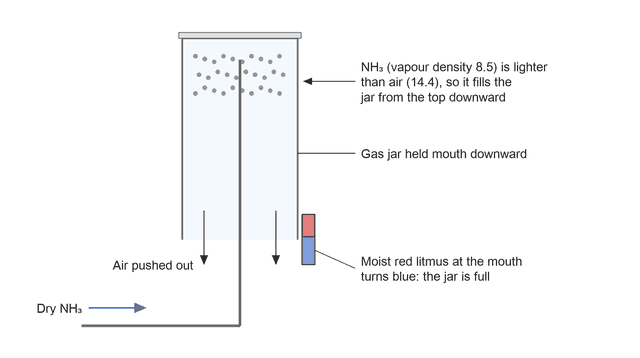
Step 2 — (b) Choose the product with excess chlorine.
Excess chlorine takes all the hydrogen of ammonia, forming nitrogen trichloride:
With excess ammonia the products would instead be ammonium chloride and nitrogen.
Watch out: 'downward displacement of water' is a different method (collection over water); ammonia would dissolve.
Therefore, (a) downward displacement of air and (b) nitrogen trichloride fill the blanks.
- 305 marks
Question 30
Complete the blanks (i) to (v) in the passage given, using the following words. [Ammonium, reddish brown, hydroxyl, nitrogen dioxide, ammonia, dirty green, alkaline, acidic]. In the presence of a catalyst nitrogen and hydrogen combine to give (i) .............. gas. When the same gas is passed through water it forms a solution, which will be (ii) .............. in nature, and will contain the ions (iii) .............. and (iv) .............. A (v) .............. coloured precipitate of iron [II] hydroxide is formed when the above solution is added to iron [II] sulphate solution.
Solve with AIWritten solution
Solution:
Concept: Nitrogen and hydrogen combine over an iron catalyst to give ammonia. Ammonia dissolves in water to form ammonium hydroxide, which ionises into ammonium and hydroxyl ions; the hydroxyl ions make the solution alkaline.
Step 1 — Blank (i).
Nitrogen and hydrogen combine in the presence of a catalyst to give ammonia gas:
Step 2 — Blanks (ii), (iii) and (iv).
In water, ammonia forms ammonium hydroxide, which ionises partly:
So the solution is alkaline, and it contains ammonium ions and hydroxyl ions.
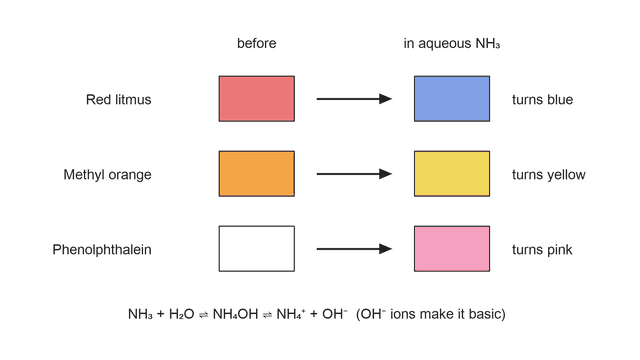
Step 3 — Blank (v).
The hydroxyl ions precipitate iron (II) hydroxide from iron (II) sulphate. Iron (II) hydroxide is dirty green:
Watch out: Reddish brown is the colour of iron (III) hydroxide; iron (II) hydroxide is dirty green.
Therefore, the blanks are (i) ammonia, (ii) alkaline, (iii) ammonium, (iv) hydroxyl and (v) dirty green.
- 312 marks
Question 31
Name the gas evolved when the following mixtures are heated.
(a) calcium hydroxide and ammonium chloride.
(b) Sodium nitrite and ammonium chloride.
Solve with AIWritten solution
Solution:
Concept: An ammonium salt heated with an alkali gives ammonia. Sodium nitrite with ammonium chloride first forms ammonium nitrite, which decomposes into nitrogen and water.
Step 1 — (a) Heat calcium hydroxide with ammonium chloride.
Calcium hydroxide is an alkali, so ammonia is evolved:
Step 2 — (b) Mix sodium nitrite with ammonium chloride.
The two salts exchange ions (double decomposition), forming ammonium nitrite in the solution:
Step 3 — (b) Heat the ammonium nitrite.
Ammonium nitrite decomposes, giving nitrogen:
This is why sodium nitrite is never used with ammonium salts to prepare ammonia.
Watch out: Both mixtures contain ammonium chloride, but only the one with an alkali gives ammonia.
Therefore, (a) gives ammonia and (b) gives nitrogen.
- 324 marks
Question 32
Name a compound prepared by ammonia and is used as :
(a) Explosive, (b) Fertilizers,
(c) Medicine, (d) Laboratory reagent.
Solve with AIWritten solution
Solution:
Concept: Ammonia is a base, so acids neutralise it to give ammonium salts. These salts (and urea, made from ammonia and carbon dioxide) have many uses.
Step 1 — (a) Explosive.
Ammonium nitrate is made from ammonia and nitric acid. It decomposes violently and is used in explosives:
Step 2 — (b) Fertiliser.
Ammonium sulphate is made from ammonia and sulphuric acid (urea, ammonium nitrate and diammonium hydrogen phosphate are other examples):
Step 3 — (c) Medicine.
Ammonium carbonate is used as smelling salts to revive a person who has fainted.
Step 4 — (d) Laboratory reagent.
Ammonium hydroxide (aqueous ammonia) is used in qualitative analysis, because it gives characteristic coloured precipitates of metal hydroxides:
Therefore, the compounds are (a) ammonium nitrate, (b) ammonium sulphate, (c) ammonium carbonate and (d) ammonium hydroxide.
- 331 mark
Question 33
From the list of gases — ammonia, ethane, hydrogen chloride, hydrogen sulphide, select the gas which is used as a reducing agent in reducing copper oxide to copper.
Solve with AIWritten solution
Solution:
Concept: A reducing agent removes oxygen from a metal oxide. Of the four gases, ammonia is the one that reduces heated copper (II) oxide to copper.
Step 1 — Pick the reducing gas.
Ammonia reduces hot copper (II) oxide and is itself oxidised to nitrogen:
Step 2 — Check by observation.
The black copper (II) oxide turns reddish brown (copper), and the water formed turns anhydrous copper sulphate blue. The nitrogen is collected over water.
Therefore, the gas used to reduce copper oxide to copper is ammonia.
- 344 marks
Question 34
Pick the odd member from the list giving reasons:
(a) Ammonia, sulphur dioxide, hydrogen chloride, carbon dioxide.
(b) Copper oxide, aluminium oxide, sodium oxide, magnesium oxide.
Solve with AIWritten solution
Solution:
Concept: To find the odd member, compare the chemical nature of all four (acidic or basic, how each reacts) and pick the one that differs from the other three.
Step 1 — (a) Compare the gases.
Sulphur dioxide, hydrogen chloride and carbon dioxide are acidic gases; their solutions turn blue litmus red. Ammonia is a basic gas; its solution turns red litmus blue:
So the odd member is ammonia.
Step 2 — (b) Compare the oxides.
Copper (II) oxide is the only one reduced by ammonia (to reddish brown copper). The oxides of aluminium, sodium and magnesium, all reactive metals, are not reduced by ammonia:
So the odd member is copper oxide.
Step 3 — (b) Note another valid answer.
Grouped by acid–base nature instead, aluminium oxide is the odd member: it is the only amphoteric oxide, while the other three are basic oxides.
Watch out: Give the reason with the odd member; the mark is for the reason.
Therefore, the odd members are (a) ammonia, the only basic gas, and (b) copper oxide, the only oxide reduced by ammonia (or aluminium oxide, the only amphoteric oxide).
- 352 marks
Question 35
A gas 'P' gives dense white fumes with chlorine. Its aqueous solution gives a blue colour with copper (II) hydroxide. Give the name and formula of the gas P.
Solve with AIWritten solution
Solution:
Concept: Two tests point to the same gas: dense white fumes with chlorine (ammonium chloride) and a deep blue solution with copper (II) hydroxide (the tetrammine copper (II) ion). Only ammonia gives both.
Step 1 — Use the test with chlorine.
Ammonia in excess reduces chlorine; the hydrogen chloride formed combines with more ammonia, giving dense white fumes of ammonium chloride:
Step 2 — Use the test with copper (II) hydroxide.
Aqueous ammonia dissolves pale blue copper (II) hydroxide, forming the soluble, deep (azure) blue tetrammine copper (II) ion, :
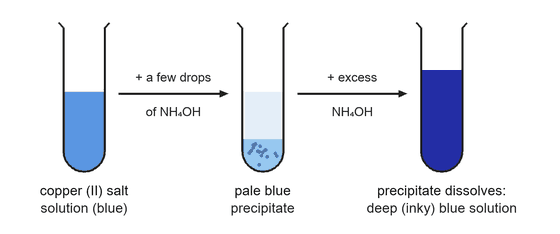
Step 3 — Name the gas.
Both tests point to ammonia, formula .
Therefore, the gas P is ammonia, NH₃.
- 365 marks
Question 36
Copy and complete the following equations.
(a) (b)
(c) (d)
(i) Which property of ammonia is illustrated by equation (c) ?
(ii) What important fertiliser is prepared from equation (d) ? State the conditions.
Solve with AIWritten solution
Solution:
Concept: Complete each equation from the known reaction, then balance it by counting every kind of atom on both sides.
Step 1 — (a) Aluminium nitride with water.
The nitride is hydrolysed to aluminium hydroxide and ammonia:
Step 2 — (b) Ammonia with lead monoxide.
Ammonia reduces heated yellow lead monoxide to greyish lead:
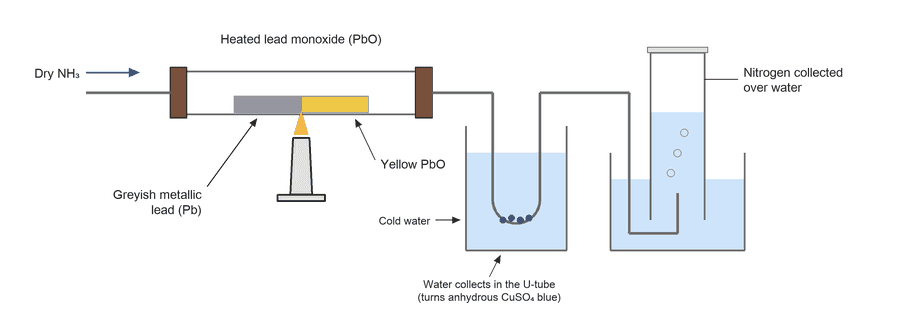
Step 3 — (c) Ammonia with chlorine.
Chlorine (3 molecules to 1 of ammonia, an excess) removes all the hydrogen of ammonia:
Step 4 — (d) Ammonia with carbon dioxide.
Ammonia and carbon dioxide combine under heat and pressure to give urea and water:
Step 5 — (i) Name the property shown by (c).
In (c), chlorine takes the hydrogen away from ammonia, so ammonia is oxidised and chlorine is reduced to hydrogen chloride. This shows that ammonia is a reducing agent.
Step 6 — (ii) Name the fertiliser from (d).
The fertiliser is urea, , made at about 150 °C and 150 atm pressure.
Watch out: Check that 3Cl₂ means chlorine is in excess; that is why the product is NCl₃, not NH₄Cl.
Therefore, the equations are completed as above; (c) shows that ammonia is a reducing agent, and (d) gives urea at about 150 °C and 150 atm.
- 374 marks
Question 37
(a) What do you observe when ammonium hydroxide is added to the aqueous solution of :
(i) FeSO, (ii) Iron (III) chloride,
(iii) Lead nitrate, (iv) Zinc nitrate ?
(b) Write balanced equation for Q. 8(a).
Solve with AIWritten solution
Solution:
Concept: Ammonium hydroxide () gives hydroxyl ions, which precipitate the metal hydroxide from a salt solution. The colour of the precipitate, and whether it dissolves in excess, tell us which metal ion is present. Of these four, only zinc hydroxide dissolves in excess ammonium hydroxide. Part (b) asks for the equations of part (a).
Step 1 — (a)(i) Iron (II) sulphate.
A dirty green precipitate of iron (II) hydroxide forms; it is insoluble in excess:
Step 2 — (a)(ii) Iron (III) chloride.
A reddish brown precipitate of iron (III) hydroxide forms; it is insoluble in excess:
Step 3 — (a)(iii) Lead nitrate.
A chalky white precipitate of lead hydroxide forms; it is insoluble in excess:
Step 4 — (a)(iv) Zinc nitrate.
A white gelatinous precipitate of zinc hydroxide forms:
It dissolves in excess, giving a colourless solution of tetrammine zinc (II) nitrate:

Step 5 — (b) Collect the equations.
The balanced equations are the ones written under each part above.
Watch out: Lead hydroxide dissolves in excess sodium hydroxide, but NOT in excess ammonium hydroxide.
Therefore, the observations are dirty green, reddish brown and chalky white precipitates (insoluble in excess) and a white precipitate that dissolves in excess for zinc nitrate.
- 382 marks
Question 38
When ammonium hydroxide is added to solution B, a pale blue precipitate is formed. This pale blue precipitate dissolves in excess ammonium hydroxide giving an inky blue solution. What is the cation [positive ion] present in solution B? What is the probable colour of solution B.
Solve with AIWritten solution
Solution:
Concept: A pale blue precipitate that dissolves in excess ammonium hydroxide to an inky (deep) blue solution is the test for the copper (II) ion. No other common cation behaves like this.
Step 1 — Add a little ammonium hydroxide.
The pale blue precipitate is copper (II) hydroxide:
Step 2 — Add excess ammonium hydroxide.
The precipitate dissolves, forming soluble tetrammine copper (II) sulphate, which is inky blue:
Step 3 — Name the cation and the colour.
So solution B contains the copper (II) ion, . Copper (II) salts such as copper sulphate give blue solutions.
Watch out: The original solution is blue; the inky (deep) blue colour appears only after excess ammonium hydroxide.
Therefore, the cation in B is Cu²⁺, and solution B is probably blue.
- 394 marks
Question 39
Write the equation for the action of heat on :
(a) Ammonium chloride, (b) Ammonium nitrate.
State whether each reaction is an example of thermal decomposition or thermal dissociation.
Solve with AIWritten solution
Solution:
Concept: In thermal dissociation, the products recombine on cooling to give back the original substance (reversible, ⇌). In thermal decomposition, the products do not recombine (irreversible, →).
Step 1 — (a) Heat ammonium chloride.
Ammonium chloride splits into ammonia and hydrogen chloride:
The gases join again on the cooler part of the tube to form white ammonium chloride, so this is thermal dissociation.
Step 2 — (b) Heat ammonium nitrate.
Ammonium nitrate breaks into nitrous oxide and steam:
These products do not recombine to form ammonium nitrate, so this is thermal decomposition.
Watch out: Write ⇌ for dissociation and → for decomposition; the arrow itself shows which one it is.
Therefore, (a) ammonium chloride undergoes thermal dissociation and (b) ammonium nitrate undergoes thermal decomposition.
- 402 marks
Question 40
Name two gases which can be used to study the fountain experiment. State the common property demonstrated by the fountain experiment.
Solve with AIWritten solution
Solution:
Concept: The fountain forms because the gas is so highly soluble that a few drops of water dissolve most of it. This leaves a partial vacuum in the flask, and the air pressure outside pushes the liquid up the jet tube.
Step 1 — Name two gases.
Ammonia and hydrogen chloride are both very highly soluble in water, so both give the fountain.
Step 2 — Start the fountain with ammonia.
A few drops of water are squeezed into the flask of dry ammonia. The ammonia dissolves and the pressure inside falls.
Step 3 — Explain the blue fountain.
The higher outside pressure forces red litmus solution up the jet tube. It comes out as a blue fountain, because ammonia solution is basic.
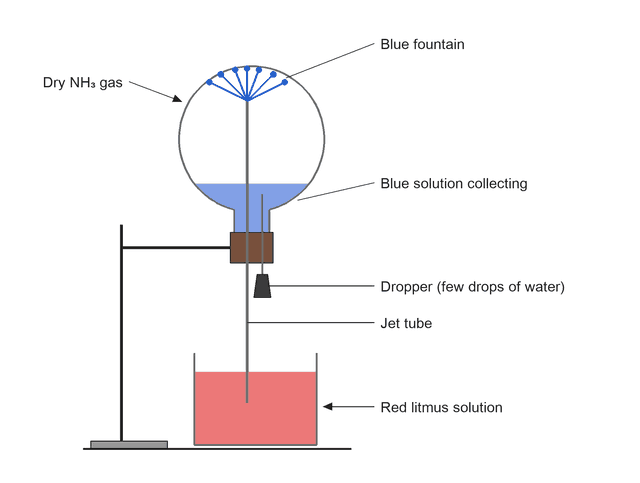
With hydrogen chloride, blue litmus solution is used and a red fountain is seen, because HCl is acidic.
Watch out: The fountain shows high solubility; the colour change shows the acidic or basic nature as an extra point.
Therefore, ammonia and hydrogen chloride can be used, and the common property shown is very high solubility in water.
- 412 marks
Question 41
Name the other ion formed when ammonia dissolves in water. Give one test that can be used to detect the presence of the ion produced.
Solve with AIWritten solution
Solution:
Concept: Ammonia takes a proton from water, so two ions form: the ammonium ion and the hydroxyl ion.
Step 1 — Name the other ion.
From the equation, the ion formed besides is the hydroxyl ion, :
Step 2 — Test with indicators.
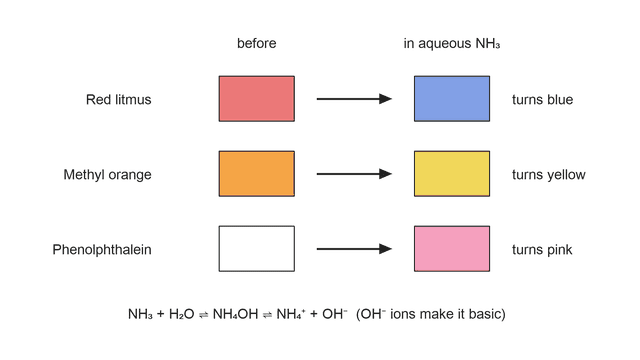
Add the solution to moist red litmus paper; it turns blue. (Methyl orange turns yellow and phenolphthalein turns pink.) These colours show an alkaline solution, that is, ions.
Step 3 — Another test.
Add a few drops of iron (II) sulphate solution; the ions give a dirty green precipitate of iron (II) hydroxide:
Therefore, the other ion is OH⁻, and it is detected because it turns moist red litmus blue.
- 422 marks
Question 42
State the conditions required for : Catalytic oxidation of ammonia to nitric oxide.
Solve with AIWritten solution
Solution:
Concept: The catalytic oxidation of ammonia is the first step of the Ostwald process for nitric acid.
Step 1 — State the conditions.
The reaction needs:
- a platinum catalyst (gauze);
- a temperature of about 800 °C;
- dry ammonia and dry oxygen (air); in industry, ammonia and air in the ratio 1 : 10 by volume.
Step 2 — Write the equation.
Under these conditions ammonia is oxidised to nitric oxide:
Step 3 — Note what is seen.
The reaction is exothermic, so the platinum keeps glowing even after the heating is stopped. The colourless nitric oxide meets oxygen and forms reddish brown nitrogen dioxide:
Watch out: Without a catalyst, ammonia burns in oxygen to give nitrogen, not nitric oxide.
Therefore, ammonia is oxidised to nitric oxide over platinum at about 800 °C, with ammonia and air in the ratio 1 : 10.
- 435 marks
Question 43
Give reasons for the following :
(a) Liquid ammonia is used as a refrigerant in ice plants.
(b) Aqueous solution of ammonia is used for removing grease stains from woollen clothes.
(c) Aqueous solution of ammonia gives a pungent smell.
(d) Aqueous solution of ammonia conducts electricity.
Solve with AIWritten solution
Solution:
Concept: Each use or observation comes from one property of ammonia: its high latent heat of vaporisation, its action on grease, its volatility and its ionisation in water.
Step 1 — (a) Refrigerant.
Liquid ammonia has a high latent heat of vaporisation (about 1.37 kJ for every gram that evaporates). As it evaporates, it absorbs a large amount of heat from its surroundings, which cool down. It is easily liquefied again by pressure, so it can be used over and over.
Step 2 — (b) Removing grease stains.
Aqueous ammonia emulsifies or dissolves fats and grease, so the grease can be washed away. Being a weak alkali, it does this without harming the wool.
Step 3 — (c) Pungent smell.
Ammonia is only loosely held in its aqueous solution and is very volatile, so ammonia gas escapes easily from the solution; the gas has a strong, pungent smell.
Step 4 — (d) Conducts electricity.
In water, ammonia forms ammonium hydroxide, which ionises partly. The free ions carry the current:
Dry ammonia gas and liquid ammonia contain only molecules, so they do not conduct.
Watch out: The cooling comes from evaporation (liquid to gas) taking heat in, not from the liquid being cold to start with.
Therefore, ammonia is a refrigerant (high latent heat), removes grease (emulsifies it), smells (escapes from solution) and conducts in solution (NH₄⁺ and OH⁻ ions).
- 445 marks
Question 44
Write balanced chemical equations for the following :
(a) Ammonium hydroxide is added to ferrous sulphate solution.
(b) Magnesium nitride is treated with warm water.
(c) Ammonium chloride is heated with sodium hydroxide.
(d) Chlorine reacts with excess of ammonia.
(e) Ammonia and oxygen in the presence of a catalyst.
(f) Reduction of hot copper (II) oxide to copper using ammonia gas.
(g) To illustrate the reducing nature of ammonia
(h) Lab. preparation of ammonia using an ammonium salt.
(i) Reaction of ammonia with excess of chlorine.
(j) Reaction of ammonia with sulphuric acid.
(k) When excess of ammonia is treated with chlorine.
Solve with AIWritten solution
Solution:
Concept: Write the correct reactants and products for each reaction, then balance it by counting every kind of atom on both sides. In the chlorine reactions, note which reactant is in excess: it changes the products.
Step 1 — (a) Ammonium hydroxide and ferrous sulphate.
A dirty green precipitate of iron (II) hydroxide forms:
Step 2 — (b) Magnesium nitride and warm water.
The nitride is hydrolysed, giving ammonia:
Step 3 — (c) Ammonium chloride heated with sodium hydroxide.
The alkali sets ammonia free:
Step 4 — (d) Chlorine with excess ammonia.
White fumes of ammonium chloride form and nitrogen is set free:
Step 5 — (e) Ammonia and oxygen over a catalyst.
Over platinum at about 800 °C, ammonia is oxidised to nitric oxide:
Step 6 — (f) Hot copper (II) oxide reduced by ammonia.
The black oxide turns reddish brown copper:
Step 7 — (g) The reducing nature of ammonia.
A second example: ammonia reduces heated yellow lead monoxide to greyish lead:
Step 8 — (h) Laboratory preparation from an ammonium salt.
Ammonium chloride is heated with slaked lime:
Step 9 — (i) Ammonia with excess chlorine.
Yellow, explosive nitrogen trichloride forms:
Step 10 — (j) Ammonia with sulphuric acid.
The base is neutralised, giving ammonium sulphate:
Step 11 — (k) Excess ammonia with chlorine.
This is the same reaction as (d):
Watch out: (d) and (k) have ammonia in excess (8NH₃ : 3Cl₂), while (i) has chlorine in excess (NH₃ : 3Cl₂).
Therefore, the eleven balanced equations are as written above.
- 454 marks
Question 45
Write a balanced equation for a reaction in which ammonia is oxidized by :
(a) a metal oxide,
(b) a gas which is not oxygen.
Solve with AIWritten solution
Solution:
Concept: When ammonia is oxidised, its hydrogen is removed and nitrogen is set free. Whatever removes the hydrogen (or gives oxygen to it) is the oxidising agent.
Step 1 — (a) Oxidise ammonia with a metal oxide.
Copper (II) oxide loses its oxygen (it is reduced to copper), and ammonia loses its hydrogen as water (it is oxidised to nitrogen):
Step 2 — (b) Oxidise ammonia with a gas other than oxygen.
Chlorine takes the hydrogen of ammonia, forming hydrogen chloride, which then combines with the excess ammonia:
Step 3 — Link the two reactions.
In both, ammonia acts as a reducing agent and is itself oxidised to nitrogen.
Therefore, ammonia is oxidised by copper (II) oxide and by chlorine, giving nitrogen each time.
- 462 marks
Question 46
Write a relevant equation to show that ammonia acts as a reducing agent.
Solve with AIWritten solution
Solution:
Concept: A reducing agent removes oxygen from another substance. Ammonia reduces hot copper (II) oxide to copper and is itself oxidised to nitrogen.
Step 1 — Write the equation.
Dry ammonia is passed over heated copper (II) oxide:
Step 2 — Check it by observation.
The black copper (II) oxide turns reddish brown (copper). The water formed collects in a U-tube and turns anhydrous copper sulphate blue, and nitrogen is collected over water.
Step 3 — Note a second example.
Ammonia reduces heated yellow lead monoxide to greyish lead in the same way.
Therefore, 2NH₃ + 3CuO → 3Cu + 3H₂O + N₂ shows that ammonia is a reducing agent.
- 472 marks
Question 47
Rewrite the correct statement with the missing word/s : Magnesium nitride reacts with water to liberate ammonia.
Solve with AIWritten solution
Solution:
Concept: A metal nitride reacts only slowly with cold water; warm water, added slowly, is used to liberate ammonia.
Step 1 — Find the missing word.
The statement leaves out the condition. The corrected statement is: Magnesium nitride reacts with warm water to liberate ammonia.
Step 2 — Write the equation.
Magnesium nitride is hydrolysed to magnesium hydroxide and ammonia:
Magnesium hydroxide stays in the flask, while ammonia escapes through the delivery tube.
Therefore, magnesium nitride reacts with warm water to liberate ammonia.
- 485 marks
Question 48
Distinguish between the following (using ammonia solution) :
(a) Calcium chloride and zinc chloride,
(b) Ferric salt and ferrous salt,
(c) Zinc nitrate and lead nitrate.
Solve with AIWritten solution
Solution:
Concept: Ammonium hydroxide gives hydroxyl ions, which precipitate the metal hydroxide from a salt solution. The colour of the precipitate, and whether it dissolves in excess, tell us which metal ion is present. Add ammonium hydroxide drop by drop, then in excess. It gives no precipitate with calcium salts, and its precipitate dissolves in excess only with zinc (and copper) salts.
Step 1 — (a) Calcium chloride and zinc chloride.
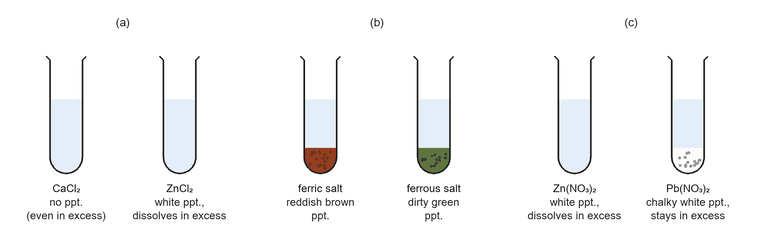
Calcium chloride gives no precipitate, even in excess. Zinc chloride gives a white gelatinous precipitate:
which dissolves in excess ammonium hydroxide:
Step 2 — (b) Ferric salt and ferrous salt.
A ferric salt gives a reddish brown precipitate of iron (III) hydroxide; a ferrous salt gives a dirty green precipitate of iron (II) hydroxide. Both stay in excess:
Step 3 — (c) Zinc nitrate and lead nitrate.
Zinc nitrate gives a white gelatinous precipitate that is soluble in excess (colourless solution). Lead nitrate gives a chalky white precipitate that is insoluble in excess:
Watch out: Calcium hydroxide is fairly soluble, and ammonium hydroxide is too weak an alkali to precipitate it, so there is no precipitate at all.
Therefore, ammonia solution tells the pairs apart: (a) no precipitate against a white one that dissolves; (b) reddish brown against dirty green; (c) white soluble in excess against chalky white insoluble.
- 495 marks
Question 49
Give balanced equations for the following conversions :
(a) Ammonia to nitrogen using an acidic gas,
(b) Ammonia to brown gas,
(c) Ammonia to nitrogen trichloride,
(d) Ammonia solution to an amphoteric hydroxide,
(e) A nitride of a trivalent metal to ammonia,
(f) Lead oxide to lead.
Solve with AIWritten solution
Solution:
Concept: For each conversion, choose a known reaction of ammonia (or of a nitride) that gives the named product, then balance it.
Step 1 — (a) Ammonia to nitrogen using an acidic gas.
Chlorine, whose solution is acidic, oxidises excess ammonia to nitrogen:
Step 2 — (b) Ammonia to a brown gas.
Catalytic oxidation gives nitric oxide, which air turns into brown nitrogen dioxide:
Step 3 — (c) Ammonia to nitrogen trichloride.
Excess chlorine removes all the hydrogen of ammonia:
Step 4 — (d) Ammonia solution to an amphoteric hydroxide.
Zinc hydroxide is amphoteric; ammonium hydroxide precipitates it from zinc sulphate:
Step 5 — (e) A nitride of a trivalent metal to ammonia.
Aluminium (valency 3) nitride is hydrolysed by water:
Step 6 — (f) Lead oxide to lead.
Ammonia reduces heated lead monoxide:
Watch out: Add only a little ammonium hydroxide in (d): in excess, zinc hydroxide dissolves again.
Therefore, the six conversions are made by the balanced equations above.
- 502 marks
Question 50
State two relevant observations for : Ammonium hydroxide solution is added to zinc nitrate solution slowly and then in excess.
Solve with AIWritten solution
Solution:
Concept: Zinc hydroxide is first precipitated by the hydroxyl ions; with excess ammonium hydroxide it forms a soluble ammine complex, so the precipitate disappears.
Step 1 — Observation 1: added slowly.
A white gelatinous precipitate of zinc hydroxide forms:
Step 2 — Observation 2: added in excess.
The precipitate dissolves, giving a clear, colourless solution of tetrammine zinc (II) nitrate:
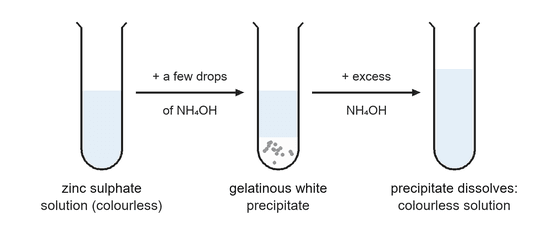
Therefore, a white gelatinous precipitate forms first, and it dissolves in excess to give a colourless solution.
- 512 marks
Question 51
Copy and complete the following table relating to important industrial process :
Name of the process Temperature Catalyst Equation for the catalyzed reaction Haber's process Solve with AIWritten solution
Solution:
Concept: The Haber process uses an iron catalyst at an optimum temperature of 450–500 °C: hot enough for a good rate, but not so hot that the exothermic reaction goes backwards.
Step 1 — Fill in the table.
The temperature, catalyst and equation are entered in the row for Haber's process:
Name of the process Temperature Catalyst Equation for the catalyzed reaction Haber's process 450–500 °C Finely divided iron (molybdenum promoter) N₂ + 3H₂ ⇌ 2NH₃ + heat Step 2 — Show the equation with its conditions.
Written in full, nitrogen and hydrogen combine reversibly over the iron catalyst:

Watch out: The catalyst is iron; molybdenum is only the promoter.
Therefore, Haber's process runs at 450–500 °C over finely divided iron, for N₂ + 3H₂ ⇌ 2NH₃ + heat.
- 524 marks
Question 52
Distinguish between the following pairs of compounds using the test given in bracket :
(a) Iron [II] sulphate and iron [III] sulphate (using ammonium hydroxide)
(b) A lead salt and a zinc salt (using excess ammonium hydroxide)
Solve with AIWritten solution
Solution:
Concept: Ammonium hydroxide gives hydroxyl ions, which precipitate the metal hydroxide from a salt solution. The colour of the precipitate, and whether it dissolves in excess, tell us which metal ion is present.
Step 1 — (a) Iron [II] sulphate and iron [III] sulphate.
Iron (II) sulphate gives a dirty green precipitate of iron (II) hydroxide; iron (III) sulphate gives a reddish brown precipitate of iron (III) hydroxide:
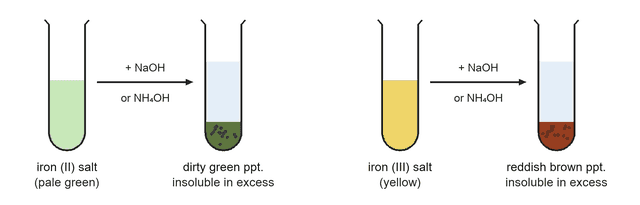
Step 2 — (b) A lead salt and a zinc salt.
Both give a white precipitate at first. With excess ammonium hydroxide, the lead salt's chalky white precipitate stays (insoluble), while the zinc salt's white gelatinous precipitate dissolves, giving a colourless solution.
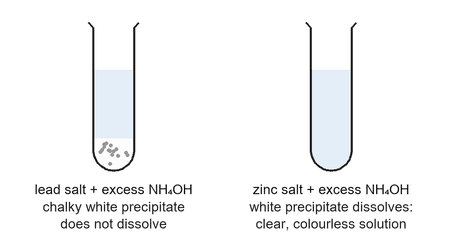
Watch out: In (b) the first drops look the same for both; only excess ammonium hydroxide tells them apart.
Therefore, (a) dirty green means iron (II), reddish brown means iron (III); (b) the precipitate stays with lead and dissolves with zinc.
- 535 marks
Question 53
State relevant observations for the following :
(a) Ammonia gas is passed over heated copper (II) oxide.
(b) In the absence of catalyst, ammonia is burnt in an atmosphere of oxygen.
(c) Ammonium hydroxide is first added in a small quantity and then in excess to a solution of copper sulphate.
(d) Water is added to the product formed, when Al is burnt in a jar of nitrogen gas.
(e) Excess of chlorine gas is reacted with ammonia gas.
(f) Calcium hydroxide is heated with ammonium chloride crystals.
Solve with AIWritten solution
Solution:
Concept: An observation is what you see, smell or detect: a colour change, a flame, fumes, a precipitate. Naming the product alone is not enough.
Step 1 — (a) Ammonia over heated copper (II) oxide.
The black copper (II) oxide turns reddish brown (copper); droplets of water collect, and a colourless gas (nitrogen) is given off:
Step 2 — (b) Ammonia burnt in oxygen without a catalyst.
Ammonia burns with a greenish yellow flame, giving nitrogen and water vapour:
Step 3 — (c) Ammonium hydroxide added to copper sulphate.
A pale blue precipitate forms first; in excess it dissolves, giving a deep (inky) blue solution.
Step 4 — (d) Water added to the product of aluminium and nitrogen.
Aluminium burns in nitrogen to form aluminium nitride:
With water, a pungent-smelling gas (ammonia) is given off, which turns moist red litmus blue:
Step 5 — (e) Excess chlorine with ammonia.
A yellow, oily, highly explosive liquid (nitrogen trichloride) forms, along with hydrogen chloride:
Step 6 — (f) Calcium hydroxide heated with ammonium chloride.
A colourless gas with a pungent smell (ammonia) is given off; it turns moist red litmus blue and gives dense white fumes with a rod dipped in conc. HCl.
Therefore, the observations are a black-to-reddish-brown change, a greenish yellow flame, a pale blue precipitate turning deep blue, a pungent gas, a yellow explosive oil and a pungent alkaline gas.
- 545 marks
Question 54
(a) Is ammonia more dense or less dense than air?
(b) What property of ammonia is demonstrated by the Fountain Experiment?
(c) Write the balanced equation for the reaction between ammonia and sulphuric acid.
Solve with AIWritten solution
Solution:
Concept: The vapour density (V.D.) of a gas tells how heavy it is compared with hydrogen: V.D. = relative molecular mass ÷ 2. Air behaves like a gas of V.D. about 14.4. A gas with V.D. below 14.4 is lighter than air; above 14.4, heavier.
Step 1 — (a) Find the vapour density of ammonia.
The relative molecular mass of is 14 + 3 × 1 = 17, so
This is less than 14.4, so ammonia is less dense than air. That is why it is collected in inverted jars.
Step 2 — (b) State what the fountain experiment shows.
It shows the high solubility of ammonia in water (about 702 volumes in 1 volume of water). The blue fountain from red litmus solution also shows that the solution is basic.
Step 3 — (c) React ammonia with sulphuric acid.
Ammonia, a base, is neutralised by sulphuric acid, forming ammonium sulphate:
Watch out: Compare vapour densities, not the atomic mass of nitrogen; ammonia (8.5) and air (14.4).
Therefore, ammonia is less dense than air, the fountain shows its high solubility, and 2NH₃ + H₂SO₄ → (NH₄)₂SO₄.
- 553 marks
Question 55
Ammonia solution in water gives a blue precipitate when it combines with a solution of copper salt. The blue precipitate further dissolves in excess of ammonia solution to give an azure blue solution. Explain with equation.
Solve with AIWritten solution
Solution:
Concept: Ammonia solution supplies hydroxyl ions, which first precipitate copper (II) hydroxide. Excess ammonia then joins the copper ion to form a soluble deep blue complex, so the precipitate dissolves.
Step 1 — Add a little ammonia solution.
Pale blue copper (II) hydroxide is precipitated:
Step 2 — Add excess ammonia solution.
The precipitate dissolves, forming soluble tetrammine copper (II) sulphate, which is azure (deep) blue:
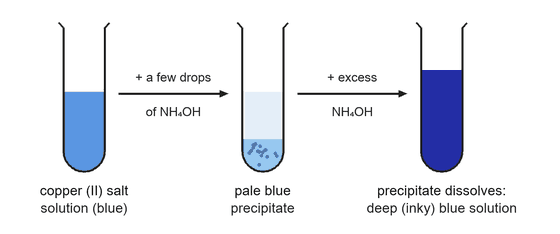
Step 3 — Explain the colour.
The deep blue colour is due to the ion. This change is used to identify copper (II) ions.
Watch out: The precipitate is pale blue; the azure (deep) blue colour belongs to the solution formed in excess.
Therefore, copper (II) hydroxide is precipitated first and then dissolves in excess ammonia as the deep blue [Cu(NH₃)₄]²⁺ ion.
- 563 marks
Question 56
Give chemical equation(s) to prove that NH contains nitrogen and hydrogen.
Solve with AIWritten solution
Solution:
Concept: To show what ammonia contains, break it up so that its nitrogen appears as nitrogen gas and its hydrogen appears as water, then identify each product.
Step 1 — Pass dry ammonia over heated copper (II) oxide.
Ammonia reduces the oxide:
Step 2 — Identify the hydrogen.
The water formed collects in a U-tube and turns anhydrous copper sulphate blue. Its hydrogen can only have come from ammonia, so ammonia contains hydrogen.
Step 3 — Identify the nitrogen.
The colourless, neutral gas left over is collected over water; it is nitrogen. So ammonia contains nitrogen.
Step 4 — Support it with burning.
Ammonia burns in oxygen with a greenish yellow flame, again giving nitrogen and water:
Therefore, these reactions show that ammonia contains nitrogen and hydrogen; it is a hydride of nitrogen.
- 573 marks
Question 57
When an ammonium salt is warmed with sodium hydroxide solution, a gas is evolved. State three ways in which you could identify this gas.
Solve with AIWritten solution
Solution:
Concept: Any ammonium salt warmed with an alkali gives ammonia. The gas is identified by its smell and by its basic nature.
Step 1 — Name the gas.
Sodium hydroxide sets ammonia free from the ammonium salt:
Step 2 — Test 1: smell.
It has a sharp, characteristic pungent smell.
Step 3 — Test 2: litmus.
It turns moist red litmus paper blue (and moist turmeric paper brown).
Step 4 — Test 3: hydrochloric acid.
A glass rod dipped in conc. hydrochloric acid gives dense white fumes of ammonium chloride:
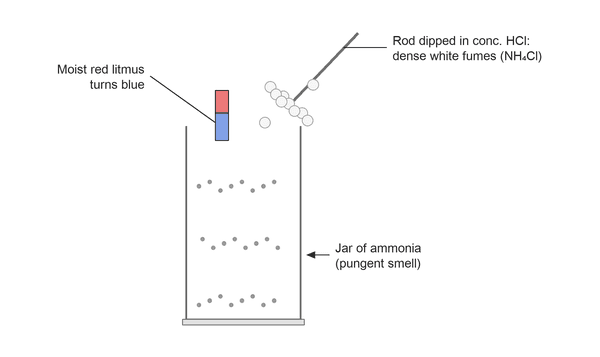
It also turns copper sulphate solution deep blue.
Watch out: Smell gases by wafting them towards the nose, never by sniffing directly from the jar.
Therefore, the gas is ammonia, identified by its pungent smell, by turning moist red litmus blue, and by dense white fumes with conc. HCl.
- 583 marks
Question 58
A gas 'A' reacts with another gas 'B' in the presence of a catalyst to give a colourless gas 'C'. The gas 'C' when comes in contact with air produces a brown gas 'D'. The solution of 'A' in water turns red litmus blue. Explain the observations.
Solve with AIWritten solution
Solution:
Concept: A basic gas oxidised over a catalyst to a colourless gas that turns brown in air is the catalytic oxidation of ammonia (Ostwald process).
Step 1 — Identify gas A.
The solution of A turns red litmus blue, so A is a basic gas: A = ammonia. Its solution contains hydroxyl ions:
Step 2 — Identify gases B and C.
B = oxygen. Over platinum at about 800 °C, ammonia is oxidised to C = nitric oxide (NO), a colourless gas:
Step 3 — Identify gas D.
Nitric oxide combines with the oxygen of the air to form D = nitrogen dioxide, a reddish brown gas:
Watch out: Nitric oxide (NO) is colourless; only nitrogen dioxide (NO₂) is brown.
Therefore, A is ammonia, B is oxygen, C is nitric oxide and D is nitrogen dioxide.
- 595 marks
Question 59
(a) Name the common refrigerant. How does it deplete ozone layer ?
(b) What is the alternative of chlorofluorocarbons ?
(c) State the advantages and disadvantages of using ammonia as refrigerant?
Solve with AIWritten solution
Solution:
Concept: CFCs break up in the upper atmosphere and release chlorine atoms (free radicals). Each chlorine atom destroys ozone and is then set free again, so one atom destroys many ozone molecules. Ammonia does not do this.
Step 1 — (a) Name the common refrigerant.
The common refrigerants are chlorofluorocarbons (CFCs), for example freon, .
Step 2 — (a) Release of chlorine.
Ultraviolet rays break the CFC molecule and set free a chlorine atom:
Step 3 — (a) Attack on ozone.
The chlorine atom reacts with ozone, forming chlorine monoxide:
Step 4 — (a) Chlorine set free again.
Chlorine monoxide reacts with an oxygen atom and gives back the chlorine atom, which attacks more ozone:
This chain continues, so the ozone layer is depleted. (CFCs also add to global warming.)
Step 5 — (b) Name the alternative.
Liquid ammonia is the alternative; it does not deplete the ozone layer.
Step 6 — (c) Advantages of ammonia.
Ammonia as a refrigerant:
- is environmentally friendly: it neither depletes the ozone layer nor adds to global warming;
- has a high latent heat of vaporisation, so ammonia systems need less electricity;
- has a recognisable smell, so leaks are noticed quickly.
Step 7 — (c) Disadvantages of ammonia.
But ammonia:
- is not compatible with copper, so it cannot be used with copper pipes;
- is poisonous in high concentration.
Watch out: The chlorine atom is not used up; that is why a small amount of CFC destroys a large amount of ozone.
Therefore, CFCs deplete ozone through chlorine atoms; liquid ammonia is the alternative, efficient and ozone-safe but poisonous and unsuitable with copper.
- 605 marks
Question 60
(a) Which feature of ammonia molecule leads to the formation of the ammonium ion when ammonia dissolves in water ?
(b) Name the other ion formed when ammonia dissolves in water.
(c) Give one test that can be used to detect the presence of the ion produced in (b).
Solve with AIWritten solution
Solution:
Concept: The nitrogen atom in ammonia has a lone pair of electrons. It donates this pair to a hydrogen ion taken from water, forming a coordinate bond.
Step 1 — (a) Name the feature.
The lone pair of electrons on the nitrogen atom is donated to an ion from water, giving the ammonium ion:
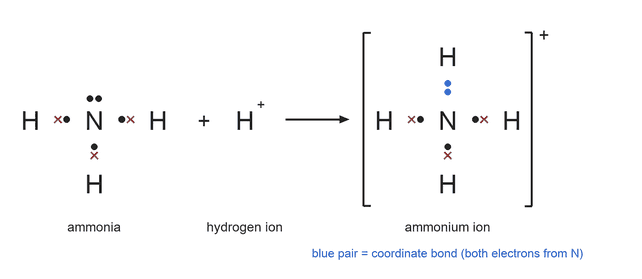
Step 2 — (b) Name the other ion.
When water loses , the hydroxyl ion, , is left behind.
Step 3 — (c) Test for the hydroxyl ion.
The solution turns moist red litmus paper blue (phenolphthalein turns pink). Or add iron (II) sulphate solution: a dirty green precipitate of iron (II) hydroxide forms:
Therefore, (a) the lone pair on nitrogen forms NH₄⁺, (b) the other ion is OH⁻, and (c) it turns moist red litmus blue.
- 615 marks
Question 61
(a) Of the two gases, ammonia and hydrogen chloride, which is more dense ? Name the method of collection of this gas.
(b) Give one example of a reaction between the above two gases which produces a solid compound.
Solve with AIWritten solution
Solution:
Concept: The vapour density (V.D.) of a gas tells how heavy it is compared with hydrogen: V.D. = relative molecular mass ÷ 2. Air behaves like a gas of V.D. about 14.4. A gas with V.D. below 14.4 is lighter than air; above 14.4, heavier. A gas heavier than air is collected in an upright jar (upward displacement of air).
Step 1 — (a) Find both vapour densities.
The relative molecular masses are 17 for ammonia and 1 + 35.5 = 36.5 for hydrogen chloride, so
Step 2 — (a) Compare and choose the method.
18.25 > 8.5, so hydrogen chloride is more dense. It is also heavier than air (14.4), so it is collected by upward displacement of air in upright gas jars.
Step 3 — (b) React the two gases.
The two colourless gases combine directly to form solid ammonium chloride, seen as dense white fumes:
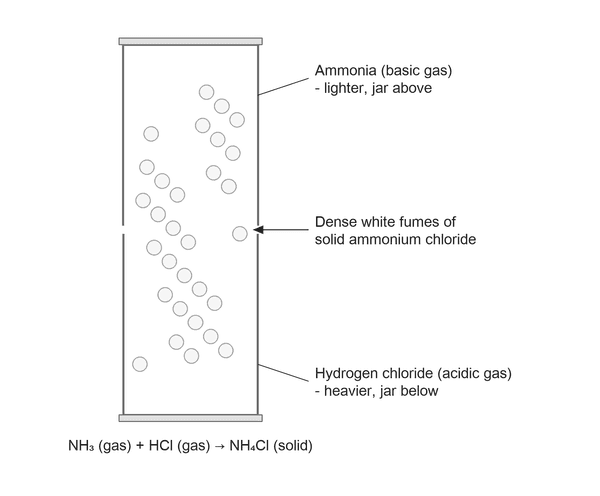
Watch out: Upward displacement of air is for heavy gases (jar upright); downward displacement of air is for light gases (jar inverted).
Therefore, hydrogen chloride is more dense and is collected by upward displacement of air, and NH₃ + HCl → NH₄Cl gives a solid.
- 623 marks
Question 62
Study the flow chart given and give balanced equations to represent the reactions A, B and C.
Solve with AIWritten solution
Solution:
Concept: A makes ammonia from a nitride (with warm water); B turns ammonia into its salt (with hydrogen chloride); C gets ammonia back from the salt (heating with an alkali).
Step 1 — Reaction A.
Magnesium nitride is hydrolysed by warm water:
Step 2 — Reaction B.
Ammonia combines with hydrogen chloride:
Step 3 — Reaction C.
Ammonium chloride is heated with an alkali such as slaked lime (or sodium hydroxide):

Watch out: Heating ammonium chloride ALONE only dissociates it (the gases recombine); C needs an alkali.
Therefore, A, B and C are represented by the three balanced equations above.
- 635 marks
Question 63
With respect to the manutacture of ammonia, answer the following :
(a) Name the process involved.
(b) State the ratio of the reactants taken.
(c) State the catalyst used.
(d) Give the equation for the manufacture of the gas – ammonia.
Solve with AIWritten solution
Solution:
Concept: Ammonia is manufactured by the Haber process: nitrogen and hydrogen combine reversibly over an iron catalyst. The reaction is exothermic and turns 4 volumes of gas into 2.
Step 1 — (a) Name the process.
The process is Haber's process.
Step 2 — (b) State the ratio.
From the coefficients 1 and 3 in the equation, nitrogen : hydrogen = 1 : 3 by volume.
Step 3 — (c) Name the catalyst.
The catalyst is finely divided iron, with molybdenum (or aluminium oxide) as promoter.
Step 4 — (d) Write the equation.
Under the conditions of the process:
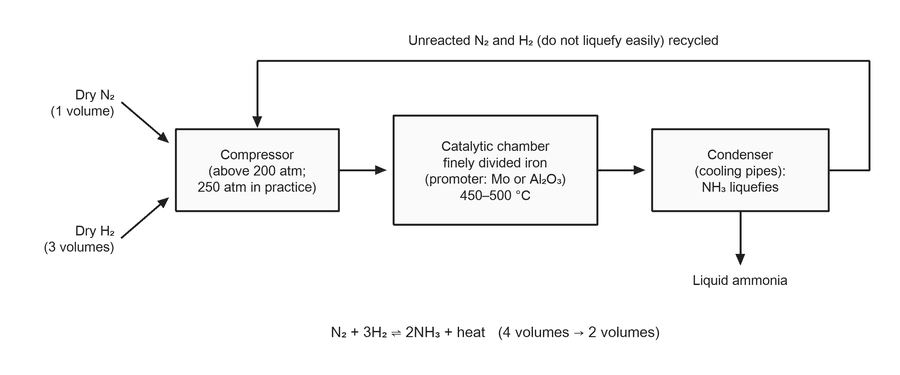
Therefore, ammonia is made by Haber's process from N₂ and H₂ (1 : 3) over finely divided iron.
- 645 marks
Question 64
The following questions are based on the preparation of ammonia gas in the laboratory :
(a) Explain why ammonium nitrate is not used in the preparation of ammonia.
(b) Name the compound normally used as a drying agent during the process.
(c) How is ammonia gas collected. Explain why it is not collected over water.
Solve with AIWritten solution
Solution:
Concept: Ammonia is light (V.D. 8.5), very soluble in water and basic; these decide how it is collected and dried. Ammonium nitrate is avoided because it is explosive.
Step 1 — (a) Explain why ammonium nitrate is not used.
Ammonium nitrate is explosive on heating; instead of giving ammonia, it decomposes into nitrous oxide and water:
Step 2 — (b) Name the drying agent.
Quicklime (calcium oxide, CaO) is used. It is basic, so it absorbs the moisture without reacting with ammonia.
Step 3 — (c) Collect the gas.
Ammonia is collected by downward displacement of air in inverted gas jars, since it is lighter than air (V.D. 8.5 against 14.4).
Step 4 — (c) Explain why not over water.
Ammonia is highly soluble in water (about 702 volumes in 1 volume of water), so it would dissolve instead of collecting.
Therefore, ammonium nitrate is explosive, quicklime dries the gas, and ammonia is collected by downward displacement of air because it is too soluble to collect over water.
- 655 marks
Question 65
The diagram below shows the set up for the laboratory preparation of a pungent alkaline gas.
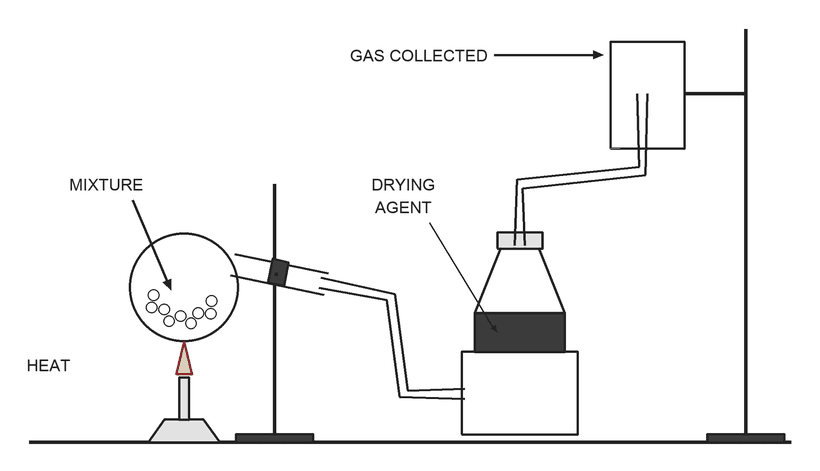
(a) Name the gas collected in the jar.
(b) Give a balanced equation for the above preparation.
(c) State how the above gas is collected.
(d) Name the drying agent used.
(e) State how you will find out that the jar is full of the pungent gas.
Solve with AIWritten solution
Solution:
Concept: A pungent, alkaline gas prepared by heating a mixture in the laboratory is ammonia, made from ammonium chloride and slaked lime.
Step 1 — (a) Name the gas.
The gas is ammonia.
Step 2 — (b) Write the equation.
Ammonium chloride is heated with calcium hydroxide:
Step 3 — (c) State how it is collected.
By downward displacement of air (upward delivery into an inverted gas jar), since ammonia is lighter than air.
Step 4 — (d) Name the drying agent.
Quicklime (CaO).
Step 5 — (e) Check that the jar is full.
Hold moist red litmus paper at the mouth of the jar. When the jar is full, ammonia escapes and the paper turns blue. (A glass rod dipped in conc. HCl also gives dense white fumes at the mouth.)
Therefore, the gas is ammonia, prepared from NH₄Cl and Ca(OH)₂, dried by quicklime, collected by downward displacement of air, and the jar is full when moist red litmus at its mouth turns blue.
- 665 marks
Question 66
Answer the following questions with respect to the given figure.
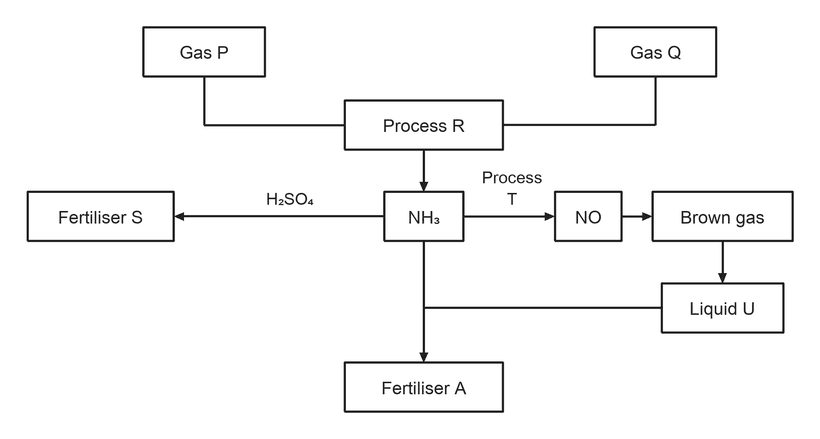
(a) Identify gas P and gas Q.
(b) Give a balanced equation to convert ammonia into gas P by a method other than decomposition. State the property of ammonia used in carrying out the conversion.
(c) Name fertiliser S and give a balanced equation for its preparation.
(d) Name process T and state the conditions that enable conversion of ammonia to nitric oxide.
(e) Give a balanced equation for the conversion of brown gas to liquid U.
(f) Name fertiliser A.
(g) Name process R.
Solve with AIWritten solution
Solution:
Concept: Gases P and Q combine in process R (Haber) to give ammonia. Ammonia is then used in two ways: with sulphuric acid to make fertiliser S, and by process T (Ostwald) to make nitric acid (liquid U), which with more ammonia gives fertiliser A.
Step 1 — (a) Identify P and Q.
Ammonia is made from P = nitrogen and Q = hydrogen.
Step 2 — (b) Convert ammonia into P without decomposition.
Pass ammonia over heated copper (II) oxide:
The property used is that ammonia is a reducing agent (it is oxidised to nitrogen).
Step 3 — (c) Name fertiliser S.
S = ammonium sulphate:
Step 4 — (d) Name process T and its conditions.
T = Ostwald process (catalytic oxidation of ammonia), over a platinum catalyst at about 800 °C, with ammonia and air in the ratio 1 : 10 by volume:
Step 5 — (e) Convert the brown gas into liquid U.
Nitric oxide first forms the brown gas:
The brown gas is absorbed in water in the presence of oxygen, giving nitric acid (liquid U):
Step 6 — (f) Name fertiliser A.
A = ammonium nitrate:
Step 7 — (g) Name process R.
R = Haber's process.
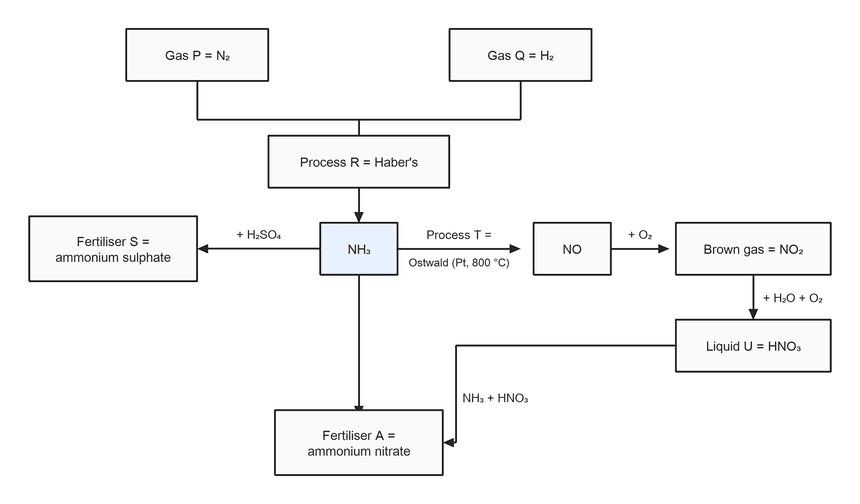
Therefore, P is nitrogen, Q is hydrogen, R is Haber's process, S is ammonium sulphate, T is the Ostwald process, U is nitric acid and A is ammonium nitrate.
- 675 marks
Question 67
The diagram given below describes the manufacturing process of a gas.
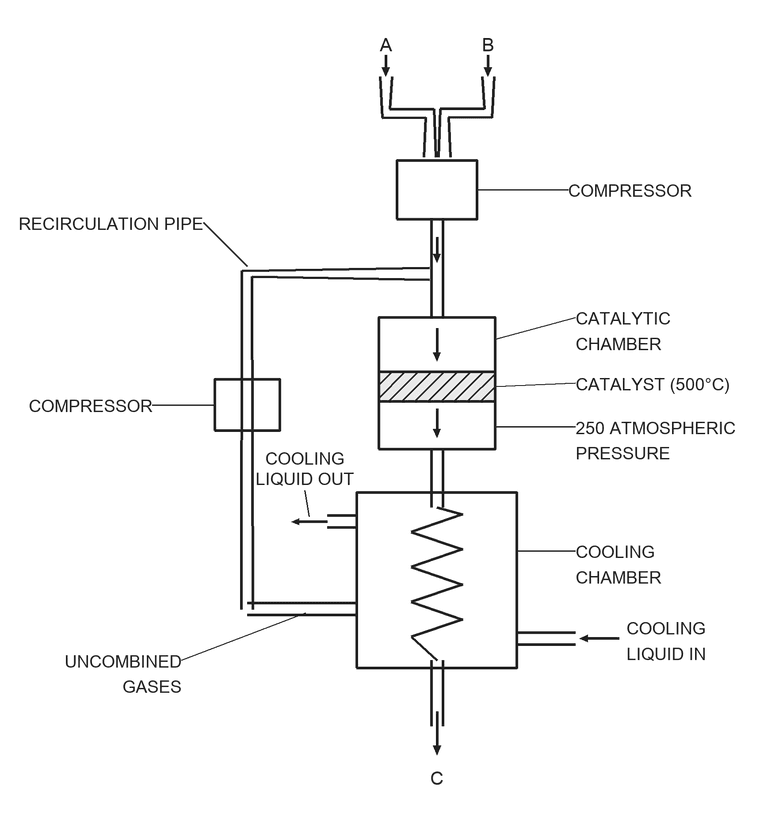
(a) Name the process.
(b) Identify A, B and C.
(c) State the ratio of A and B.
(d) Write the equation involved with their respective conditions.
(e) How is the product separated from unreacted reactants?
Solve with AIWritten solution
Solution:
Concept: Two gases combined over a catalyst at about 500 °C and high pressure, with the product liquefied in a cooling chamber and the uncombined gases recirculated, is the Haber process for ammonia.
Step 1 — (a) Name the process.
The process is Haber's process.
Step 2 — (b) Identify A, B and C.
A = nitrogen and B = hydrogen enter the compressor; C = (liquid) ammonia leaves the cooling chamber.
Step 3 — (c) State the ratio.
A is nitrogen and B is hydrogen, so the ratio A : B is 1 : 3 by volume.
Step 4 — (d) Write the equation and conditions.
Temperature 450–500 °C, pressure above 200 atm (250 atm in the diagram), catalyst finely divided iron with molybdenum as promoter:
Step 5 — (e) Separate the product.
The hot gas (about 15% ammonia) is cooled. Ammonia liquefies easily and is drawn off; the unreacted nitrogen and hydrogen do not liquefy and are recirculated to the catalytic chamber through the compressor.
Therefore, the process is Haber's, A is nitrogen, B is hydrogen, C is ammonia (1 : 3), and ammonia is separated by liquefaction while unreacted gases are recycled.
What Class 10 Chemistry Ch 9 covers
The sections of the chapter, in the order the book takes them. Every question above comes from one of these.
- 01Occurrence
- 02Preparation of Ammonia Gas
- 03Preparation of Aqueous Ammonia
- 04Manufacture of Ammonia (Haber's Process)
- 05Physical Properties of Ammonia
- 06Chemical Properties of Ammonia
More ways to study this chapter
The same chapter asked three other ways. Practise it, revise it, and see what the board has set on Ch 9 before.
- Competency-Based Questions (CBQ)Case study questions: a situation, and the part of the chapter that answers it.40questionsOpen
- Previous Year QuestionsQuestions that have actually appeared in board papers, each tagged with its year.46questionsOpen
- Practice QuestionsExtra questions per chapter, for when one attempt at a method is not enough.43questionsOpen
Ch 9 in past ICSE papers
The same chapter as the board has actually asked it. These are worded differently from the textbook exercise, which is the point of reading them.
- 11 mark
Board paper question 1
Write balanced chemical equations for each of the following:
Action of warm water on AlN.
Solve with AIWritten solution
Solution:
Concept: A metal nitride reacts with warm water to give ammonia and the metal hydroxide. The nitride ion takes hydrogen from water and becomes ammonia, while the metal ends up as its hydroxide.
Step 1 — Write the formulae.
Aluminium nitride is AlN (Al³⁺ and N³⁻), and water is H₂O. The products are aluminium hydroxide, Al(OH)₃, and ammonia, NH₃.
Step 2 — Balance the equation.
One AlN gives one NH₃ and one Al(OH)₃. The Al(OH)₃ needs three O atoms, so three water molecules are needed. Check: Al 1 = 1, N 1 = 1, H 6 = 3 + 3, O 3 = 3.
Step 3 — Say what happens in the flask.
Aluminium hydroxide stays behind in the flask while the ammonia gas escapes through the delivery tube.
Watch out: The nitride needs WARM water; write Al(OH)₃, not Al₂O₃, as the product.
Therefore, AlN + 3H₂O → Al(OH)₃ + NH₃↑.
- 22 marks
Board paper question 2
Name the gas evolved when the following mixtures are heated:
(i) Calcium hydroxide and Ammonium Chloride
(ii) Sodium Nitrite and Ammonium Chloride
Solve with AIWritten solution
Solution:
Concept: An ammonium salt heated with an alkali gives ammonia. But ammonium nitrite is unstable: on heating it breaks up into nitrogen and water, so a mixture that forms ammonium nitrite gives nitrogen, not ammonia.
Step 1 — (i) Calcium hydroxide and ammonium chloride.
This is an ammonium salt with an alkali, which is the laboratory preparation of ammonia, so the gas evolved is ammonia.
Step 2 — (ii) Sodium nitrite and ammonium chloride: the salts exchange ions.
On warming, the two salts exchange their ions (double decomposition) and form ammonium nitrite.
Step 3 — (ii) Ammonium nitrite decomposes.
Ammonium nitrite decomposes on heating, giving nitrogen and water, so the gas evolved is nitrogen.
Watch out: Sodium nitrite is not an alkali, so mixture (ii) does not give ammonia even though it contains an ammonium salt.
Therefore, (i) ammonia (NH₃); (ii) nitrogen (N₂).
- 32 marks
Board paper question 3
Write balanced chemical equations for each of the following:
(i) When excess of ammonia is treated with chlorine.
(ii) An equation to illustrate the reducing nature of ammonia.
Solve with AIWritten solution
Solution:
Concept: The product of ammonia and chlorine depends on which gas is in excess. Chlorine always takes hydrogen from ammonia. With excess ammonia, the HCl formed combines with the extra ammonia to give white ammonium chloride, and nitrogen is set free. With excess chlorine, all three hydrogen atoms are replaced, giving nitrogen trichloride, a yellow, oily, explosive liquid. Ammonia is a reducing agent: it removes oxygen from heated oxides of less active metals (copper, lead) and is itself oxidised to nitrogen. The hydrogen of the ammonia ends up in water.
Step 1 — (i) Chlorine takes hydrogen from ammonia.
Chlorine has a strong attraction for hydrogen. It removes the hydrogen of ammonia as hydrogen chloride and sets nitrogen free.
Step 2 — (i) The HCl combines with the excess ammonia.
Ammonia is in excess, so the hydrogen chloride formed meets more ammonia and combines with it to give ammonium chloride.
Step 3 — (i) Add the two steps.
Adding the two equations and cancelling the 6HCl that is formed and used up gives the overall equation. Check: N 8 = 2 + 6, H 24 = 24, Cl 6 = 6.
The greenish-yellow colour of chlorine disappears and dense white fumes of ammonium chloride form.
Step 4 — (ii) Show ammonia as a reducing agent.
When dry ammonia is passed over heated copper(II) oxide, it removes the oxygen and reduces the oxide to copper; ammonia itself is oxidised to nitrogen.
The black copper(II) oxide turns reddish brown (copper). Heated lead monoxide is reduced in the same way.
Watch out: Check which gas is in excess: excess AMMONIA gives NH₄Cl + N₂; excess CHLORINE gives NCl₃ + HCl.
Therefore, (i) 8NH₃ + 3Cl₂ → N₂ + 6NH₄Cl; (ii) 2NH₃ + 3CuO → 3Cu + 3H₂O + N₂ (ammonia reduces copper oxide).
- 41 mark
Board paper question 4
Identify the substance underlined, in each of the following cases:
A solid formed by reaction of two gases, one of which is acidic and the other basic in nature.
Solve with AIWritten solution
Solution:
Concept: An acidic gas and a basic gas neutralise each other. Hydrogen chloride (acidic) and ammonia (basic, the only common basic gas) are both colourless gases, and they combine directly.
Step 1 — Name the two gases.
The common basic gas is ammonia, NH₃. A common acidic gas that combines with it to give a solid is hydrogen chloride, HCl.
Step 2 — Write the reaction.
The two gases combine directly; the product is a white solid.
Step 3 — Say what is seen.
Where the two gases meet, dense white fumes of tiny solid particles of ammonium chloride appear.
Therefore, the solid is ammonium chloride, NH₄Cl.
- 51 mark
Board paper question 5
Write a balanced chemical equation for each of the following:
Reaction of Ammonia with heated copper oxide.
Solve with AIWritten solution
Solution:
Concept: Ammonia is a reducing agent: it removes oxygen from heated oxides of less active metals (copper, lead) and is itself oxidised to nitrogen. The hydrogen of the ammonia ends up in water.
Step 1 — Write the formulae.
The reactants are ammonia, NH₃, and copper(II) oxide, CuO. The products are copper, water and nitrogen.
Step 2 — Balance the equation.
Two NH₃ give one N₂ and three H₂O; three H₂O need three O atoms, so three CuO are used. Check: N 2 = 2, H 6 = 6, Cu 3 = 3, O 3 = 3.
Step 3 — Say what is seen.
The black copper oxide turns reddish brown, droplets of water appear and nitrogen gas is given off.
Watch out: Count each element on both sides before writing the final equation; leaving out the ↑ or the conditions costs marks.
Therefore, 2NH₃ + 3CuO → 3Cu + 3H₂O + N₂ (on heating).
- 61 mark
Board paper question 6
Write a balanced chemical equation for each of the following:
Laboratory preparation of ammonia from ammonium chloride.
Solve with AIWritten solution
Solution:
Concept: In the laboratory, ammonia is made by heating an ammonium salt with an alkali. The hydroxide ion of the alkali takes a proton (H⁺) from the ammonium ion, so ammonia gas is driven off.
Step 1 — Choose the alkali.
In the laboratory, ammonium chloride is heated with slaked lime, calcium hydroxide, taken in excess. It is cheap and not deliquescent, and the excess makes up for any ammonium chloride lost by sublimation.
Step 2 — Write and balance the equation.
Two NH₄Cl are needed for one Ca(OH)₂, because calcium forms CaCl₂. Check: N 2 = 2, H 10 = 4 + 6, Cl 2 = 2, Ca 1 = 1, O 2 = 2.
Watch out: The products are CaCl₂ + 2H₂O + 2NH₃; writing NH₄OH as a product is wrong, because the gas is driven off by heat.
Therefore, 2NH₄Cl + Ca(OH)₂ → CaCl₂ + 2H₂O + 2NH₃↑ (on heating).
All 46 board paper questions for this chapter, solved the same way.
Class 10 Chemistry Ch 9 questions students ask
How many questions are there in Class 10 Chemistry Ch 9?
67 questions. Every one is solved step by step on this page.
Are these Class 10 Chemistry solutions free?
Yes. Every question and its full working is free to read, with no account needed.
Can I download the Class 10 Chemistry Ch 9 solutions as a PDF?
There is no PDF to download. Every solution is on this page instead, which means it is searchable, always the current syllabus, and readable on a phone. Use your browser's print option if you want it on paper.