
Opening your dashboard
Class 10 Chemistry Chapter 9 Study of Compounds – Ammonia: Previous Year Questions
46 questions on Chapter 9, each solved step by step. Class 10 Chemistry, ICSE 2026-27.
46 questions with solutions
1–5 marks · Mixed difficulty
- 11 mark
Question 1
Write balanced chemical equations for each of the following:
Action of warm water on AlN.
Solve with AIWritten solution
Solution:
Concept: A metal nitride reacts with warm water to give ammonia and the metal hydroxide. The nitride ion takes hydrogen from water and becomes ammonia, while the metal ends up as its hydroxide.
Step 1 — Write the formulae.
Aluminium nitride is AlN (Al³⁺ and N³⁻), and water is H₂O. The products are aluminium hydroxide, Al(OH)₃, and ammonia, NH₃.
Step 2 — Balance the equation.
One AlN gives one NH₃ and one Al(OH)₃. The Al(OH)₃ needs three O atoms, so three water molecules are needed. Check: Al 1 = 1, N 1 = 1, H 6 = 3 + 3, O 3 = 3.
Step 3 — Say what happens in the flask.
Aluminium hydroxide stays behind in the flask while the ammonia gas escapes through the delivery tube.
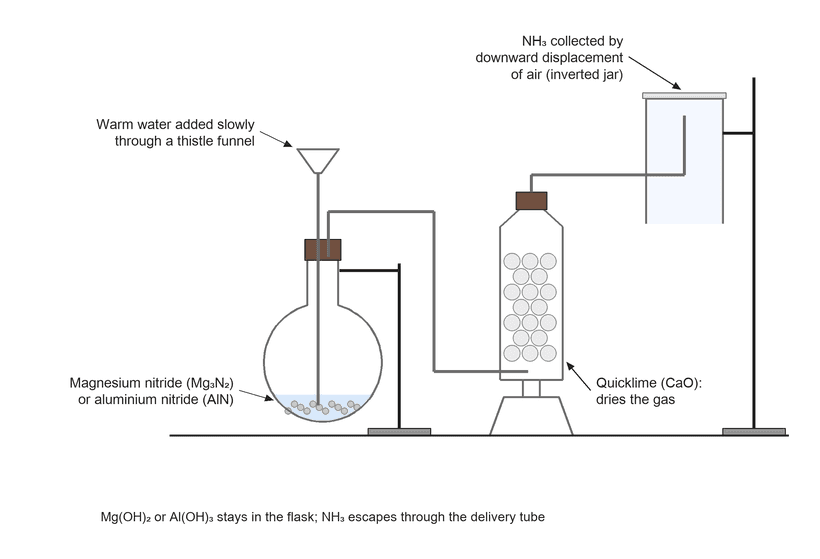
Watch out: The nitride needs WARM water; write Al(OH)₃, not Al₂O₃, as the product.
Therefore, AlN + 3H₂O → Al(OH)₃ + NH₃↑.
- 22 marks
Question 2
Name the gas evolved when the following mixtures are heated:
(i) Calcium hydroxide and Ammonium Chloride
(ii) Sodium Nitrite and Ammonium Chloride
Solve with AIWritten solution
Solution:
Concept: An ammonium salt heated with an alkali gives ammonia. But ammonium nitrite is unstable: on heating it breaks up into nitrogen and water, so a mixture that forms ammonium nitrite gives nitrogen, not ammonia.
Step 1 — (i) Calcium hydroxide and ammonium chloride.
This is an ammonium salt with an alkali, which is the laboratory preparation of ammonia, so the gas evolved is ammonia.
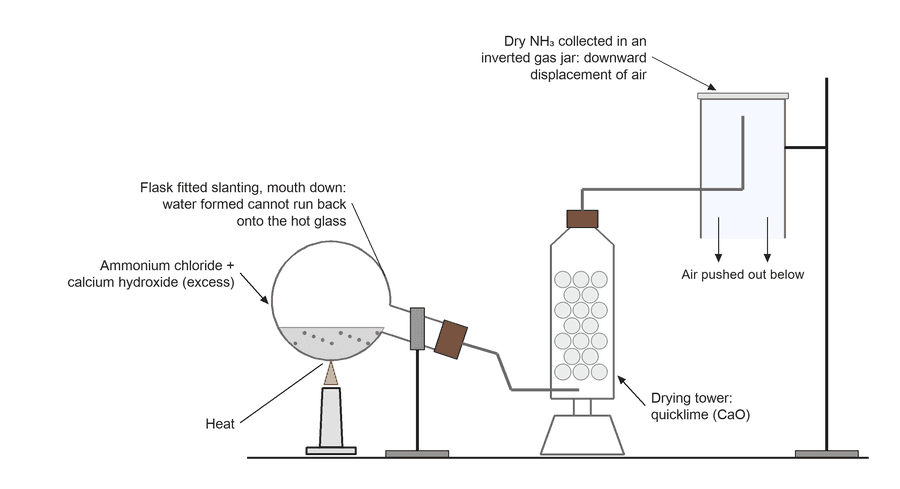
Step 2 — (ii) Sodium nitrite and ammonium chloride: the salts exchange ions.
On warming, the two salts exchange their ions (double decomposition) and form ammonium nitrite.
Step 3 — (ii) Ammonium nitrite decomposes.
Ammonium nitrite decomposes on heating, giving nitrogen and water, so the gas evolved is nitrogen.
Watch out: Sodium nitrite is not an alkali, so mixture (ii) does not give ammonia even though it contains an ammonium salt.
Therefore, (i) ammonia (NH₃); (ii) nitrogen (N₂).
- 32 marks
Question 3
Write balanced chemical equations for each of the following:
(i) When excess of ammonia is treated with chlorine.
(ii) An equation to illustrate the reducing nature of ammonia.
Solve with AIWritten solution
Solution:
Concept: The product of ammonia and chlorine depends on which gas is in excess. Chlorine always takes hydrogen from ammonia. With excess ammonia, the HCl formed combines with the extra ammonia to give white ammonium chloride, and nitrogen is set free. With excess chlorine, all three hydrogen atoms are replaced, giving nitrogen trichloride, a yellow, oily, explosive liquid. Ammonia is a reducing agent: it removes oxygen from heated oxides of less active metals (copper, lead) and is itself oxidised to nitrogen. The hydrogen of the ammonia ends up in water.
Step 1 — (i) Chlorine takes hydrogen from ammonia.
Chlorine has a strong attraction for hydrogen. It removes the hydrogen of ammonia as hydrogen chloride and sets nitrogen free.
Step 2 — (i) The HCl combines with the excess ammonia.
Ammonia is in excess, so the hydrogen chloride formed meets more ammonia and combines with it to give ammonium chloride.
Step 3 — (i) Add the two steps.
Adding the two equations and cancelling the 6HCl that is formed and used up gives the overall equation. Check: N 8 = 2 + 6, H 24 = 24, Cl 6 = 6.
The greenish-yellow colour of chlorine disappears and dense white fumes of ammonium chloride form.
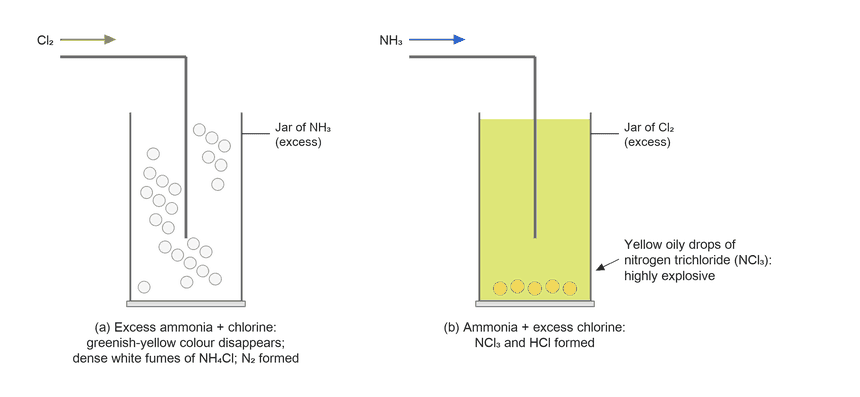
Step 4 — (ii) Show ammonia as a reducing agent.
When dry ammonia is passed over heated copper(II) oxide, it removes the oxygen and reduces the oxide to copper; ammonia itself is oxidised to nitrogen.
The black copper(II) oxide turns reddish brown (copper). Heated lead monoxide is reduced in the same way.
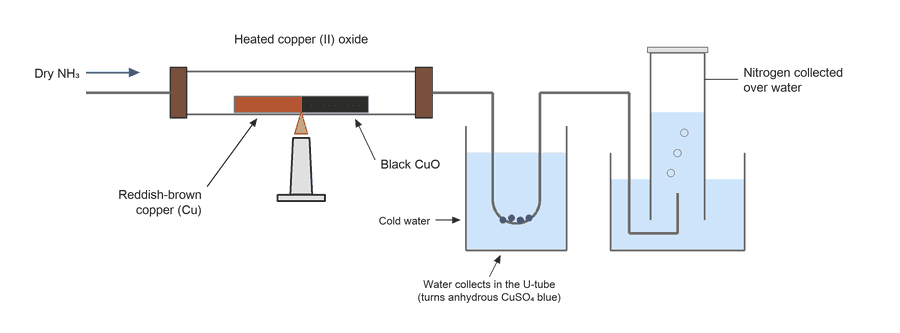
Watch out: Check which gas is in excess: excess AMMONIA gives NH₄Cl + N₂; excess CHLORINE gives NCl₃ + HCl.
Therefore, (i) 8NH₃ + 3Cl₂ → N₂ + 6NH₄Cl; (ii) 2NH₃ + 3CuO → 3Cu + 3H₂O + N₂ (ammonia reduces copper oxide).
- 41 mark
Question 4
Identify the substance underlined, in each of the following cases:
A solid formed by reaction of two gases, one of which is acidic and the other basic in nature.
Solve with AIWritten solution
Solution:
Concept: An acidic gas and a basic gas neutralise each other. Hydrogen chloride (acidic) and ammonia (basic, the only common basic gas) are both colourless gases, and they combine directly.
Step 1 — Name the two gases.
The common basic gas is ammonia, NH₃. A common acidic gas that combines with it to give a solid is hydrogen chloride, HCl.
Step 2 — Write the reaction.
The two gases combine directly; the product is a white solid.
Step 3 — Say what is seen.
Where the two gases meet, dense white fumes of tiny solid particles of ammonium chloride appear.
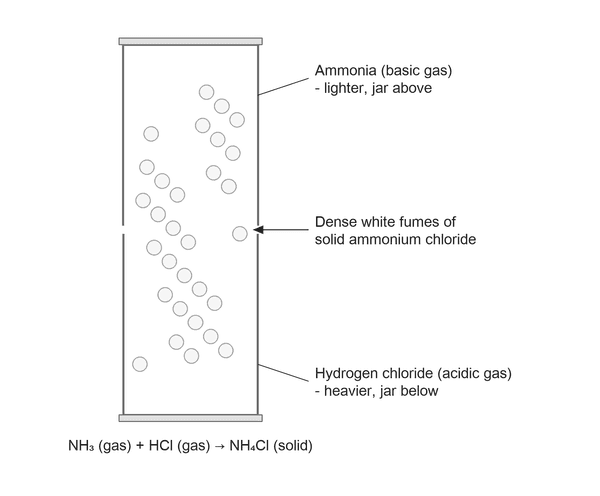
Therefore, the solid is ammonium chloride, NH₄Cl.
- 51 mark
Question 5
Write a balanced chemical equation for each of the following:
Reaction of Ammonia with heated copper oxide.
Solve with AIWritten solution
Solution:
Concept: Ammonia is a reducing agent: it removes oxygen from heated oxides of less active metals (copper, lead) and is itself oxidised to nitrogen. The hydrogen of the ammonia ends up in water.
Step 1 — Write the formulae.
The reactants are ammonia, NH₃, and copper(II) oxide, CuO. The products are copper, water and nitrogen.
Step 2 — Balance the equation.
Two NH₃ give one N₂ and three H₂O; three H₂O need three O atoms, so three CuO are used. Check: N 2 = 2, H 6 = 6, Cu 3 = 3, O 3 = 3.
Step 3 — Say what is seen.
The black copper oxide turns reddish brown, droplets of water appear and nitrogen gas is given off.
Watch out: Count each element on both sides before writing the final equation; leaving out the ↑ or the conditions costs marks.
Therefore, 2NH₃ + 3CuO → 3Cu + 3H₂O + N₂ (on heating).
- 61 mark
Question 6
Write a balanced chemical equation for each of the following:
Laboratory preparation of ammonia from ammonium chloride.
Solve with AIWritten solution
Solution:
Concept: In the laboratory, ammonia is made by heating an ammonium salt with an alkali. The hydroxide ion of the alkali takes a proton (H⁺) from the ammonium ion, so ammonia gas is driven off.
Step 1 — Choose the alkali.
In the laboratory, ammonium chloride is heated with slaked lime, calcium hydroxide, taken in excess. It is cheap and not deliquescent, and the excess makes up for any ammonium chloride lost by sublimation.
Step 2 — Write and balance the equation.
Two NH₄Cl are needed for one Ca(OH)₂, because calcium forms CaCl₂. Check: N 2 = 2, H 10 = 4 + 6, Cl 2 = 2, Ca 1 = 1, O 2 = 2.
Watch out: The products are CaCl₂ + 2H₂O + 2NH₃; writing NH₄OH as a product is wrong, because the gas is driven off by heat.
Therefore, 2NH₄Cl + Ca(OH)₂ → CaCl₂ + 2H₂O + 2NH₃↑ (on heating).
- 71 mark
Question 7
State one relevant observation for each of the following reactions:
Burning of ammonia in air.
Solve with AIWritten solution
Solution:
Concept: Ammonia is not combustible in air (a burning splint is put out by it), but it burns in oxygen, giving nitrogen and water vapour.
Step 1 — Read the stem.
The stem says "in air". In ordinary air a jet of ammonia does not keep burning, so the observation expected is the one seen when ammonia burns in oxygen (or in air enriched with oxygen).
Step 2 — State the observation.
Ammonia burns with a greenish-yellow (yellowish-green) flame.

Watch out: Over a heated platinum catalyst ammonia is oxidised to NITRIC OXIDE instead; plain burning gives NITROGEN.
Note: As printed, the stem says "in air"; ammonia burns steadily only in oxygen, so the observation given is the one seen in oxygen.
Therefore, ammonia burns (in oxygen) with a greenish-yellow flame, forming nitrogen and water vapour.
- 85 marks
Question 8
Certain blank spaces are left in the following table and these are labelled as A, B, C, D and E. Identify each of them.
Lab preparation of Reactants used Products formed Drying agent Method of collection HCl gas NaCl + A Conc. B gas C , D E Solve with AIWritten solution
Solution:
Concept: Each laboratory preparation follows from the gas's properties. HCl is acidic, heavier than air and very soluble: it is dried by conc. sulphuric acid and collected by upward displacement of air. NH₃ is basic, lighter than air and very soluble: it needs a basic drying agent and downward displacement of air.
Step 1 — Find A, the products of the HCl preparation.
Sodium chloride is heated with conc. sulphuric acid below 200 °C. The products are sodium hydrogen sulphate and hydrogen chloride.
Step 2 — Find B, the collection of HCl.
Hydrogen chloride is heavier than air (vapour density 18.25, air 14.4) and very soluble in water, so it is collected by upward displacement of air.
Step 3 — Find C, the reactants for ammonia.
The products are magnesium hydroxide and ammonia, which come from a nitride and water. So C is magnesium nitride and warm water.
Step 4 — Find D, the drying agent for ammonia.
Ammonia is basic, so it is dried with quicklime (calcium oxide). Conc. sulphuric acid and phosphorus pentoxide are acidic and react with it, and anhydrous calcium chloride forms CaCl₂·4NH₃ with it.
Step 5 — Find E, the collection of ammonia.
Ammonia is lighter than air (vapour density 8.5) and very soluble in water, so it is collected by downward displacement of air in inverted gas jars.
Watch out: Ammonia is collected by DOWNWARD displacement of air (jar held mouth down) because it is lighter than air; hydrogen chloride, which is heavier, is collected by UPWARD displacement.
Therefore, A: NaHSO₄ + HCl; B: upward displacement of air; C: magnesium nitride (Mg₃N₂) + warm water; D: quicklime (CaO); E: downward displacement of air.
- 93 marks
Question 9
(i) Write the balanced chemical equation to prepare ammonia gas in the laboratory by using an alkali.
(ii) State why concentrated sulphuric acid is not used for drying ammonia gas.
(iii) Why is ammonia gas not collected over water?
Solve with AIWritten solution
Solution:
Concept: In the laboratory, ammonia is made by heating an ammonium salt with an alkali. The hydroxide ion of the alkali takes a proton (H⁺) from the ammonium ion, so ammonia gas is driven off. Three properties of ammonia decide how it is handled: it is basic (so it is dried by a basic drying agent), it is lighter than air (vapour density 8.5, air 14.4) and it is extremely soluble in water (so it is never collected over water).
Step 1 — (i) Write the equation.
Ammonium chloride is heated with excess calcium hydroxide (slaked lime), an alkali. Check: N 2 = 2, H 10 = 10, Cl 2 = 2, Ca 1 = 1, O 2 = 2.
Step 2 — (ii) Why conc. sulphuric acid is not used.
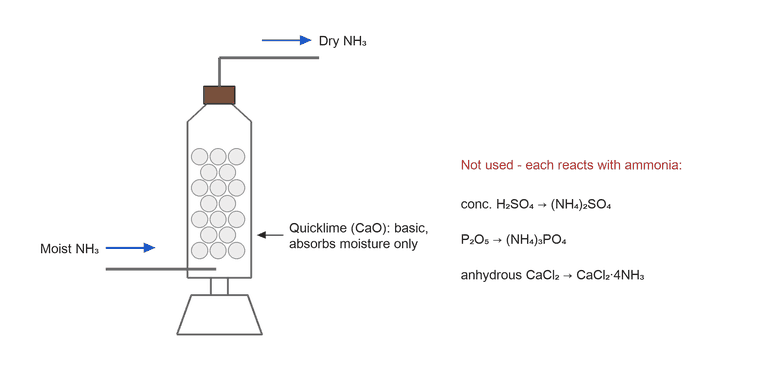
A drying agent must remove only water and must not react with the gas. Ammonia is a base and conc. sulphuric acid is an acid, so the acid would react with and absorb the ammonia, forming ammonium sulphate.
Ammonia is dried with quicklime (CaO) instead.
Step 3 — (iii) Why it is not collected over water.
Ammonia is extremely soluble in water: about 700 volumes of ammonia dissolve in 1 volume of water at 20 °C. Bubbled into water, the gas would dissolve instead of collecting in the jar.
Watch out: Anhydrous calcium chloride, the usual neutral drying agent, cannot be used either: it forms CaCl₂·4NH₃.
Therefore, (i) 2NH₄Cl + Ca(OH)₂ → CaCl₂ + 2H₂O + 2NH₃↑; (ii) conc. H₂SO₄ is an acid and reacts with basic ammonia to form (NH₄)₂SO₄; (iii) ammonia is highly soluble in water.
- 101 mark
Question 10
Fill in the blanks with the choices given in brackets:
Ammonia reacts with excess chlorine to form ............... (nitrogen / nitrogen trichloride / ammonium chloride)
Solve with AIWritten solution
Solution:
Concept: The product of ammonia and chlorine depends on which gas is in excess. Chlorine always takes hydrogen from ammonia. With excess ammonia, the HCl formed combines with the extra ammonia to give white ammonium chloride, and nitrogen is set free. With excess chlorine, all three hydrogen atoms are replaced, giving nitrogen trichloride, a yellow, oily, explosive liquid.
Step 1 — Find which gas is in excess.
The stem says chlorine is in excess.
Step 2 — Write the reaction.
With excess chlorine, all three hydrogen atoms of ammonia are replaced by chlorine atoms. Check: N 1 = 1, H 3 = 3, Cl 6 = 3 + 3.
Watch out: Check which gas is in excess: excess AMMONIA gives NH₄Cl + N₂; excess CHLORINE gives NCl₃ + HCl.
Therefore, ammonia reacts with excess chlorine to form nitrogen trichloride.
- 111 mark
Question 11
State one observation for each of the following:
Ammonia gas is passed over heated copper (II) oxide.
Solve with AIWritten solution
Solution:
Concept: Ammonia is a reducing agent: it removes oxygen from heated oxides of less active metals (copper, lead) and is itself oxidised to nitrogen. The hydrogen of the ammonia ends up in water.
Step 1 — Name the reaction.
Ammonia reduces the hot copper(II) oxide to copper metal and is itself oxidised to nitrogen.
Step 2 — State what is seen.
The black copper(II) oxide turns reddish brown (copper). Droplets of water collect on the cooler parts of the tube, and a colourless gas (nitrogen) is given off.
Therefore, the black copper(II) oxide turns reddish brown as it is reduced to copper.
- 123 marks
Question 12
Name the gas evolved in each of the following cases:
(i) Alumina undergoes electrolytic reduction.
(ii) Ethene undergoes hydrogenation reaction.
(iii) Ammonia reacts with heated copper oxide.
Solve with AIWritten solution
Solution:
Concept: Name the gas leaving each reaction: the gas set free at the anode in (i), the gaseous product of adding hydrogen to ethene in (ii), and the gas formed when ammonia is oxidised in (iii).
Step 1 — (i) Electrolytic reduction of alumina.
Molten alumina (dissolved in cryolite) is electrolysed: aluminium forms at the cathode and oxygen is given off at the anode.
The oxygen attacks the hot carbon anodes, so oxides of carbon also form and the anodes have to be replaced from time to time.
Step 2 — (ii) Hydrogenation of ethene.
Ethene adds hydrogen over a nickel catalyst at about 200 °C, giving ethane, a gas.
Step 3 — (iii) Ammonia with heated copper oxide.
Ammonia is oxidised while the copper oxide is reduced to copper, so nitrogen is evolved.
Watch out: In (ii) the hydrogen is used up, not given off; ethane is the gaseous product.
Note: As printed, "evolved" does not fit (ii) exactly, since hydrogen is taken up and no gas is set free; ethane is the gaseous product the question expects.
Therefore, (i) oxygen; (ii) ethane; (iii) nitrogen.
- 133 marks
Question 13
Study the flow chart given and give balanced equations to represent the reactions A, B and C:
Solve with AIWritten solution
Solution:
Concept: Read the flow chart left to right. A: a nitride with warm water gives ammonia. B: ammonia, a base, combines with hydrogen chloride to give ammonium chloride. C (the return arrow): an ammonium salt heated with an alkali gives ammonia back.
Step 1 — Reaction A: magnesium nitride with warm water.
Magnesium nitride reacts with warm water to give magnesium hydroxide and ammonia.
Step 2 — Reaction B: ammonia with hydrogen chloride.
Ammonia combines directly with hydrogen chloride, forming white ammonium chloride.
Step 3 — Reaction C: ammonium chloride back to ammonia.
Ammonium chloride is heated with calcium hydroxide (slaked lime); ammonia is driven off.

Watch out: The return arrow C needs an ALKALI; heating ammonium chloride alone only dissociates it, and the gases recombine on cooling.
Therefore, A: Mg₃N₂ + 6H₂O → 3Mg(OH)₂ + 2NH₃; B: NH₃ + HCl → NH₄Cl; C: 2NH₄Cl + Ca(OH)₂ → CaCl₂ + 2H₂O + 2NH₃.
- 144 marks
Question 14
Copy and complete the following table which refers to the industrial method for preparation of ammonia and sulphuric acid.
Name of the compound Name of the process Catalytic equation [with the catalyst] Ammonia (i) (ii) Sulphuric acid (iii) (iv) Solve with AIWritten solution
Solution:
Concept: Both are industrial processes in which a reversible, exothermic reaction is speeded up by a catalyst: iron for ammonia (Haber process) and vanadium pentoxide for sulphur trioxide, the key step in making sulphuric acid (Contact process).
Step 1 — Fill in the table.
Each process is named after its key step, and the catalyst is written over the arrow of its equation.
Name of the compound Name of the process Catalytic equation [with the catalyst] Ammonia (i) Haber process (ii) N₂ + 3H₂ ⇌ 2NH₃ over finely divided iron Sulphuric acid (iii) Contact process (iv) 2SO₂ + O₂ ⇌ 2SO₃ over vanadium pentoxide Step 2 — (ii) Catalytic equation for ammonia.
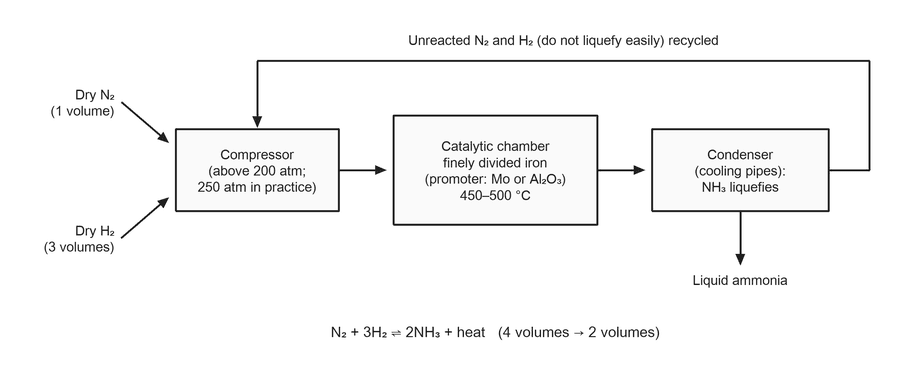
Nitrogen and hydrogen (1 : 3 by volume) are passed over finely divided iron, with molybdenum as promoter, at 450–500 °C and above 200 atm.
Step 3 — (iv) Catalytic equation for sulphuric acid.
Sulphur dioxide and oxygen are passed over vanadium pentoxide at about 450 °C; the sulphur trioxide formed is then turned into sulphuric acid.
Watch out: Write the catalyst over the arrow and use the reversible sign (⇌) for both reactions.
Therefore, (i) Haber process; (ii) N₂ + 3H₂ ⇌ 2NH₃ (iron catalyst); (iii) Contact process; (iv) 2SO₂ + O₂ ⇌ 2SO₃ (V₂O₅ catalyst).
- 151 mark
Question 15
Write a balanced chemical equation for each of the following:
(ii) Reaction of excess ammonia with chlorine.
Solve with AIWritten solution
Solution:
Concept: The product of ammonia and chlorine depends on which gas is in excess. Chlorine always takes hydrogen from ammonia. With excess ammonia, the HCl formed combines with the extra ammonia to give white ammonium chloride, and nitrogen is set free. With excess chlorine, all three hydrogen atoms are replaced, giving nitrogen trichloride, a yellow, oily, explosive liquid.
Step 1 — Chlorine takes hydrogen from ammonia.
First, chlorine removes the hydrogen of ammonia as hydrogen chloride and nitrogen is set free.
Step 2 — The HCl combines with the extra ammonia.
Ammonia is in excess, so the hydrogen chloride combines with more ammonia to form ammonium chloride.
Step 3 — Add the steps.
Adding the two steps gives the overall equation. Check: N 8 = 2 + 6, H 24 = 24, Cl 6 = 6.
The greenish-yellow colour of chlorine disappears and dense white fumes of ammonium chloride are seen.
Watch out: Check which gas is in excess: excess AMMONIA gives NH₄Cl + N₂; excess CHLORINE gives NCl₃ + HCl.
Therefore, 8NH₃ + 3Cl₂ → N₂ + 6NH₄Cl.
- 161 mark
Question 16
Identify the substance underlined in each of the following:
(iii) The catalyst used to oxidize ammonia into nitric oxide.
Solve with AIWritten solution
Solution:
Concept: In catalytic oxidation, ammonia and oxygen (or air) are passed over heated platinum at about 800 °C. Ammonia is oxidised to nitric oxide (NO) and water vapour; the reaction gives out heat.
Step 1 — Name the catalyst.
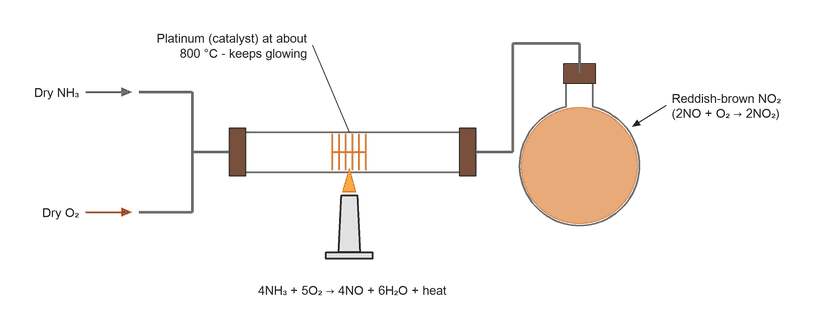
The catalyst that speeds up the oxidation of ammonia to nitric oxide is platinum (platinum gauze), heated to about 800 °C.
Step 2 — Say what is seen.
The platinum keeps glowing even after the heating is stopped, because the reaction gives out heat.
Watch out: Iron is the Haber-process catalyst and V₂O₅ the Contact-process catalyst; ammonia to nitric oxide needs platinum.
Therefore, the catalyst is platinum.
- 171 mark
Question 17
An aqueous solution of ammonia is:
Solve with AIAnswer
(A) Neutral
(B) Acidic
- Correct
(C) Basic
(D) Amphoteric
Answer: (C) Basic
Concept: Ammonia dissolves in water, and a small part of it takes a proton from water, giving ammonium ions and hydroxide ions (OH⁻). A solution that contains OH⁻ ions is basic (alkaline).
Step 1 — Ammonia reacts with water.
Ammonia dissolves in water to form ammonium hydroxide.
Step 2 — Ammonium hydroxide ionises partly.
Ammonium hydroxide gives hydroxide ions, but only a few of its molecules ionise, so it is a weak base.
Step 3 — Test the solution.
The solution turns red litmus blue, methyl orange yellow and phenolphthalein pink, so it is basic.
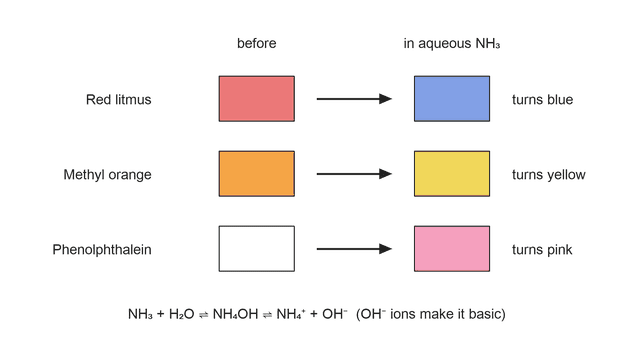
Watch out: Aqueous ammonia is a WEAK base: it is only partly ionised.
Why the other options are wrong:
- (A) Neutral: a neutral solution has no excess of OH⁻ ions; aqueous ammonia has OH⁻ ions and turns red litmus blue.
- (B) Acidic: an acidic solution turns blue litmus red; aqueous ammonia does the opposite.
- (D) Amphoteric: an amphoteric substance, such as zinc oxide, reacts with both acids and bases. Aqueous ammonia reacts with acids to form ammonium salts, but it does not react with alkalis such as sodium hydroxide.
Therefore, an aqueous solution of ammonia is basic, option (C).
- 181 mark
Question 18
State the following:
(a) A compound formed when excess ammonia gas reacts with chlorine.
Solve with AIWritten solution
Solution:
Concept: The product of ammonia and chlorine depends on which gas is in excess. Chlorine always takes hydrogen from ammonia. With excess ammonia, the HCl formed combines with the extra ammonia to give white ammonium chloride, and nitrogen is set free. With excess chlorine, all three hydrogen atoms are replaced, giving nitrogen trichloride, a yellow, oily, explosive liquid.
Step 1 — Find which gas is in excess.
The stem says ammonia is in excess, so the hydrogen chloride formed is taken up by the extra ammonia.
Step 2 — Write the reaction.
The overall reaction gives ammonium chloride and nitrogen. Check: N 8 = 2 + 6, H 24 = 24, Cl 6 = 6.
Watch out: Check which gas is in excess: excess AMMONIA gives NH₄Cl + N₂; excess CHLORINE gives NCl₃ + HCl.
Therefore, the compound formed is ammonium chloride, NH₄Cl (nitrogen is set free with it).
- 193 marks
Question 19
State the observation for the following:
(a) Dry ammonia gas reacts with oxygen in the presence of a catalyst.
(b) Excess chlorine gas reacts with ammonia gas.
(c) Carbon reacts with hot concentrated nitric acid.
Solve with AIWritten solution
Solution:
Concept: (a) Ammonia is oxidised to nitric oxide over a platinum catalyst. (b) With excess chlorine, ammonia gives nitrogen trichloride. (c) Hot concentrated nitric acid is a strong oxidising agent: it oxidises carbon to carbon dioxide and is itself reduced to nitrogen dioxide.
Step 1 — (a) Ammonia with oxygen over a catalyst.
Ammonia is oxidised over heated platinum to colourless nitric oxide. The platinum keeps glowing after the heating stops, because the reaction gives out heat.
Step 2 — (a) The brown gas.
The nitric oxide combines with more oxygen to give reddish-brown fumes of nitrogen dioxide.
Step 3 — (b) Excess chlorine with ammonia.
A yellow, oily, highly explosive liquid, nitrogen trichloride, forms together with hydrogen chloride.
Step 4 — (c) Carbon with hot conc. nitric acid.
Reddish-brown fumes of nitrogen dioxide are given off and the carbon slowly disappears as it is oxidised to carbon dioxide. Check: C 1 = 1, H 4 = 4, N 4 = 4, O 12 = 2 + 2 + 8.
Therefore, (a) the platinum keeps glowing and reddish-brown fumes (NO₂) appear; (b) a yellow, oily, explosive liquid (NCl₃) forms; (c) reddish-brown fumes of NO₂ are given off.
- 203 marks
Question 20
Complete the table given below which refers to the Laboratory preparation of Ammonia gas:
Laboratory preparation Reactants used Products formed Drying agent Method of collection Ammonia gas (a) ............... Calcium chloride + water + ammonia (b) ............... (c) ............... Solve with AIWritten solution
Solution:
Concept: In the laboratory, ammonia is made by heating an ammonium salt with an alkali. The hydroxide ion of the alkali takes a proton (H⁺) from the ammonium ion, so ammonia gas is driven off. Three properties of ammonia decide how it is handled: it is basic (so it is dried by a basic drying agent), it is lighter than air (vapour density 8.5, air 14.4) and it is extremely soluble in water (so it is never collected over water).
Step 1 — (a) Work out the reactants.
The products are calcium chloride, water and ammonia. Calcium chloride comes from calcium hydroxide, and ammonia from an ammonium salt, so the reactants are ammonium chloride and calcium hydroxide.
Step 2 — (b) Choose the drying agent.
Ammonia is basic, so it is dried with quicklime (calcium oxide), a basic drying agent that does not react with it.
Step 3 — (c) Choose the method of collection.
Ammonia is lighter than air (vapour density 8.5, air 14.4), so it is collected by downward displacement of air in inverted gas jars.
Watch out: Never write conc. H₂SO₄, P₂O₅ or anhydrous CaCl₂ as the drying agent for ammonia: each reacts with it.
Therefore, (a) ammonium chloride + calcium hydroxide; (b) quicklime (CaO); (c) downward displacement of air.
- 211 mark
Question 21
State the terms/process for the following:
(c) The name of the process by which Ammonia is manufactured on a large scale.
Solve with AIWritten solution
Solution:
Concept: Ammonia is made on a large scale by combining nitrogen and hydrogen directly over an iron catalyst. This is a reversible, exothermic reaction.
Step 1 — Name the process.
The large-scale manufacture of ammonia from nitrogen and hydrogen is the Haber process.
Step 2 — Recall the conditions.
These conditions give a good yield at a useful speed.
- nitrogen and hydrogen in the ratio 1 : 3 by volume;
- catalyst: finely divided iron, with molybdenum as promoter;
- temperature: 450–500 °C;
- pressure: above 200 atm.
Watch out: The Contact process makes sulphuric acid and the Ostwald process nitric acid; ammonia comes from the Haber process.
Therefore, ammonia is manufactured by the Haber process.
- 221 mark
Question 22
Complete and balance the following equations:
(a)
Solve with AIWritten solution
Solution:
Concept: In the laboratory, ammonia is made by heating an ammonium salt with an alkali. The hydroxide ion of the alkali takes a proton (H⁺) from the ammonium ion, so ammonia gas is driven off.
Step 1 — Write the products.
Calcium hydroxide gives calcium chloride, water and ammonia with ammonium chloride.
Step 2 — Balance the equation.
One Ca(OH)₂ needs two NH₄Cl, because calcium chloride is CaCl₂. Check: N 2 = 2, H 10 = 4 + 6, Cl 2 = 2, Ca 1 = 1, O 2 = 2.
This is the laboratory preparation of ammonia.
Watch out: Count each element on both sides before writing the final equation; leaving out the ↑ or the conditions costs marks.
Therefore, 2NH₄Cl + Ca(OH)₂ → CaCl₂ + 2H₂O + 2NH₃↑ (on heating).
- 231 mark
Question 23
State a relevant reason for the following:
(b) Ammonia gas is not collected over water.
Solve with AIWritten solution
Solution:
Concept: A gas can be collected over water only if it hardly dissolves in water.
Step 1 — Recall the solubility of ammonia.
Ammonia is extremely soluble in water: about 700 volumes of ammonia dissolve in 1 volume of water at 20 °C.
Step 2 — Explain the result.
If ammonia were bubbled into water, it would dissolve in the water instead of collecting in the jar, so it is collected instead by downward displacement of air (it is lighter than air).
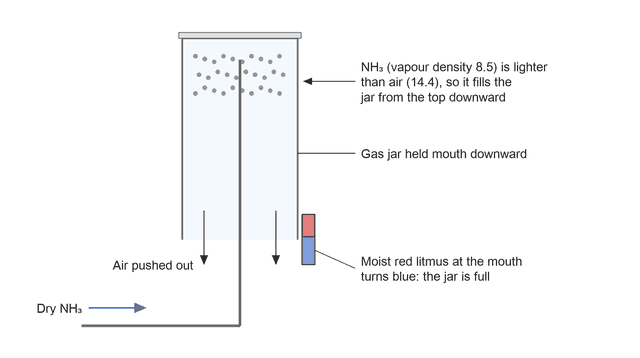
Therefore, ammonia is not collected over water because it is highly soluble in water.
- 243 marks
Question 24
The following questions are pertaining to the laboratory preparation of Ammonia gas from Magnesium nitride:
(a) Write a balanced chemical equation for its preparation.
(b) Why is this method seldom used?
(c) How do you identify the gas formed?
Solve with AIWritten solution
Solution:
Concept: A metal nitride reacts with warm water to give ammonia and the metal hydroxide. The nitride ion takes hydrogen from water and becomes ammonia, while the metal ends up as its hydroxide. The method works, but magnesium nitride is costly, so it is seldom used.
Step 1 — (a) Write the balanced equation.
Magnesium nitride reacts with warm water. Check: Mg 3 = 3, N 2 = 2, H 12 = 6 + 6, O 6 = 6.
Step 2 — (b) Explain why it is seldom used.
Magnesium nitride is expensive: it first has to be made by heating magnesium in nitrogen. Heating an ammonium salt with slaked lime gives ammonia far more cheaply.
Step 3 — (c) Identify the gas.
Ammonia is identified by these tests:
- it has a strong, pungent smell;
- it turns moist red litmus paper blue, since it is an alkaline gas;
- a glass rod dipped in conc. hydrochloric acid, held near it, gives dense white fumes of ammonium chloride.
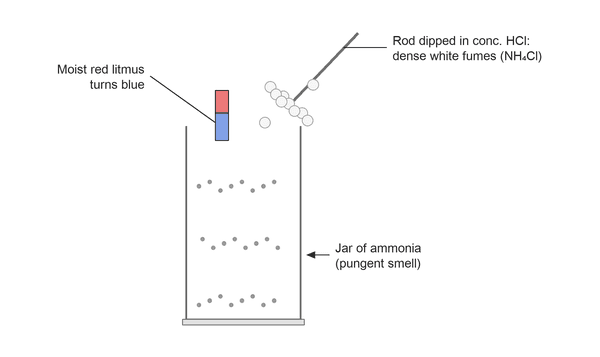
Therefore, (a) Mg₃N₂ + 6H₂O → 3Mg(OH)₂ + 2NH₃↑; (b) magnesium nitride is costly; (c) the gas turns moist red litmus blue and gives dense white fumes with a rod dipped in conc. HCl.
- 253 marks
Question 25
State one relevant observation for each of the following:
(a) To the copper nitrate solution, initially few drops of sodium hydroxide solution is added and then added in excess.
(b) Burning of ammonia in excess of oxygen.
(c) Dry ammonia gas is passed over heated PbO.
Solve with AIWritten solution
Solution:
Concept: (a) Sodium hydroxide precipitates copper(II) hydroxide, which does not dissolve in excess sodium hydroxide. (b) Ammonia burns in oxygen. (c) Ammonia is a reducing agent: it removes oxygen from heated oxides of less active metals (copper, lead) and is itself oxidised to nitrogen. The hydrogen of the ammonia ends up in water.
Step 1 — (a) Sodium hydroxide added to copper nitrate.
A few drops of sodium hydroxide give a pale blue precipitate of copper(II) hydroxide, which does not dissolve in excess sodium hydroxide.
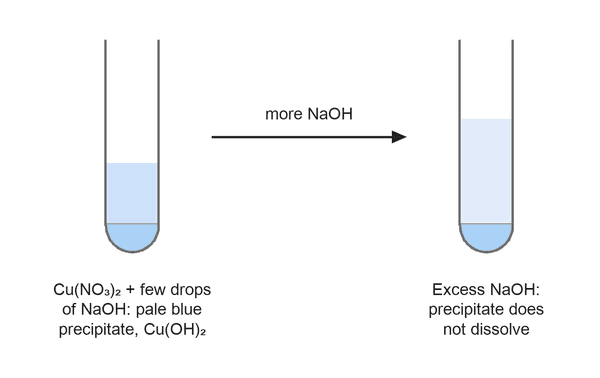
Step 2 — (b) Ammonia burning in excess oxygen.
Ammonia burns with a greenish-yellow flame, forming nitrogen and water vapour.
Step 3 — (c) Dry ammonia over heated lead monoxide.
The buff-yellow lead monoxide turns greyish (metallic lead); droplets of water form and nitrogen gas is given off.
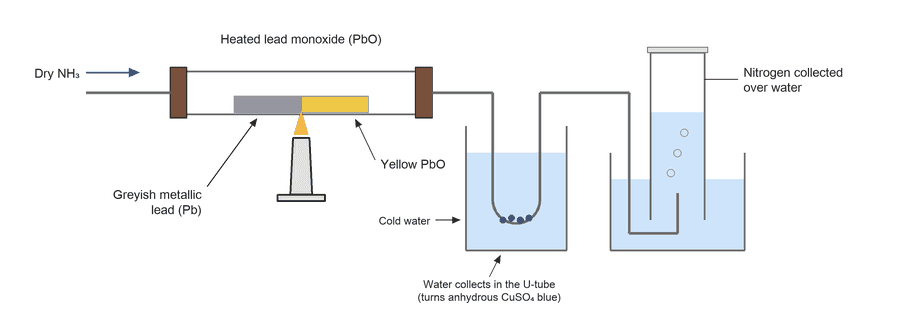
Watch out: In (a) it is AMMONIUM hydroxide in excess that dissolves the blue precipitate (deep blue solution); sodium hydroxide does not.
Therefore, (a) a pale blue precipitate forms that does not dissolve in excess NaOH; (b) ammonia burns with a greenish-yellow flame; (c) the yellow PbO turns grey (lead).
- 261 mark
Question 26
Convert the following reactions into a balanced chemical equation:
(a) Ammonia to nitric oxide using oxygen and platinum catalyst.
Solve with AIWritten solution
Solution:
Concept: In catalytic oxidation, ammonia and oxygen (or air) are passed over heated platinum at about 800 °C. Ammonia is oxidised to nitric oxide (NO) and water vapour; the reaction gives out heat.
Step 1 — Write the formulae.
Ammonia and oxygen give nitric oxide, NO, and water.
Step 2 — Balance the equation.
Four NH₃ give four NO and six H₂O, which need 4 + 6 = 10 O atoms, that is five O₂. Check: N 4 = 4, H 12 = 12, O 10 = 4 + 6.
This is the first step of the Ostwald process for nitric acid.
Watch out: Without the catalyst ammonia burns to N₂, not NO.
Therefore, 4NH₃ + 5O₂ → 4NO + 6H₂O (platinum, about 800 °C).
- 271 mark
Question 27
Choose the answer from the list which fits in the description:
[, PbO, NaCl, CuO, ]
(a) A compound which undergoes thermal dissociation.
Solve with AIWritten solution
Solution:
Concept: Thermal dissociation is a reversible splitting on heating: the products combine again to form the original substance on cooling.
Step 1 — Test each substance in the list.
Only one of them splits on heating and re-forms on cooling.
- PbO and CuO are not split by heating alone; they are reduced when heated with a reducing agent such as ammonia or carbon;
- NaCl simply melts on strong heating;
- CCl₄ is a stable liquid that just boils;
- NH₄Cl splits into two gases that recombine on cooling.
Step 2 — Write the dissociation.
On heating, ammonium chloride splits into ammonia and hydrogen chloride; on the cooler part of the tube the two gases combine again to give white ammonium chloride.
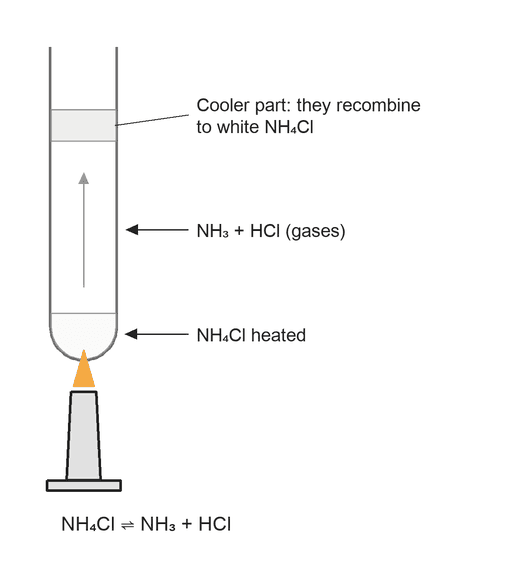
Watch out: Dissociation is reversible; decomposition (as of ammonium nitrite) is not.
Therefore, the compound is ammonium chloride, NH₄Cl.
- 281 mark
Question 28
On passing ammonia gas over heated copper oxide for some time, a reddish-brown residue is left behind. What property of ammonia is demonstrated here?
Solve with AIAnswer
(A) Basic property
(B) Oxidising property
- Correct
(C) Reducing property
(D) Acidic property
Answer: (C) Reducing property
Concept: A reducing agent removes oxygen from a substance (or adds hydrogen to it) and is itself oxidised.
Step 1 — Write the reaction.
Ammonia passed over heated copper oxide gives copper, water and nitrogen.
Step 2 — Explain the residue.
The black copper(II) oxide loses its oxygen and becomes reddish-brown copper, which is the residue seen.
Step 3 — Name the property.
Ammonia takes the oxygen away and is itself oxidised to nitrogen, so it acts as a reducing agent.
Watch out: The colour change is in the copper oxide; it shows what ammonia DOES to the oxide (reduces it).
Why the other options are wrong:
- (A) Basic property: the basic property is shown when ammonia turns red litmus blue or forms salts with acids; no acid is involved here.
- (B) Oxidising property: an oxidising agent would give oxygen to the copper oxide; ammonia takes oxygen away and is itself oxidised to nitrogen.
- (D) Acidic property: ammonia is a basic gas, not an acidic one.
Therefore, the reaction shows the reducing property of ammonia, option (C).
- 291 mark
Question 29
Ammonia gas is collected by downward displacement of air since ammonia is:
Solve with AIAnswer
(A) very slightly soluble in water
(B) heavier than air
- Correct
(C) lighter than air
(D) insoluble in water
Answer: (C) lighter than air
Concept: A gas lighter than air rises into a jar held mouth downward and pushes the air out below: this is downward displacement of air.
Step 1 — Compare the densities.
The vapour density of ammonia is 17 ÷ 2 = 8.5, and that of air is about 14.4, so ammonia is lighter than air.
Step 2 — See how the jar fills.
The gas rises, fills the inverted jar from the top and pushes the heavier air down and out of the mouth.
Watch out: Ammonia is collected by DOWNWARD displacement of air (jar held mouth down) because it is lighter than air; hydrogen chloride, which is heavier, is collected by UPWARD displacement.
Why the other options are wrong:
- (A) very slightly soluble in water: ammonia is extremely soluble in water (about 700 volumes in 1 volume of water), not very slightly soluble; its solubility explains why it is NOT collected over water.
- (B) heavier than air: ammonia is lighter than air; a gas heavier than air, like hydrogen chloride, is collected by upward displacement of air.
- (D) insoluble in water: ammonia is one of the most soluble gases, not an insoluble one.
Therefore, ammonia is collected by downward displacement of air because it is lighter than air, option (C).
- 301 mark
Question 30
Rewrite the following statements by adding the correct word as shown in the example:
Example:
Given statement: Ammonia changes moist red litmus to blue.
Correct statement: Aqueous ammonia changes moist red litmus to blue.
(b) Ammonia reacts with chlorine to give ammonium chloride and nitrogen.
Solve with AIWritten solution
Solution:
Concept: The product of ammonia and chlorine depends on which gas is in excess. Chlorine always takes hydrogen from ammonia. With excess ammonia, the HCl formed combines with the extra ammonia to give white ammonium chloride, and nitrogen is set free. With excess chlorine, all three hydrogen atoms are replaced, giving nitrogen trichloride, a yellow, oily, explosive liquid.
Step 1 — Find the missing condition.
The products named, ammonium chloride and nitrogen, form only when ammonia is in excess, so the missing word is "excess" before ammonia.
Step 2 — Write the reaction for excess ammonia.
The extra ammonia takes up the HCl formed.
Step 3 — Compare with excess chlorine.
With excess chlorine the products would be different: nitrogen trichloride and hydrogen chloride.
Watch out: Check which gas is in excess: excess AMMONIA gives NH₄Cl + N₂; excess CHLORINE gives NCl₃ + HCl.
Therefore, Excess ammonia reacts with chlorine to give ammonium chloride and nitrogen.
- 311 mark
Question 31
Give balanced equation for the following reactions:
(b) Aluminium nitride is treated with warm water.
Solve with AIWritten solution
Solution:
Concept: A metal nitride reacts with warm water to give ammonia and the metal hydroxide. The nitride ion takes hydrogen from water and becomes ammonia, while the metal ends up as its hydroxide.
Step 1 — Write the formulae.
Aluminium nitride is AlN; the products are aluminium hydroxide, Al(OH)₃, and ammonia.
Step 2 — Balance the equation.
One AlN needs three water molecules. Check: Al 1 = 1, N 1 = 1, H 6 = 6, O 3 = 3.
Watch out: The nitride needs WARM water; the product is the hydroxide, Al(OH)₃.
Therefore, AlN + 3H₂O → Al(OH)₃ + NH₃↑.
- 325 marks
Question 32
A student was instructed by the teacher to prepare and collect ammonia gas in the laboratory by using aluminium nitride. The student had set up the apparatus as shown in the diagram below. Study the given diagram and answer the following questions:

(a) Name the substance X added through the thistle funnel by the student.
(b) Write a balanced equation for the reaction occurring between Aluminium nitride and substance X.
(c) Identify the substance Y.
(d) State the function of Y.
(e) Why could the student not collect ammonia gas at the end of the experiment?
Solve with AIWritten solution
Solution:
Concept: A metal nitride reacts with warm water to give ammonia and the metal hydroxide. The nitride ion takes hydrogen from water and becomes ammonia, while the metal ends up as its hydroxide. Three properties of ammonia decide how it is handled: it is basic (so it is dried by a basic drying agent), it is lighter than air (vapour density 8.5, air 14.4) and it is extremely soluble in water (so it is never collected over water).
Step 1 — (a) Name X.
Aluminium nitride gives ammonia with water, so X, added slowly through the thistle funnel, is warm water.
Step 2 — (b) Write the balanced equation.
Aluminium nitride reacts with the warm water. Check: Al 1 = 1, N 1 = 1, H 6 = 6, O 3 = 3.
Step 3 — (c) Identify Y.
The tower packed with lumps between the flask and the collecting end is a drying tower, so Y is quicklime (calcium oxide, CaO).
Step 4 — (d) State the function of Y.
Quicklime is a drying agent: it absorbs the moisture from the ammonia. Being basic, it does not react with ammonia, unlike conc. sulphuric acid or phosphorus pentoxide.
Step 5 — (e) Explain why no ammonia was collected.
The outlet tube from the tower dipped into water. Ammonia is extremely soluble in water (about 700 volumes in 1 volume of water), so the gas dissolved in the water in the beaker and none was left to collect. It should have been collected in an inverted gas jar by downward displacement of air, since it is lighter than air.

Watch out: Y is not conc. H₂SO₄ or anhydrous CaCl₂: both react with ammonia.
Therefore, (a) warm water; (b) AlN + 3H₂O → Al(OH)₃ + NH₃↑; (c) quicklime (CaO); (d) it dries the ammonia; (e) the outlet dipped into water and the highly soluble ammonia dissolved in it.
- 331 mark
Question 33
Match the Column A with Column B:
Column A Column B (a) 1. Vanadium Pentoxide 2. Nickel 3. Iron 4. Concentrated Sulphuric acid 5. Platinum Solve with AIWritten solution
Solution:
Concept: Each industrial reaction has its own catalyst: iron for the Haber process (ammonia), platinum for the catalytic oxidation of ammonia (Ostwald process), vanadium pentoxide for the Contact process (sulphur trioxide) and nickel for the hydrogenation of oils and alkenes.
Step 1 — Recognise the reaction.
N₂ + 3H₂ ⇌ 2NH₃ is the Haber process for ammonia.
Step 2 — Choose its catalyst.
The Haber process uses finely divided iron (with molybdenum as promoter), so (a) matches 3.
Step 3 — Rule out the others.
Vanadium pentoxide is the Contact-process catalyst, nickel the hydrogenation catalyst, platinum the catalyst for oxidising ammonia, and concentrated sulphuric acid is not a catalyst for this reaction.
Therefore, (a) → 3. Iron.
- 341 mark
Question 34
Match the Column A with Column B:
Column A Column B (b) 1. Vanadium Pentoxide 2. Nickel 3. Iron 4. Concentrated Sulphuric acid 5. Platinum Solve with AIWritten solution
Solution:
Concept: Each industrial reaction has its own catalyst: iron for the Haber process (ammonia), platinum for the catalytic oxidation of ammonia (Ostwald process), vanadium pentoxide for the Contact process (sulphur trioxide) and nickel for the hydrogenation of oils and alkenes.
Step 1 — Recognise the reaction.
4NH₃ + 5O₂ → 4NO + 6H₂O is the catalytic oxidation of ammonia, the first step of the Ostwald process for nitric acid.
Step 2 — Choose its catalyst.
This oxidation is carried out over heated platinum at about 800 °C, so (b) matches 5. The platinum keeps glowing during the reaction.
Watch out: Iron catalyses the Haber process, not the oxidation of ammonia.
Therefore, (b) → 5. Platinum.
- 351 mark
Question 35
Name the gas produced during each of the following reactions:
When ammonia is burnt in an atmosphere of oxygen.
Solve with AIWritten solution
Solution:
Concept: When ammonia burns in oxygen (without a catalyst), its nitrogen is set free as nitrogen gas and its hydrogen becomes water.
Step 1 — Write the reaction.
Ammonia burns in oxygen with a greenish-yellow flame. Check: N 4 = 4, H 12 = 12, O 6 = 6.
Step 2 — Name the gas.
The gas produced is nitrogen; the water formed is a vapour at the flame temperature.
Watch out: Over a platinum catalyst the product would be nitric oxide (NO) instead.
Therefore, the gas produced is nitrogen, N₂.
- 362 marks
Question 36
Ammonia gas is passed over heated copper (II) oxide in a combustion tube:
(a) Name the gas evolved.
(b) What will be the colour of the residue that is left in the combustion tube at the end of the reaction?
Solve with AIWritten solution
Solution:
Concept: Ammonia is a reducing agent: it removes oxygen from heated oxides of less active metals (copper, lead) and is itself oxidised to nitrogen. The hydrogen of the ammonia ends up in water.
Step 1 — Write the reaction.
Ammonia passed over heated copper(II) oxide in a combustion tube gives copper, water and nitrogen.
Step 2 — (a) Name the gas evolved.
The gas evolved is nitrogen; water vapour also forms and condenses.
Step 3 — (b) State the colour of the residue.
The black copper(II) oxide is reduced to copper metal, so the residue is reddish brown.
Watch out: The residue is copper (reddish brown), not black copper oxide.
Therefore, (a) nitrogen; (b) reddish brown (copper).
- 371 mark
Question 37
Which gas is evolved when ammonia gas is passed over buff yellow ?
Solve with AIAnswer
(A)
(B)
- Correct
(C)
(D)
Answer: (C)
Concept: Ammonia is a reducing agent: it removes oxygen from heated oxides of less active metals (copper, lead) and is itself oxidised to nitrogen. The hydrogen of the ammonia ends up in water.
Step 1 — Write the reaction.
Ammonia passed over heated lead monoxide reduces it to lead.
Step 2 — Name the gas.
The buff-yellow lead monoxide turns greyish (lead), water vapour forms and a colourless gas, nitrogen, is given off.
Watch out: The oxides of nitrogen form only when ammonia is oxidised by OXYGEN; a metal oxide oxidises it only as far as N₂.
Why the other options are wrong:
- (A) : dinitrogen oxide (N₂O) is formed when ammonium nitrate is heated, not when ammonia reduces a metal oxide.
- (B) : nitric oxide (NO) is formed when ammonia is oxidised by oxygen over platinum at about 800 °C.
- (D) : nitrogen dioxide (NO₂) is the reddish-brown gas formed when nitric oxide meets oxygen; no such gas appears here.
Therefore, the gas evolved is nitrogen, option (C).
- 381 mark
Question 38
Complete the following sentences by choosing the correct answer from the brackets:
Ammonia gas is collected by ............... displacement of air. [upward / downward]
Solve with AIWritten solution
Solution:
Concept: A gas lighter than air is collected in a gas jar held mouth downward.
Step 1 — Compare ammonia with air.
Ammonia has vapour density 17 ÷ 2 = 8.5, less than that of air (about 14.4), so it is lighter than air.
Step 2 — Choose the method.
Ammonia rises and fills the inverted jar, pushing the air down and out, so it is collected by downward displacement of air. It is not collected over water because it is extremely soluble in water.
Watch out: Ammonia is collected by DOWNWARD displacement of air (jar held mouth down) because it is lighter than air; hydrogen chloride, which is heavier, is collected by UPWARD displacement.
Therefore, Ammonia gas is collected by downward displacement of air.
- 391 mark
Question 39
Complete the following sentences by choosing the correct answer from the brackets:
Excess ammonia reacts with chlorine to form ............... [nitrogen / nitrogen trichloride]
Solve with AIWritten solution
Solution:
Concept: The product of ammonia and chlorine depends on which gas is in excess. Chlorine always takes hydrogen from ammonia. With excess ammonia, the HCl formed combines with the extra ammonia to give white ammonium chloride, and nitrogen is set free. With excess chlorine, all three hydrogen atoms are replaced, giving nitrogen trichloride, a yellow, oily, explosive liquid.
Step 1 — Find which gas is in excess.
The stem says ammonia is in excess.
Step 2 — Write the reaction.
The HCl formed combines with the extra ammonia, and nitrogen is set free.
Watch out: Check which gas is in excess: excess AMMONIA gives NH₄Cl + N₂; excess CHLORINE gives NCl₃ + HCl.
Therefore, Excess ammonia reacts with chlorine to form nitrogen.
- 401 mark
Question 40
Harsh performed the following experiments in the laboratory. State one significant observation made by Harsh when:
he passed ammonia gas over heated .
Solve with AIWritten solution
Solution:
Concept: Ammonia is a reducing agent: it removes oxygen from heated oxides of less active metals (copper, lead) and is itself oxidised to nitrogen. The hydrogen of the ammonia ends up in water.
Step 1 — Write the reaction.
Ammonia passed over heated lead monoxide reduces it to metallic lead.
Step 2 — State the observation.
The buff-yellow lead monoxide turns greyish (metallic lead); droplets of water appear on the cooler part of the tube and a colourless gas, nitrogen, is given off.
Therefore, the buff-yellow lead monoxide turns grey as it is reduced to lead.
- 411 mark
Question 41
Write the balanced equations for the following reactions:
Warm water is added to Aluminium nitride.
Solve with AIWritten solution
Solution:
Concept: A metal nitride reacts with warm water to give ammonia and the metal hydroxide. The nitride ion takes hydrogen from water and becomes ammonia, while the metal ends up as its hydroxide.
Step 1 — Write the formulae.
Aluminium nitride, AlN, reacts with water, H₂O, to give aluminium hydroxide, Al(OH)₃, and ammonia, NH₃.
Step 2 — Balance the equation.
One AlN needs three water molecules. Check: Al 1 = 1, N 1 = 1, H 6 = 6, O 3 = 3.
Therefore, AlN + 3H₂O → Al(OH)₃ + NH₃↑.
- 423 marks
Question 42
Nitrogen and hydrogen combine in the presence of a catalyst to give ammonia gas. With reference to the above reaction:
(a) Name the catalyst used.
(b) At what temperature does the above reaction occur?
(c) What optimum pressure should be maintained during the reaction?
Solve with AIWritten solution
Solution:
Concept: The Haber process combines nitrogen and hydrogen (1 : 3 by volume) over a catalyst of finely divided iron, with molybdenum as promoter. The reaction is reversible and exothermic, and 4 volumes of gas give 2 volumes of ammonia, so the conditions are chosen to give a good yield at a useful speed.
Step 1 — Write the reaction.
This is the Haber process.
Step 2 — (a) Name the catalyst.
The catalyst is finely divided iron, with molybdenum as a promoter to increase its efficiency. Finely divided iron has a large surface area.
Step 3 — (b) State the temperature.
The optimum temperature is 450–500 °C. A lower temperature would favour the exothermic forward reaction, but the reaction would then be too slow.
Step 4 — (c) State the optimum pressure.
A pressure above 200 atm is maintained. Since 4 volumes of reactants give 2 volumes of ammonia, a high pressure favours the formation of ammonia.
Watch out: The catalyst only speeds up the reaction; it does not change the yield.
Note: The textbook range for the pressure is 200–900 atm; most modern plants work at about 150–300 atm.
Therefore, (a) finely divided iron (molybdenum promoter); (b) 450–500 °C; (c) above 200 atm.
- 435 marks
Question 43
Given below is the industrial process for the manufacture of ammonia gas. Study the schematic diagram to answer the following questions.
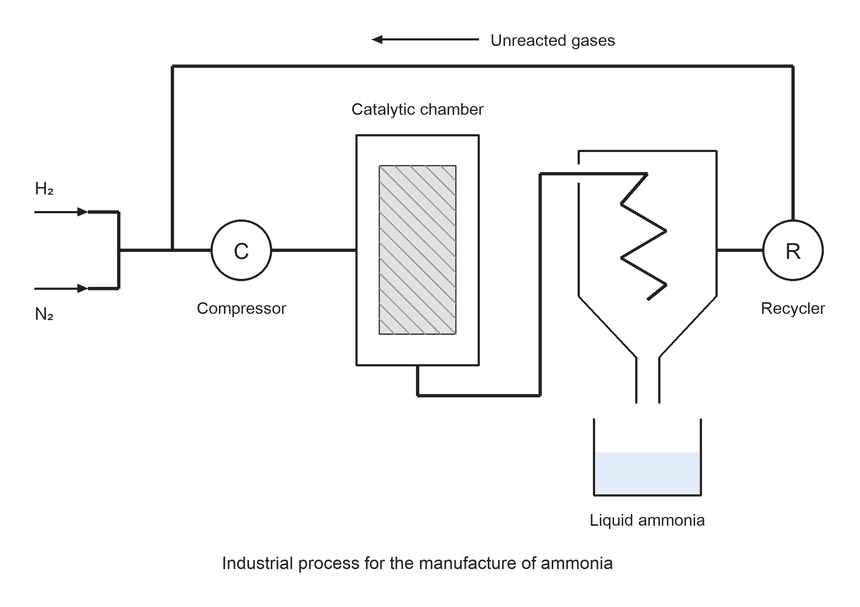
(a) Name the process.
(b) Which catalyst is used in the above process?
(c) In the above diagrammatic setup, how is ammonia gas separated from the unreacted gases to obtain liquid ammonia?
(d) Which two properties of ammonia gas can be demonstrated by the Fountain Experiment?
Solve with AIWritten solution
Solution:
Concept: The Haber process combines nitrogen and hydrogen (1 : 3 by volume) over a catalyst of finely divided iron, with molybdenum as promoter. The reaction is reversible and exothermic, and 4 volumes of gas give 2 volumes of ammonia, so the conditions are chosen to give a good yield at a useful speed. Ammonia is separated by cooling, because it liquefies far more easily than nitrogen or hydrogen. The fountain experiment shows how readily ammonia dissolves in water and that its solution is basic.
Step 1 — (a) Name the process.
Nitrogen and hydrogen are compressed (C), passed over a catalyst and the ammonia is cooled out, so this is the Haber process.
Step 2 — (b) Name the catalyst.
The catalyst is finely divided iron, with molybdenum as promoter.
Step 3 — (c) Separate the ammonia.
The hot gas mixture from the catalytic chamber still has much unreacted nitrogen and hydrogen. It is passed through cooling pipes (condenser), where ammonia liquefies, while nitrogen and hydrogen stay as gases. The liquid ammonia is run off, and the recycler R sends the unreacted gases back over the catalyst.
Step 4 — (d) Two properties shown by the fountain experiment.
A few drops of water dissolve so much ammonia that the pressure in the flask falls, and the outside air pushes the red litmus solution up as a fountain that turns blue.
- high solubility in water (the fountain);
- basic (alkaline) nature (the red litmus turns blue).
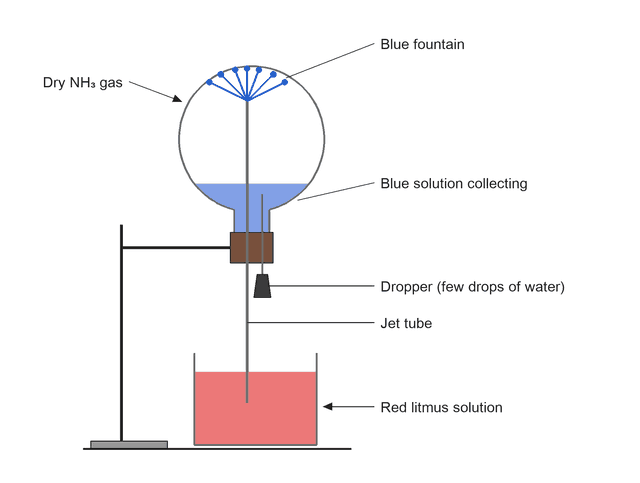
Watch out: Ammonia is separated by LIQUEFYING it (cooling), not by dissolving it in water.
Therefore, (a) Haber process; (b) finely divided iron; (c) by cooling, which liquefies the ammonia; (d) ammonia is highly soluble in water and its solution is basic.
- 441 mark
Question 44
Complete and balance the following equations:
(excess)
Solve with AIWritten solution
Solution:
Concept: The product of ammonia and chlorine depends on which gas is in excess. Chlorine always takes hydrogen from ammonia. With excess ammonia, the HCl formed combines with the extra ammonia to give white ammonium chloride, and nitrogen is set free. With excess chlorine, all three hydrogen atoms are replaced, giving nitrogen trichloride, a yellow, oily, explosive liquid.
Step 1 — Chlorine takes hydrogen from ammonia.
Chlorine removes the hydrogen of ammonia as HCl and sets nitrogen free.
Step 2 — The extra ammonia takes up the HCl.
Ammonia is in excess, so the HCl forms ammonium chloride.
Step 3 — Write the overall equation.
Adding the steps gives the balanced equation. Check: N 8 = 2 + 6, H 24 = 24, Cl 6 = 6.
Watch out: Check which gas is in excess: excess AMMONIA gives NH₄Cl + N₂; excess CHLORINE gives NCl₃ + HCl.
Therefore, 8NH₃ + 3Cl₂ → N₂ + 6NH₄Cl.
- 451 mark
Question 45
Complete the following sentences by choosing the correct word(s) from the brackets.
The drying agent not used for drying ammonia is ............... ( / )
Solve with AIWritten solution
Solution:
Concept: A drying agent must absorb water but must not react with the gas. Ammonia is basic, so the acidic drying agents (conc. sulphuric acid, phosphorus pentoxide) react with it, and anhydrous calcium chloride forms an addition compound with it. Only basic quicklime (CaO) is used.
Step 1 — Classify the two drying agents.
Quicklime, CaO, is a basic oxide. Phosphorus pentoxide, P₂O₅, is an acidic oxide.
Step 2 — See which one reacts with ammonia.
Phosphorus pentoxide reacts with ammonia (and the moisture) to form ammonium phosphate, so it cannot be used.
Therefore, The drying agent not used for drying ammonia is P₂O₅.
- 461 mark
Question 46
Complete the following sentences by choosing the correct word(s) from the brackets.
Ammonia reacts with excess chlorine to form ............... ( / )
Solve with AIWritten solution
Solution:
Concept: The product of ammonia and chlorine depends on which gas is in excess. Chlorine always takes hydrogen from ammonia. With excess ammonia, the HCl formed combines with the extra ammonia to give white ammonium chloride, and nitrogen is set free. With excess chlorine, all three hydrogen atoms are replaced, giving nitrogen trichloride, a yellow, oily, explosive liquid.
Step 1 — Find which gas is in excess.
The stem says chlorine is in excess.
Step 2 — Write the reaction.
Every hydrogen atom of ammonia is replaced by chlorine, giving nitrogen trichloride and hydrogen chloride.
Watch out: Check which gas is in excess: excess AMMONIA gives NH₄Cl + N₂; excess CHLORINE gives NCl₃ + HCl.
Therefore, Ammonia reacts with excess chlorine to form NCl₃.