
Question 171 markMCQAsked 2022Easy
An aqueous solution of ammonia is:
Confirming your payment
Sign up now and get 250 free tokens.
Previous Year Questions · Question 17 of 46
An aqueous solution of ammonia is:
(A) Neutral
(B) Acidic
(C) Basic
(D) Amphoteric
Answer: (C) Basic
Concept: Ammonia dissolves in water, and a small part of it takes a proton from water, giving ammonium ions and hydroxide ions (OH⁻). A solution that contains OH⁻ ions is basic (alkaline).
Step 1 — Ammonia reacts with water.
Ammonia dissolves in water to form ammonium hydroxide.
Step 2 — Ammonium hydroxide ionises partly.
Ammonium hydroxide gives hydroxide ions, but only a few of its molecules ionise, so it is a weak base.
Step 3 — Test the solution.
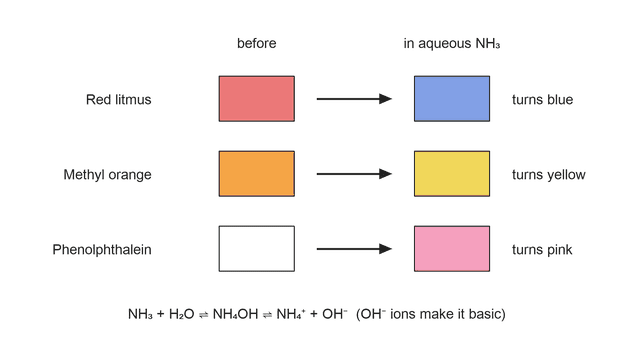
The solution turns red litmus blue, methyl orange yellow and phenolphthalein pink, so it is basic.
Watch out: Aqueous ammonia is a WEAK base: it is only partly ionised.
Why the other options are wrong:
Therefore, an aqueous solution of ammonia is basic, option (C).