
Question 123 marksAsked 2019Easy
Name the gas evolved in each of the following cases:
(i) Alumina undergoes electrolytic reduction.
(ii) Ethene undergoes hydrogenation reaction.
(iii) Ammonia reacts with heated copper oxide.
Confirming your payment
Sign up now and get 250 free tokens.
Previous Year Questions · Question 12 of 46
Name the gas evolved in each of the following cases:
(i) Alumina undergoes electrolytic reduction.
(ii) Ethene undergoes hydrogenation reaction.
(iii) Ammonia reacts with heated copper oxide.
Solution:
Concept: Name the gas leaving each reaction: the gas set free at the anode in (i), the gaseous product of adding hydrogen to ethene in (ii), and the gas formed when ammonia is oxidised in (iii).
Step 1 — (i) Electrolytic reduction of alumina.
Molten alumina (dissolved in cryolite) is electrolysed: aluminium forms at the cathode and oxygen is given off at the anode.
The oxygen attacks the hot carbon anodes, so oxides of carbon also form and the anodes have to be replaced from time to time.
Step 2 — (ii) Hydrogenation of ethene.
Ethene adds hydrogen over a nickel catalyst at about 200 °C, giving ethane, a gas.
Step 3 — (iii) Ammonia with heated copper oxide.
Ammonia is oxidised while the copper oxide is reduced to copper, so nitrogen is evolved.
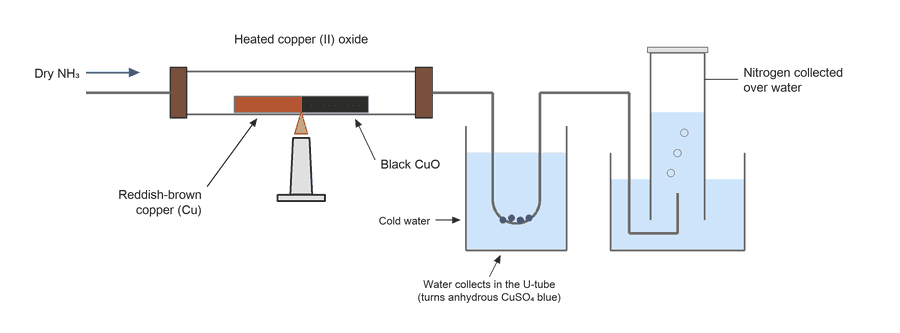
Watch out: In (ii) the hydrogen is used up, not given off; ethane is the gaseous product.
Note: As printed, "evolved" does not fit (ii) exactly, since hydrogen is taken up and no gas is set free; ethane is the gaseous product the question expects.
Therefore, (i) oxygen; (ii) ethane; (iii) nitrogen.