Solution:
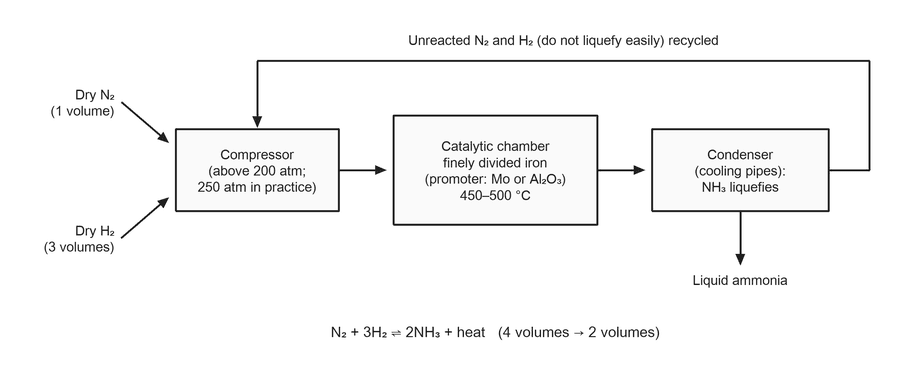
Concept: The Haber process combines nitrogen and hydrogen (1 : 3 by volume) over a catalyst of finely divided iron, with molybdenum as promoter. The reaction is reversible and exothermic, and 4 volumes of gas give 2 volumes of ammonia, so the conditions are chosen to give a good yield at a useful speed.
Step 1 — Write the reaction.
This is the Haber process.
N2+3H2⇌2NH3+heat
Step 2 — (a) Name the catalyst.
The catalyst is finely divided iron, with molybdenum as a promoter to increase its efficiency. Finely divided iron has a large surface area.
Step 3 — (b) State the temperature.
The optimum temperature is 450–500 °C. A lower temperature would favour the exothermic forward reaction, but the reaction would then be too slow.
Step 4 — (c) State the optimum pressure.
A pressure above 200 atm is maintained. Since 4 volumes of reactants give 2 volumes of ammonia, a high pressure favours the formation of ammonia.
Watch out: The catalyst only speeds up the reaction; it does not change the yield.
Note: The textbook range for the pressure is 200–900 atm; most modern plants work at about 150–300 atm.
Therefore, (a) finely divided iron (molybdenum promoter); (b) 450–500 °C; (c) above 200 atm.
