Solution:
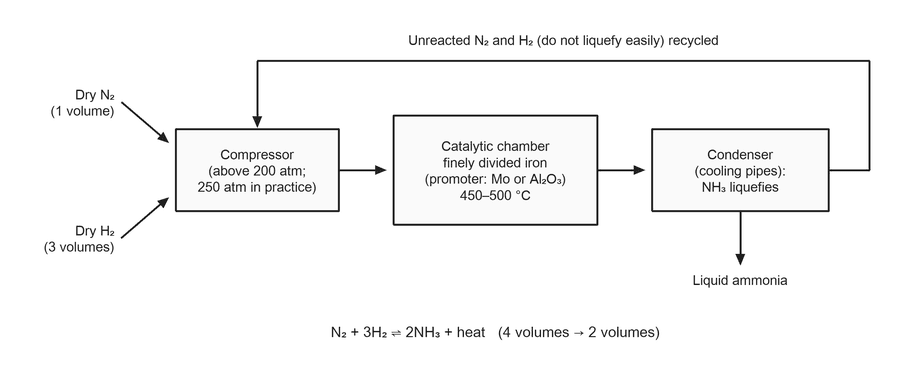
Concept: The Haber process combines nitrogen and hydrogen (1 : 3 by volume) over a catalyst of finely divided iron, with molybdenum as promoter. The reaction is reversible and exothermic, and 4 volumes of gas give 2 volumes of ammonia, so the conditions are chosen to give a good yield at a useful speed. Ammonia is separated by cooling, because it liquefies far more easily than nitrogen or hydrogen. The fountain experiment shows how readily ammonia dissolves in water and that its solution is basic.
Step 1 — (a) Name the process.
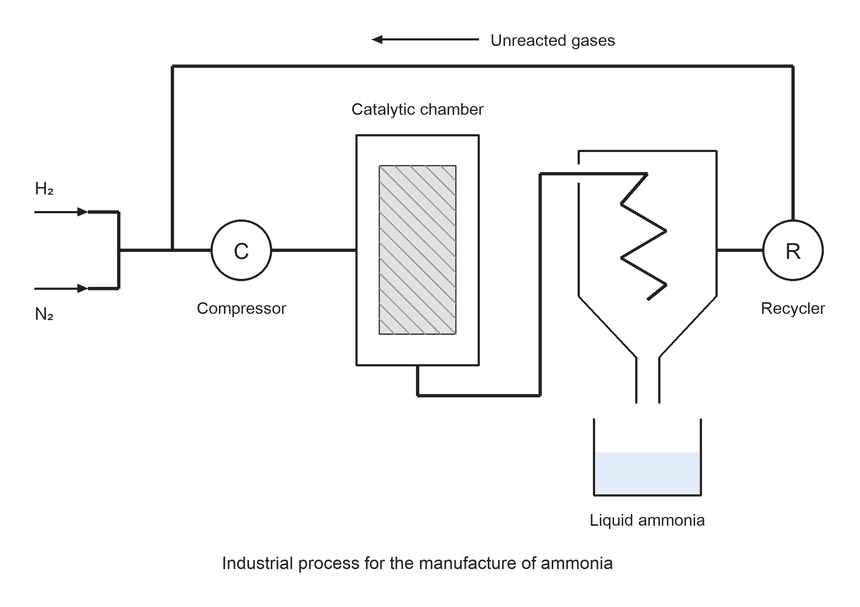
Nitrogen and hydrogen are compressed (C), passed over a catalyst and the ammonia is cooled out, so this is the Haber process.
N2+3H2⇌2NH3+heat
Step 2 — (b) Name the catalyst.
The catalyst is finely divided iron, with molybdenum as promoter.
Step 3 — (c) Separate the ammonia.
The hot gas mixture from the catalytic chamber still has much unreacted nitrogen and hydrogen. It is passed through cooling pipes (condenser), where ammonia liquefies, while nitrogen and hydrogen stay as gases. The liquid ammonia is run off, and the recycler R sends the unreacted gases back over the catalyst.
Step 4 — (d) Two properties shown by the fountain experiment.
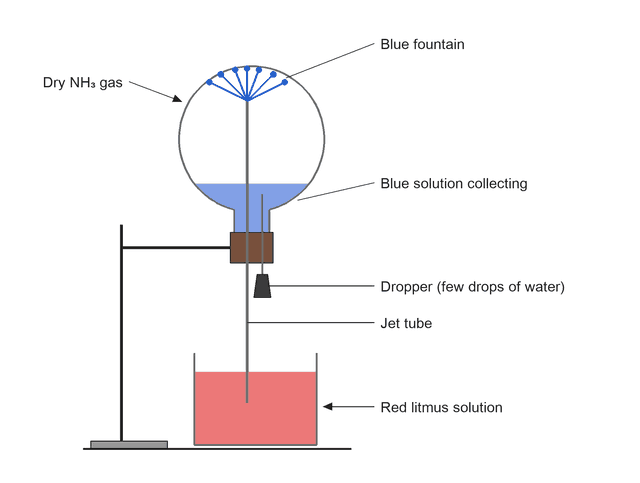
A few drops of water dissolve so much ammonia that the pressure in the flask falls, and the outside air pushes the red litmus solution up as a fountain that turns blue.
- high solubility in water (the fountain);
- basic (alkaline) nature (the red litmus turns blue).
Watch out: Ammonia is separated by LIQUEFYING it (cooling), not by dissolving it in water.
Therefore, (a) Haber process; (b) finely divided iron; (c) by cooling, which liquefies the ammonia; (d) ammonia is highly soluble in water and its solution is basic.