State one relevant observation for each of the following
Question 253 marksAsked 2023Medium
State one relevant observation for each of the following:
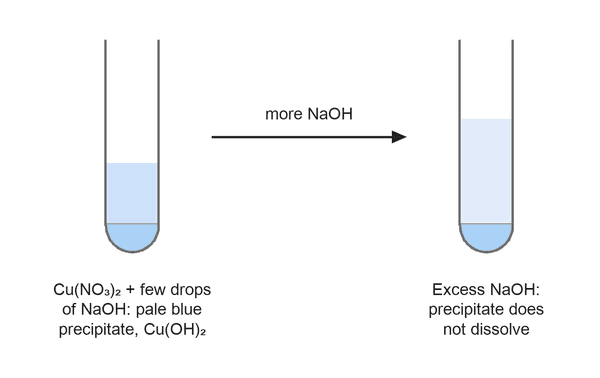
(a) To the copper nitrate solution, initially few drops of sodium hydroxide solution is added and then added in excess.
(b) Burning of ammonia in excess of oxygen.
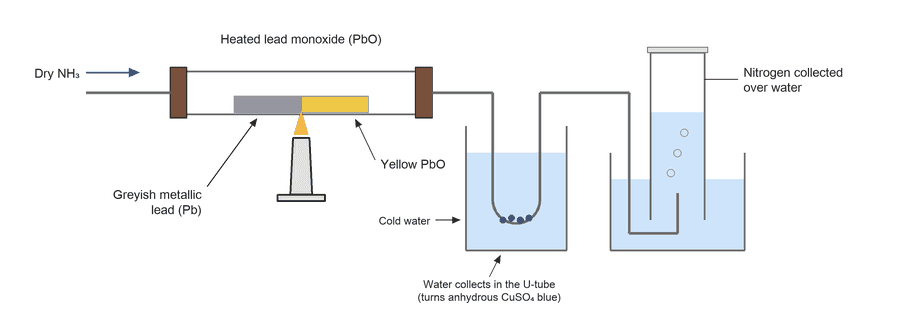
(c) Dry ammonia gas is passed over heated PbO.
Solution:
Concept: (a) Sodium hydroxide precipitates copper(II) hydroxide, which does not dissolve in excess sodium hydroxide. (b) Ammonia burns in oxygen. (c) Ammonia is a reducing agent: it removes oxygen from heated oxides of less active metals (copper, lead) and is itself oxidised to nitrogen. The hydrogen of the ammonia ends up in water.
Step 1 — (a) Sodium hydroxide added to copper nitrate.
A few drops of sodium hydroxide give a pale blue precipitate of copper(II) hydroxide, which does not dissolve in excess sodium hydroxide.
Cu(NO3)2+2NaOH→Cu(OH)2↓+2NaNO3
Step 2 — (b) Ammonia burning in excess oxygen.
Ammonia burns with a greenish-yellow flame, forming nitrogen and water vapour.
4NH3+3O2→2N2+6H2O
Step 3 — (c) Dry ammonia over heated lead monoxide.
The buff-yellow lead monoxide turns greyish (metallic lead); droplets of water form and nitrogen gas is given off.
2NH3+3PbOΔ3Pb+3H2O+N2↑
Watch out: In (a) it is AMMONIUM hydroxide in excess that dissolves the blue precipitate (deep blue solution); sodium hydroxide does not.
Therefore, (a) a pale blue precipitate forms that does not dissolve in excess NaOH; (b) ammonia burns with a greenish-yellow flame; (c) the yellow PbO turns grey (lead).