Solution:
Concept: The product of ammonia and chlorine depends on which gas is in excess. Chlorine always takes hydrogen from ammonia. With excess ammonia, the HCl formed combines with the extra ammonia to give white ammonium chloride, and nitrogen is set free. With excess chlorine, all three hydrogen atoms are replaced, giving nitrogen trichloride, a yellow, oily, explosive liquid.
Step 1 — Find the missing condition.
The products named, ammonium chloride and nitrogen, form only when ammonia is in excess, so the missing word is "excess" before ammonia.
Step 2 — Write the reaction for excess ammonia.
The extra ammonia takes up the HCl formed.
8NH3+3Cl2→6NH4Cl+N2
Step 3 — Compare with excess chlorine.
With excess chlorine the products would be different: nitrogen trichloride and hydrogen chloride.
NH3+3Cl2→NCl3+3HCl
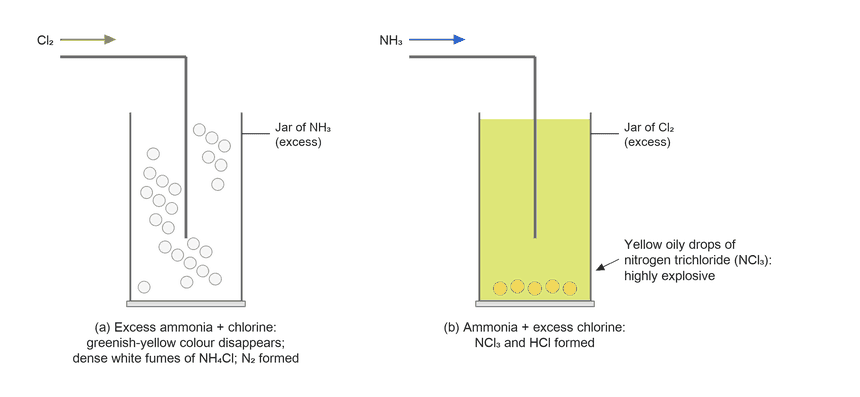
Watch out: Check which gas is in excess: excess AMMONIA gives NH₄Cl + N₂; excess CHLORINE gives NCl₃ + HCl.
Therefore, Excess ammonia reacts with chlorine to give ammonium chloride and nitrogen.
