Solution:
Concept: Both are industrial processes in which a reversible, exothermic reaction is speeded up by a catalyst: iron for ammonia (Haber process) and vanadium pentoxide for sulphur trioxide, the key step in making sulphuric acid (Contact process).
Step 1 — Fill in the table.
Each process is named after its key step, and the catalyst is written over the arrow of its equation.
| Name of the compound | Name of the process | Catalytic equation [with the catalyst] |
|---|
| Ammonia | (i) Haber process | (ii) N₂ + 3H₂ ⇌ 2NH₃ over finely divided iron |
| Sulphuric acid | (iii) Contact process | (iv) 2SO₂ + O₂ ⇌ 2SO₃ over vanadium pentoxide |
Step 2 — (ii) Catalytic equation for ammonia.
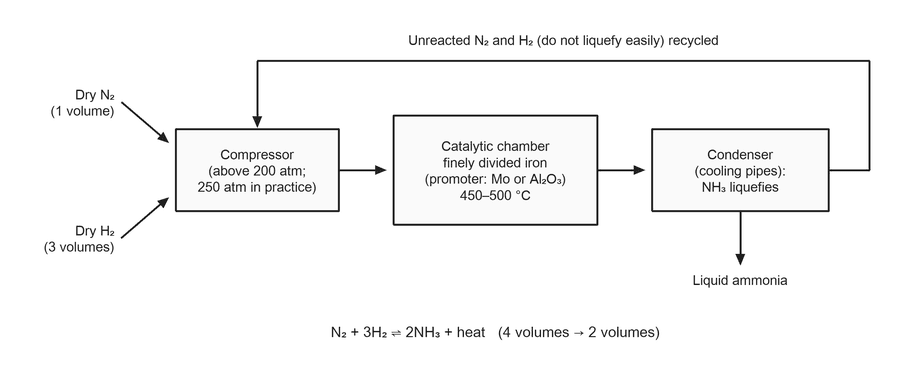
Nitrogen and hydrogen (1 : 3 by volume) are passed over finely divided iron, with molybdenum as promoter, at 450–500 °C and above 200 atm.
N2+3H2Fe catalyst, Mo promoter⇌450–500 °C, above 200 atm2NH3+heat
Step 3 — (iv) Catalytic equation for sulphuric acid.
Sulphur dioxide and oxygen are passed over vanadium pentoxide at about 450 °C; the sulphur trioxide formed is then turned into sulphuric acid.
2SO2+O2⇌vanadium pentoxide, 450 °C2SO3+heat
Watch out: Write the catalyst over the arrow and use the reversible sign (⇌) for both reactions.
Therefore, (i) Haber process; (ii) N₂ + 3H₂ ⇌ 2NH₃ (iron catalyst); (iii) Contact process; (iv) 2SO₂ + O₂ ⇌ 2SO₃ (V₂O₅ catalyst).
