
Question 193 marksAsked 2022Medium
State the observation for the following:
(a) Dry ammonia gas reacts with oxygen in the presence of a catalyst.
(b) Excess chlorine gas reacts with ammonia gas.
(c) Carbon reacts with hot concentrated nitric acid.
Confirming your payment
Sign up now and get 250 free tokens.
Previous Year Questions · Question 19 of 46
State the observation for the following:
(a) Dry ammonia gas reacts with oxygen in the presence of a catalyst.
(b) Excess chlorine gas reacts with ammonia gas.
(c) Carbon reacts with hot concentrated nitric acid.
Solution:
Concept: (a) Ammonia is oxidised to nitric oxide over a platinum catalyst. (b) With excess chlorine, ammonia gives nitrogen trichloride. (c) Hot concentrated nitric acid is a strong oxidising agent: it oxidises carbon to carbon dioxide and is itself reduced to nitrogen dioxide.
Step 1 — (a) Ammonia with oxygen over a catalyst.
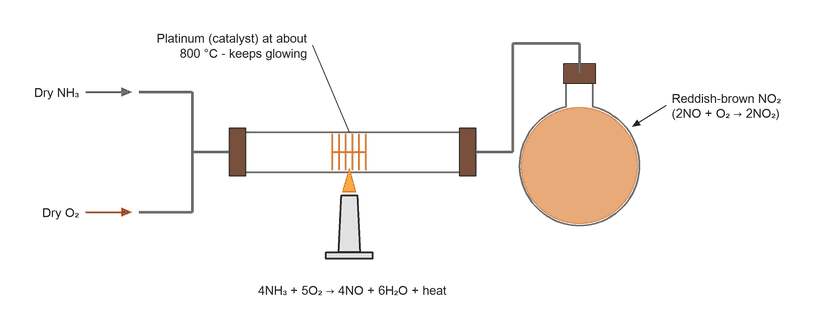
Ammonia is oxidised over heated platinum to colourless nitric oxide. The platinum keeps glowing after the heating stops, because the reaction gives out heat.
Step 2 — (a) The brown gas.
The nitric oxide combines with more oxygen to give reddish-brown fumes of nitrogen dioxide.
Step 3 — (b) Excess chlorine with ammonia.
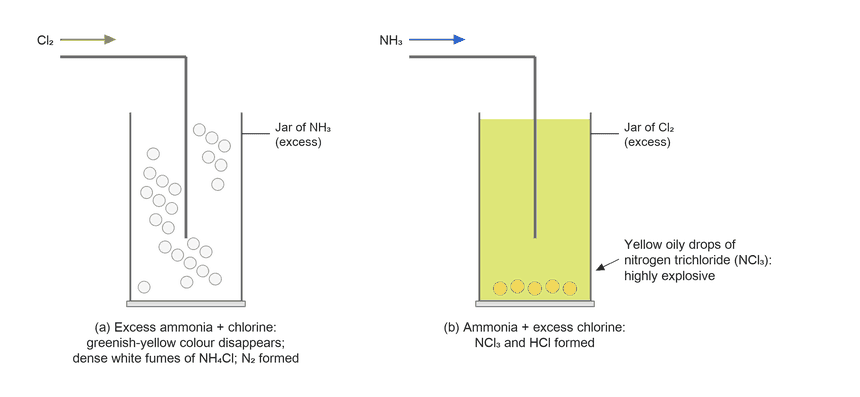
A yellow, oily, highly explosive liquid, nitrogen trichloride, forms together with hydrogen chloride.
Step 4 — (c) Carbon with hot conc. nitric acid.
Reddish-brown fumes of nitrogen dioxide are given off and the carbon slowly disappears as it is oxidised to carbon dioxide. Check: C 1 = 1, H 4 = 4, N 4 = 4, O 12 = 2 + 2 + 8.
Therefore, (a) the platinum keeps glowing and reddish-brown fumes (NO₂) appear; (b) a yellow, oily, explosive liquid (NCl₃) forms; (c) reddish-brown fumes of NO₂ are given off.