
Question 281 markMCQAsked 2024Easy
On passing ammonia gas over heated copper oxide for some time, a reddish-brown residue is left behind. What property of ammonia is demonstrated here?
Confirming your payment
Sign up now and get 250 free tokens.
Previous Year Questions · Question 28 of 46
On passing ammonia gas over heated copper oxide for some time, a reddish-brown residue is left behind. What property of ammonia is demonstrated here?
(A) Basic property
(B) Oxidising property
(C) Reducing property
(D) Acidic property
Answer: (C) Reducing property
Concept: A reducing agent removes oxygen from a substance (or adds hydrogen to it) and is itself oxidised.
Step 1 — Write the reaction.
Ammonia passed over heated copper oxide gives copper, water and nitrogen.
Step 2 — Explain the residue.
The black copper(II) oxide loses its oxygen and becomes reddish-brown copper, which is the residue seen.
Step 3 — Name the property.
Ammonia takes the oxygen away and is itself oxidised to nitrogen, so it acts as a reducing agent.
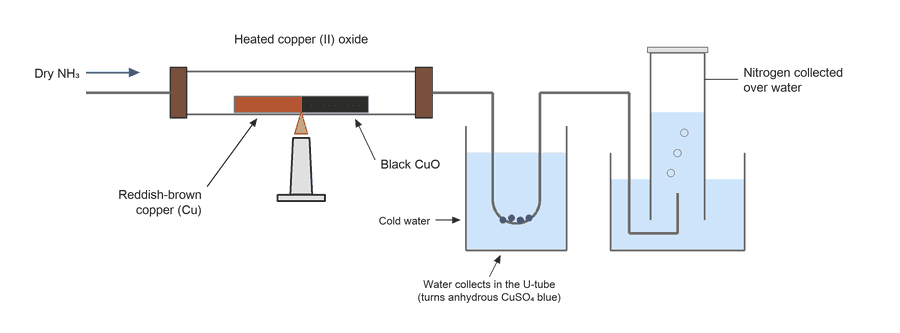
Watch out: The colour change is in the copper oxide; it shows what ammonia DOES to the oxide (reduces it).
Why the other options are wrong:
Therefore, the reaction shows the reducing property of ammonia, option (C).