
Question 331 markAsked 2025Easy
Match the Column A with Column B:
| Column A | Column B |
|---|---|
| (a) | 1. Vanadium Pentoxide |
| 2. Nickel | |
| 3. Iron | |
| 4. Concentrated Sulphuric acid | |
| 5. Platinum |
Confirming your payment
Sign up now and get 250 free tokens.
Previous Year Questions · Question 33 of 46
Match the Column A with Column B:
| Column A | Column B |
|---|---|
| (a) | 1. Vanadium Pentoxide |
| 2. Nickel | |
| 3. Iron | |
| 4. Concentrated Sulphuric acid | |
| 5. Platinum |
Solution:
Concept: Each industrial reaction has its own catalyst: iron for the Haber process (ammonia), platinum for the catalytic oxidation of ammonia (Ostwald process), vanadium pentoxide for the Contact process (sulphur trioxide) and nickel for the hydrogenation of oils and alkenes.
Step 1 — Recognise the reaction.
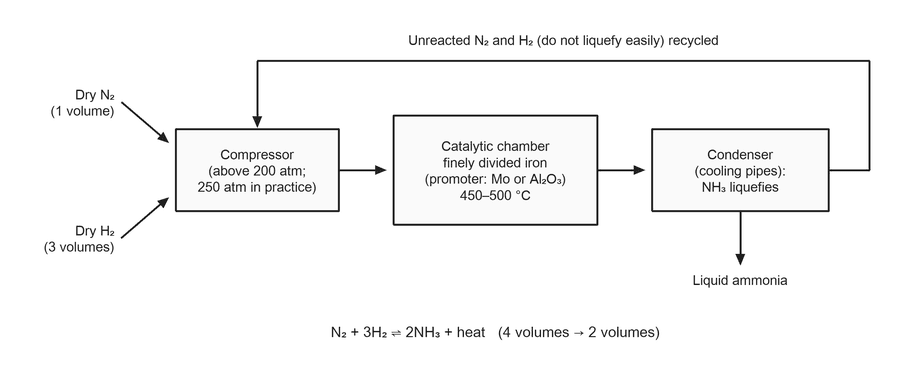
N₂ + 3H₂ ⇌ 2NH₃ is the Haber process for ammonia.
Step 2 — Choose its catalyst.
The Haber process uses finely divided iron (with molybdenum as promoter), so (a) matches 3.
Step 3 — Rule out the others.
Vanadium pentoxide is the Contact-process catalyst, nickel the hydrogenation catalyst, platinum the catalyst for oxidising ammonia, and concentrated sulphuric acid is not a catalyst for this reaction.
Therefore, (a) → 3. Iron.