(i) Write the balanced chemical equation to prepare ammonia gas in the laboratory by using an alkali.
Question 93 marksAsked 2018Easy
(i) Write the balanced chemical equation to prepare ammonia gas in the laboratory by using an alkali.
(ii) State why concentrated sulphuric acid is not used for drying ammonia gas.
(iii) Why is ammonia gas not collected over water?
Solution:
Concept: In the laboratory, ammonia is made by heating an ammonium salt with an alkali. The hydroxide ion of the alkali takes a proton (H⁺) from the ammonium ion, so ammonia gas is driven off. Three properties of ammonia decide how it is handled: it is basic (so it is dried by a basic drying agent), it is lighter than air (vapour density 8.5, air 14.4) and it is extremely soluble in water (so it is never collected over water).
Step 1 — (i) Write the equation.
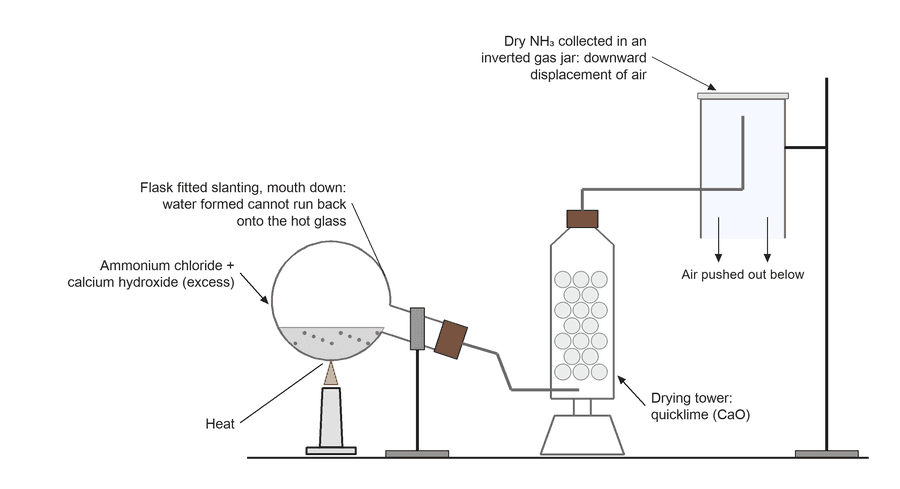
Ammonium chloride is heated with excess calcium hydroxide (slaked lime), an alkali. Check: N 2 = 2, H 10 = 10, Cl 2 = 2, Ca 1 = 1, O 2 = 2.
2NH4Cl+Ca(OH)2ΔCaCl2+2H2O+2NH3↑
Step 2 — (ii) Why conc. sulphuric acid is not used.
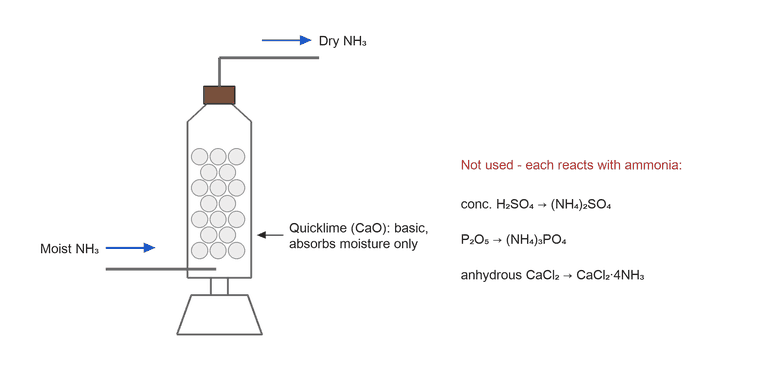
A drying agent must remove only water and must not react with the gas. Ammonia is a base and conc. sulphuric acid is an acid, so the acid would react with and absorb the ammonia, forming ammonium sulphate.
2NH3+H2SO4→(NH4)2SO4
Ammonia is dried with quicklime (CaO) instead.
Step 3 — (iii) Why it is not collected over water.
Ammonia is extremely soluble in water: about 700 volumes of ammonia dissolve in 1 volume of water at 20 °C. Bubbled into water, the gas would dissolve instead of collecting in the jar.
Watch out: Anhydrous calcium chloride, the usual neutral drying agent, cannot be used either: it forms CaCl₂·4NH₃.
Therefore, (i) 2NH₄Cl + Ca(OH)₂ → CaCl₂ + 2H₂O + 2NH₃↑; (ii) conc. H₂SO₄ is an acid and reacts with basic ammonia to form (NH₄)₂SO₄; (iii) ammonia is highly soluble in water.