Certain blank spaces are left in the following table and these are labelled as A, B, C, D and E.
Question 85 marksAsked 2017Medium
Certain blank spaces are left in the following table and these are labelled as A, B, C, D and E. Identify each of them.
Lab preparation of
Reactants used
Products formed
Drying agent
Method of collection
HCl gas
NaCl + H2SO4
A
Conc. H2SO4
B
NH3 gas
C
Mg(OH)2, NH3
D
E
Solution:
Concept: Each laboratory preparation follows from the gas's properties. HCl is acidic, heavier than air and very soluble: it is dried by conc. sulphuric acid and collected by upward displacement of air. NH₃ is basic, lighter than air and very soluble: it needs a basic drying agent and downward displacement of air.
Step 1 — Find A, the products of the HCl preparation.
Sodium chloride is heated with conc. sulphuric acid below 200 °C. The products are sodium hydrogen sulphate and hydrogen chloride.
NaCl+H2SO4below 200 °CNaHSO4+HCl↑
Step 2 — Find B, the collection of HCl.
Hydrogen chloride is heavier than air (vapour density 18.25, air 14.4) and very soluble in water, so it is collected by upward displacement of air.
Step 3 — Find C, the reactants for ammonia.
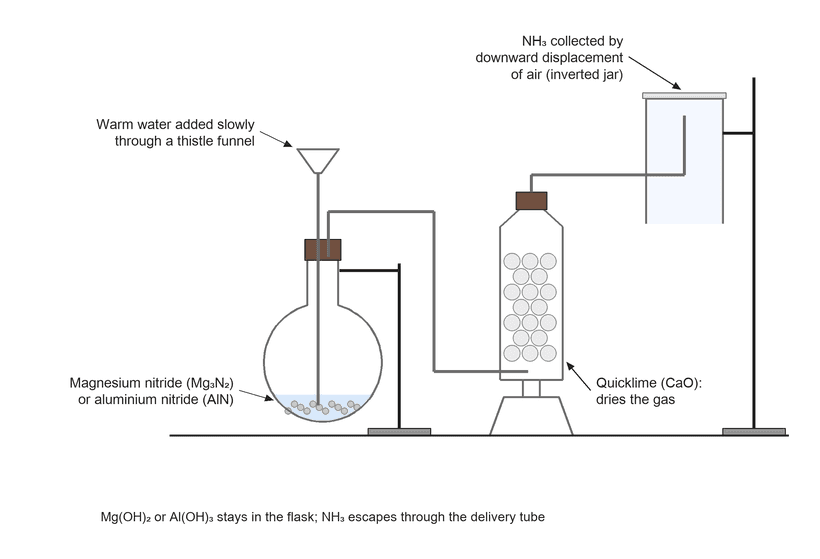
The products are magnesium hydroxide and ammonia, which come from a nitride and water. So C is magnesium nitride and warm water.
Mg3N2+6H2O→3Mg(OH)2+2NH3↑
Step 4 — Find D, the drying agent for ammonia.
Ammonia is basic, so it is dried with quicklime (calcium oxide). Conc. sulphuric acid and phosphorus pentoxide are acidic and react with it, and anhydrous calcium chloride forms CaCl₂·4NH₃ with it.
Step 5 — Find E, the collection of ammonia.
Ammonia is lighter than air (vapour density 8.5) and very soluble in water, so it is collected by downward displacement of air in inverted gas jars.
Watch out: Ammonia is collected by DOWNWARD displacement of air (jar held mouth down) because it is lighter than air; hydrogen chloride, which is heavier, is collected by UPWARD displacement.
Therefore, A: NaHSO₄ + HCl; B: upward displacement of air; C: magnesium nitride (Mg₃N₂) + warm water; D: quicklime (CaO); E: downward displacement of air.