
Question 32 marksAsked 2016Medium
Write balanced chemical equations for each of the following:
(i) When excess of ammonia is treated with chlorine.
(ii) An equation to illustrate the reducing nature of ammonia.
Confirming your payment
Sign up now and get 250 free tokens.
Previous Year Questions · Question 3 of 46
Write balanced chemical equations for each of the following:
(i) When excess of ammonia is treated with chlorine.
(ii) An equation to illustrate the reducing nature of ammonia.
Solution:
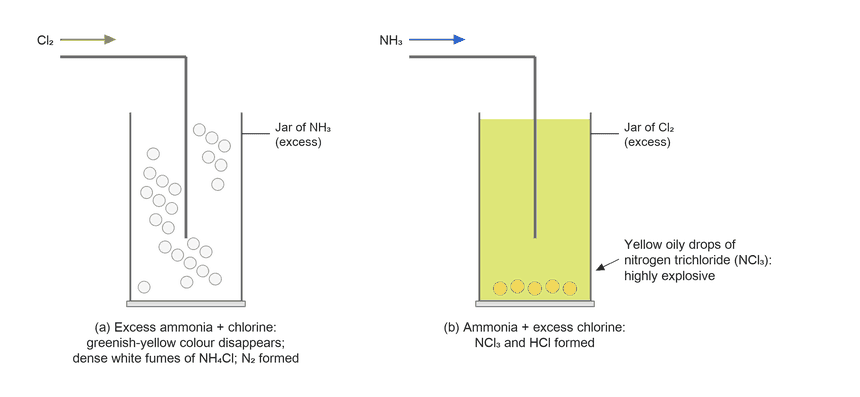
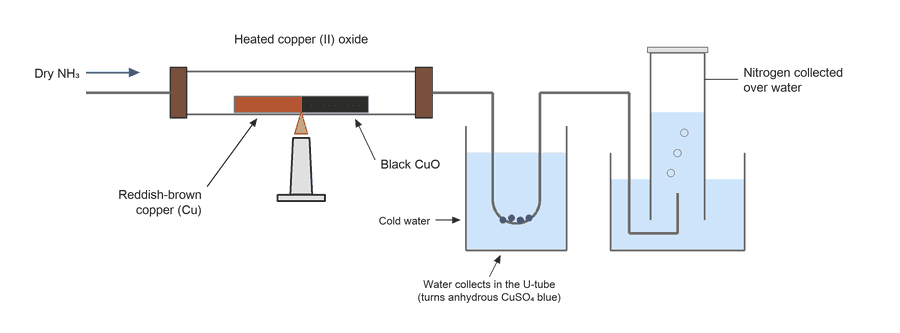
Concept: The product of ammonia and chlorine depends on which gas is in excess. Chlorine always takes hydrogen from ammonia. With excess ammonia, the HCl formed combines with the extra ammonia to give white ammonium chloride, and nitrogen is set free. With excess chlorine, all three hydrogen atoms are replaced, giving nitrogen trichloride, a yellow, oily, explosive liquid. Ammonia is a reducing agent: it removes oxygen from heated oxides of less active metals (copper, lead) and is itself oxidised to nitrogen. The hydrogen of the ammonia ends up in water.
Step 1 — (i) Chlorine takes hydrogen from ammonia.
Chlorine has a strong attraction for hydrogen. It removes the hydrogen of ammonia as hydrogen chloride and sets nitrogen free.
Step 2 — (i) The HCl combines with the excess ammonia.
Ammonia is in excess, so the hydrogen chloride formed meets more ammonia and combines with it to give ammonium chloride.
Step 3 — (i) Add the two steps.
Adding the two equations and cancelling the 6HCl that is formed and used up gives the overall equation. Check: N 8 = 2 + 6, H 24 = 24, Cl 6 = 6.
The greenish-yellow colour of chlorine disappears and dense white fumes of ammonium chloride form.
Step 4 — (ii) Show ammonia as a reducing agent.
When dry ammonia is passed over heated copper(II) oxide, it removes the oxygen and reduces the oxide to copper; ammonia itself is oxidised to nitrogen.
The black copper(II) oxide turns reddish brown (copper). Heated lead monoxide is reduced in the same way.
Watch out: Check which gas is in excess: excess AMMONIA gives NH₄Cl + N₂; excess CHLORINE gives NCl₃ + HCl.
Therefore, (i) 8NH₃ + 3Cl₂ → N₂ + 6NH₄Cl; (ii) 2NH₃ + 3CuO → 3Cu + 3H₂O + N₂ (ammonia reduces copper oxide).