
Question 92 marksMedium
An element has 2 electrons in its N shell. It reacts with a non-metal of atomic number 7. The compound formed reacts with warm water and produces a basic gas. Identify the elements and write the balanced chemical reactions.
Confirming your payment
Sign up now and get 250 free tokens.
Study of Compounds – Ammonia · Question 9 of 67
An element has 2 electrons in its N shell. It reacts with a non-metal of atomic number 7. The compound formed reacts with warm water and produces a basic gas. Identify the elements and write the balanced chemical reactions.
Solution:
Concept: The shells are named K, L, M, N from the nucleus outwards, so the N shell is the fourth shell. A metal nitride reacts with warm water to give ammonia, the only common basic gas.
Step 1 — Identify the metal.
For an element with only two electrons in its fourth shell, the K, L and M shells hold 2, 8 and 8 electrons, so the configuration is 2, 8, 8, 2. The atomic number is 2 + 8 + 8 + 2 = 20, which is calcium (Ca).
Step 2 — Identify the non-metal.
Atomic number 7 has the configuration 2, 5. This is nitrogen (N).
Step 3 — Form the compound.
Calcium has valency 2 and nitrogen valency 3, so they combine as , calcium nitride:
Step 4 — React it with warm water.
The nitride is hydrolysed by warm water to calcium hydroxide and ammonia, the basic gas:
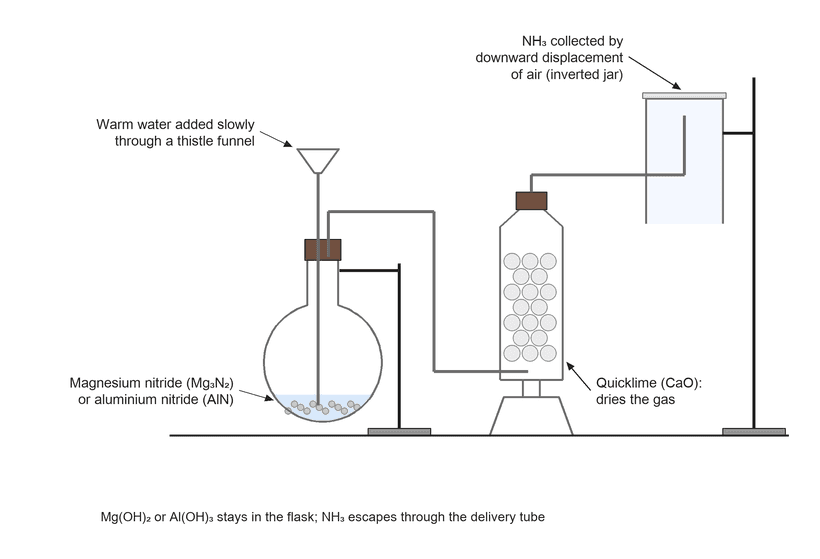
The same apparatus is used with magnesium nitride or aluminium nitride.
Watch out: The N shell is a shell name (the fourth shell), not the element nitrogen.
Therefore, the elements are calcium and nitrogen; they form Ca₃N₂, which gives ammonia with warm water.