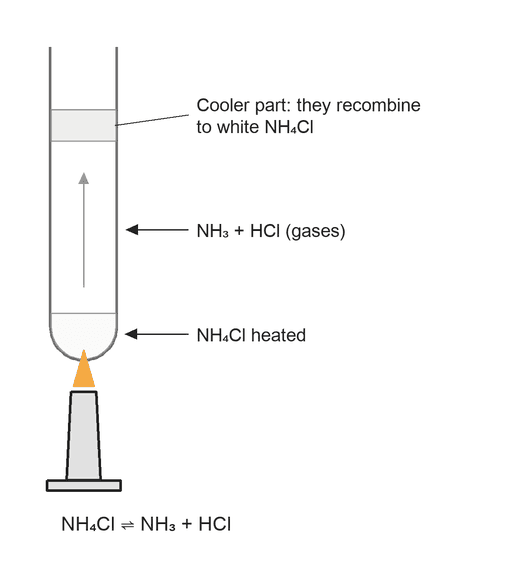
Concept: A soluble salt is made by neutralisation (acid + base). When a substance splits on heating and the parts join again on cooling, it is thermal dissociation (reversible); if they do not rejoin, it is thermal decomposition. Any ammonium salt heated with an alkali gives ammonia.
Step 1 — (a) Choose the method of preparation.
Ammonium chloride is soluble, so it cannot be collected as a precipitate; it is made by neutralization of ammonium hydroxide with hydrochloric acid:
NH4OH+HCl→NH4Cl+H2O
Step 2 — (b) Choose dissociation or decomposition.
On heating, ammonium chloride splits into ammonia and hydrogen chloride, and the two gases recombine on the cooler part of the tube. So it undergoes thermal dissociation:
NH4Cl⇌ΔNH3+HCl
Step 3 — (c) Choose the product with sodium hydroxide.
Sodium hydroxide is an alkali, so warming it with ammonium chloride gives ammonia:
NH4Cl+NaOHΔNaCl+H2O+NH3↑
Watch out: Precipitation is used only for insoluble salts; ammonium salts are all soluble.
Therefore, (a) neutralization, (b) thermal dissociation and (c) ammonia complete the sentences.