The following reactions are carried out : A : Nitrogen + metal compound X.
Question 105 marksMedium
The following reactions are carried out :
A : Nitrogen + metal → compound X.
B : X + water → ammonia + another compound.
C : Ammonia + metal oxide → metal + water + N2.
One metal that can be used for reaction A is magnesium.
(a) Write the formula of the compound X formed.
(b) Write the correctly balanced equation for reaction B where X is the compound formed.
(c) What property of ammonia is demonstrated by reaction C ?
Solution:
Concept: Magnesium burns in nitrogen to form magnesium nitride, which gives ammonia with water. When ammonia removes oxygen from a metal oxide, it is acting as a reducing agent.
Step 1 — (a) Write the formula of X.
Magnesium (valency 2) and nitrogen (valency 3) combine as Mg3N2, magnesium nitride:
3Mg+N2ΔMg3N2
Step 2 — (b) Write the equation for reaction B.
Magnesium nitride reacts with water to give magnesium hydroxide and ammonia. Count: Mg 3 = 3, N 2 = 2, H 12 = 6 + 6, O 6 = 6.
Mg3N2+6H2O→3Mg(OH)2+2NH3↑
Step 3 — (c) Name the property shown by reaction C.
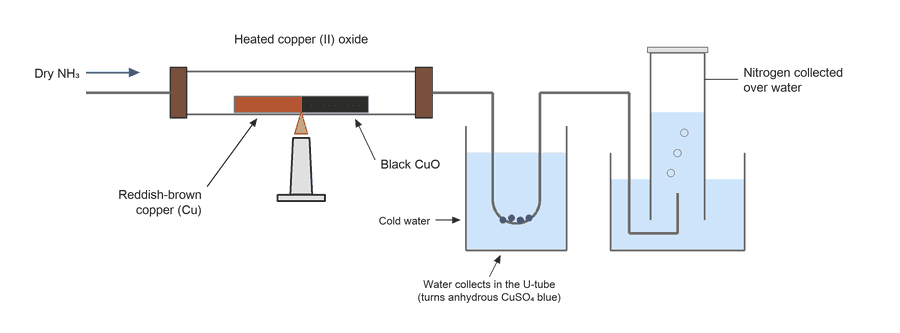
In reaction C the metal oxide loses oxygen and becomes the metal, so it is reduced; ammonia loses its hydrogen and becomes nitrogen, so it is oxidised. Ammonia is therefore a reducing agent. For example, with copper (II) oxide:
2NH3+3CuOΔ3Cu+3H2O+N2↑
The black copper (II) oxide turns reddish brown (copper), water droplets form and nitrogen is given off.
Watch out: Ammonia is oxidised in reaction C; the property shown is its reducing nature, not its basic nature.
Therefore, X is Mg₃N₂, reaction B is Mg₃N₂ + 6H₂O → 3Mg(OH)₂ + 2NH₃, and reaction C shows that ammonia is a reducing agent.