Solution:
Concept: To correct a statement, find the one wrong fact in it (a colour, a name, a catalyst, a reagent or a missing condition) and replace it with the right one.
Step 1 — (a) Correct the colour.
Ferrous sulphate is an iron (II) salt, and iron (II) hydroxide is dirty green. Corrected: A dirty green precipitate is obtained when ammonium hydroxide is added to ferrous sulphate. (A reddish brown precipitate comes from a ferric salt.)
FeSO4+2NH4OH→Fe(OH)2↓+(NH4)2SO4
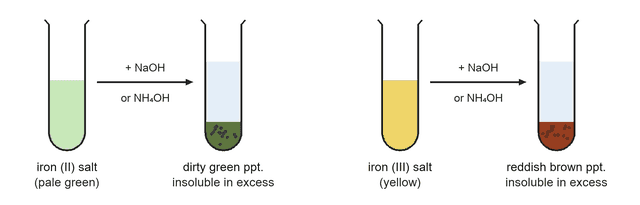
Step 2 — (b) Correct the description of liquid ammonia.
Liquid ammonia is pure ammonia gas liquefied by pressure. Corrected: Liquid ammonia is liquefied ammonia gas (pure NH₃); a solution of NH₃ in water is liquor ammonia (aqueous ammonia).
Step 3 — (c) Correct the catalyst.
Platinum is the catalyst of the Ostwald process. Corrected: Finely divided iron is used in the Haber process.
Step 4 — (d) Correct the drying agent.
Conc. sulphuric acid reacts with ammonia to form ammonium sulphate. Corrected: Quicklime (CaO) is a drying agent for NH₃.
Step 5 — (e) Add the missing reagent.
Ammonium salts give ammonia only when heated with an alkali; heated alone, they dissociate or decompose (ammonium nitrate gives nitrous oxide). Corrected: Ammonium salts, on heating with an alkali, give ammonia.
Watch out: A ferrous (iron (II)) salt gives a dirty green precipitate, and a ferric (iron (III)) salt a reddish brown one. Mixing up the two names is the commonest slip here.
Therefore, the corrected statements use dirty green, liquefied ammonia gas, finely divided iron, quicklime and heating with an alkali.
