
Question 402 marksEasy
Name two gases which can be used to study the fountain experiment. State the common property demonstrated by the fountain experiment.
Confirming your payment
Sign up now and get 250 free tokens.
Study of Compounds – Ammonia · Question 40 of 67
Name two gases which can be used to study the fountain experiment. State the common property demonstrated by the fountain experiment.
Solution:
Concept: The fountain forms because the gas is so highly soluble that a few drops of water dissolve most of it. This leaves a partial vacuum in the flask, and the air pressure outside pushes the liquid up the jet tube.
Step 1 — Name two gases.
Ammonia and hydrogen chloride are both very highly soluble in water, so both give the fountain.
Step 2 — Start the fountain with ammonia.
A few drops of water are squeezed into the flask of dry ammonia. The ammonia dissolves and the pressure inside falls.
Step 3 — Explain the blue fountain.
The higher outside pressure forces red litmus solution up the jet tube. It comes out as a blue fountain, because ammonia solution is basic.
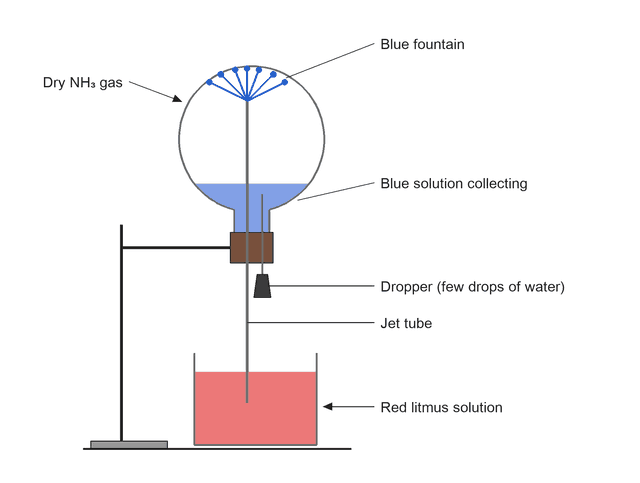
With hydrogen chloride, blue litmus solution is used and a red fountain is seen, because HCl is acidic.
Watch out: The fountain shows high solubility; the colour change shows the acidic or basic nature as an extra point.
Therefore, ammonia and hydrogen chloride can be used, and the common property shown is very high solubility in water.