
Question 545 marksEasy
(a) Is ammonia more dense or less dense than air?
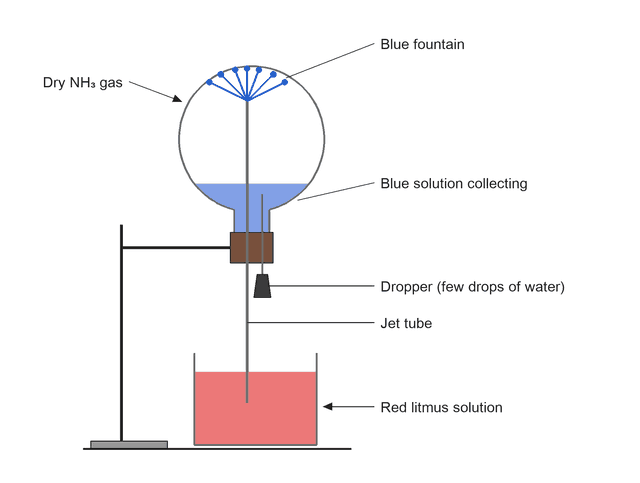
(b) What property of ammonia is demonstrated by the Fountain Experiment?
(c) Write the balanced equation for the reaction between ammonia and sulphuric acid.
Confirming your payment
Sign up now and get 250 free tokens.
Study of Compounds – Ammonia · Question 54 of 67
(a) Is ammonia more dense or less dense than air?
(b) What property of ammonia is demonstrated by the Fountain Experiment?
(c) Write the balanced equation for the reaction between ammonia and sulphuric acid.
Solution:
Concept: The vapour density (V.D.) of a gas tells how heavy it is compared with hydrogen: V.D. = relative molecular mass ÷ 2. Air behaves like a gas of V.D. about 14.4. A gas with V.D. below 14.4 is lighter than air; above 14.4, heavier.
Step 1 — (a) Find the vapour density of ammonia.
The relative molecular mass of is 14 + 3 × 1 = 17, so
This is less than 14.4, so ammonia is less dense than air. That is why it is collected in inverted jars.
Step 2 — (b) State what the fountain experiment shows.
It shows the high solubility of ammonia in water (about 702 volumes in 1 volume of water). The blue fountain from red litmus solution also shows that the solution is basic.
Step 3 — (c) React ammonia with sulphuric acid.
Ammonia, a base, is neutralised by sulphuric acid, forming ammonium sulphate:
Watch out: Compare vapour densities, not the atomic mass of nitrogen; ammonia (8.5) and air (14.4).
Therefore, ammonia is less dense than air, the fountain shows its high solubility, and 2NH₃ + H₂SO₄ → (NH₄)₂SO₄.