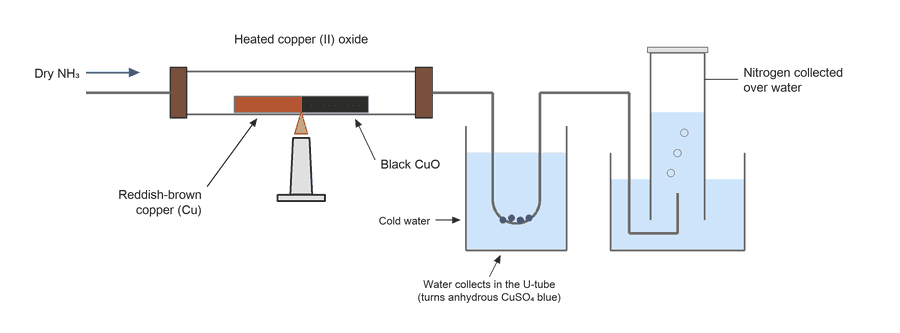
(a) Ammonia gas is passed over heated copper (II) oxide.
(b) In the absence of catalyst, ammonia is burnt in an atmosphere of oxygen.
(c) Ammonium hydroxide is first added in a small quantity and then in excess to a solution of copper sulphate.
(d) Water is added to the product formed, when Al is burnt in a jar of nitrogen gas.
(e) Excess of chlorine gas is reacted with ammonia gas.
(f) Calcium hydroxide is heated with ammonium chloride crystals.
Solution:
Concept: An observation is what you see, smell or detect: a colour change, a flame, fumes, a precipitate. Naming the product alone is not enough.
Step 1 — (a) Ammonia over heated copper (II) oxide.
The black copper (II) oxide turns reddish brown (copper); droplets of water collect, and a colourless gas (nitrogen) is given off:
2NH3+3CuOΔ3Cu+3H2O+N2↑
Step 2 — (b) Ammonia burnt in oxygen without a catalyst.
Ammonia burns with a greenish yellow flame, giving nitrogen and water vapour:
4NH3+3O2→2N2+6H2O
Step 3 — (c) Ammonium hydroxide added to copper sulphate.
A pale blue precipitate forms first; in excess it dissolves, giving a deep (inky) blue solution.
Step 4 — (d) Water added to the product of aluminium and nitrogen.
Aluminium burns in nitrogen to form aluminium nitride:
2Al+N2Δ2AlN
With water, a pungent-smelling gas (ammonia) is given off, which turns moist red litmus blue:
AlN+3H2O→Al(OH)3+NH3↑
Step 5 — (e) Excess chlorine with ammonia.
A yellow, oily, highly explosive liquid (nitrogen trichloride) forms, along with hydrogen chloride:
NH3+3Cl2→NCl3+3HCl
Step 6 — (f) Calcium hydroxide heated with ammonium chloride.
A colourless gas with a pungent smell (ammonia) is given off; it turns moist red litmus blue and gives dense white fumes with a rod dipped in conc. HCl.
Therefore, the observations are a black-to-reddish-brown change, a greenish yellow flame, a pale blue precipitate turning deep blue, a pungent gas, a yellow explosive oil and a pungent alkaline gas.