
Question 524 marksEasy
Distinguish between the following pairs of compounds using the test given in bracket :
(a) Iron [II] sulphate and iron [III] sulphate (using ammonium hydroxide)
(b) A lead salt and a zinc salt (using excess ammonium hydroxide)
Confirming your payment
Sign up now and get 250 free tokens.
Study of Compounds – Ammonia · Question 52 of 67
Distinguish between the following pairs of compounds using the test given in bracket :
(a) Iron [II] sulphate and iron [III] sulphate (using ammonium hydroxide)
(b) A lead salt and a zinc salt (using excess ammonium hydroxide)
Solution:
Concept: Ammonium hydroxide gives hydroxyl ions, which precipitate the metal hydroxide from a salt solution. The colour of the precipitate, and whether it dissolves in excess, tell us which metal ion is present.
Step 1 — (a) Iron [II] sulphate and iron [III] sulphate.
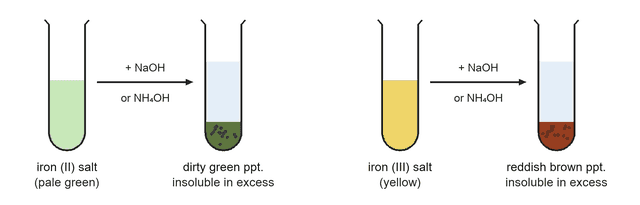
Iron (II) sulphate gives a dirty green precipitate of iron (II) hydroxide; iron (III) sulphate gives a reddish brown precipitate of iron (III) hydroxide:
Step 2 — (b) A lead salt and a zinc salt.
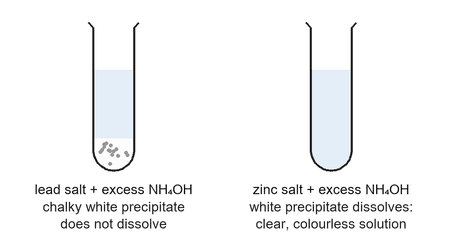
Both give a white precipitate at first. With excess ammonium hydroxide, the lead salt's chalky white precipitate stays (insoluble), while the zinc salt's white gelatinous precipitate dissolves, giving a colourless solution.
Watch out: In (b) the first drops look the same for both; only excess ammonium hydroxide tells them apart.
Therefore, (a) dirty green means iron (II), reddish brown means iron (III); (b) the precipitate stays with lead and dissolves with zinc.